A very quiet month as you’d expect – the 2 main updates are:
Clarification that Microsoft Defender for Endpoint/Cloud/Business products can be used on devices running on-premises, in Azure, and under the control of 3rd-parties
Information added about the EU data boundary service – see more here
The EU Data Boundary is a geographical area within which Microsoft has committed to store and process customer data for the majority of their online services. This is aimed at addressing concerns around data processing/location and GDPR, held both by customers and organisations such as the European Union.
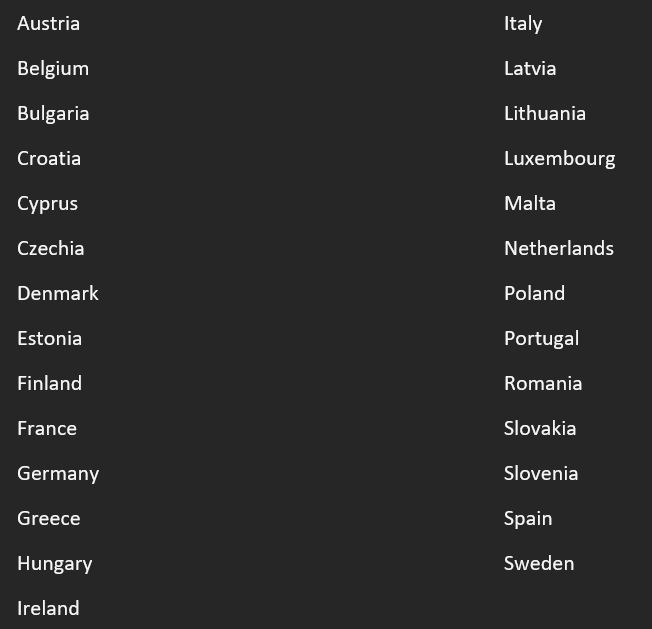
It is comprised of countries in the EU:
and EFTA:
For my fellow Brits, notice the United Kingdom isn’t included #Brexit
Currently, datacentres in the following countries are being used:
although Microsoft may add additional datacentres within the EU/EFTA over time.
How it works
Azure
Regional resources deployed within an EU Data Boundary region will be in-scope. For non-regional services, there is info here on how these can be configured within the EU Data Boundary. Note, not all services have yet been re-architected to allow this.
Dynamics 365 & Power Platform
This is based on the location of your billing address and, this, tenancy.
Microsoft 365
If you have a billing address within the EU/EFTA, you’re in scope…unless you have purchased the Multi-Geo capabilities add-on license.
Which products are in-scope?
According to the January 2023 Product Terms, the EU Data Boundary can apply to these products/services:
The Product Terms also lists half a dozen scenarios where data may still go outside the EU Data Boundary, these being:
Microsoft announced their results for FY22 Q4 and the full year and, as expected, the numbers are big and the percentage increases are (mostly) double digits. For the full year, revenue was $198.3 billion (an increase of 18%) and operating income was $83.4 billion (up 19%).
There were a few different things that negatively impacted the numbers in Q4 including:
Exchange rate changes – many of the “constant currency” growth figures are 5 or 6% higher than actual
COVID shutdowns in China cost over $300 million of Windows OEM revenue
Scaling back in Russia cost $126 million
An interesting one this – due to a “strategic realignment of…business groups”, Microsoft spent $113 million on employee severances.
but let’s take a look at some of the highlights for Q4:
FY 22 Q4
Revenue for the final 3 months was $51.9 billion, an increase of 12%.
Operating income was $20.5 billion, up 8%
Productivity & Business Processes
Revenue = $16.6 billion (up 13%)
Office 365 Commercial up 15%
LinkedIn up 26%
Dynamics 365 up 31%
Intelligent Cloud
Revenue = $20.9 billion (up 20%)
Azure up 40%
Earnings call highlights
Cosmos DB grew 100%+ YoY each quarter in FY22
25 million Monthly Active Users (MAU) for Power Platform
Office 365 E5 is now 12% of the installed base (up from 8%)
Security revenue up 40%
Azure Virtual Desktop MAU almost 60% YoY increase
Office on-premises down over 30%
25% of Fortune 500 using Viva
All these product areas are doing what Microsoft want them to do. As well as them innovating and creating products in the right areas, it also shows that their sales activities – direct and through partners – are paying off.
They said that E5 was strong both for renewals and new additions and Amy Hood mentioned they’re focusing on deployment and increasing usage of the suite. This makes sense as there are so many components of E5 these days that even customers getting value from E5 – typically via Office, Power BI, and a bit of security/telephony – have got some much more they could be using. I’d expect partners will be incentivized to get their customers utilising more of the E5 suite and it may mean that customers can use it to their advantage to extract concessions, POC funding etc. from partners and/or Microsoft.
On a similar note, Satya Nadella mentioned that Microsoft are now incentivizing their field sales teams to ensure that customer’s Azure bills “come down” through optimization efforts. This is a good thing to see from a cloud vendor and will hopefully lead to some legitimate savings for customers.
Announced at Inspire 2022, the Microsoft Digital Contact Center (MDCC) is the latest in a relatively recent line of “Products that are actually bundles of other products and parts of other bundles” – namely the various “Industry Cloud for…” and the “Intelligent Data Platform”.
The MDCC is comprised of:
Dynamics 365
Teams
Power Platform
Nuance
It’s interesting to see Nuance appear in something outside the Cloud for Healthcare…Microsoft clearly had some plans when they made that acquisition! This new offering focuses in all the areas you’d expect such as:
Omni-channel engagement
Customer self-service
AI powered virtual agents
Voice & video engagement
Biometrics and customer security
Analytics
AI powered support & knowledge articles
Microsoft look to be using established partners in this areas to deliver solutions based on MDCC, at launch these include:
Accenture-Avanade
EY
HCL
Hitachi
KPMG
PWC
Avaya
and more. Check out more information from Microsoft here.
A new “Cloud for…” has been announced and this one – Cloud for Sovereignty – is aimed at helping Public Sector organisations make the most of, and thus use more of, the Azure cloud. It does this by offering enhanced capabilities to meet the various rules and regulations around data location and access such as the GDPR.
A key focus for public sector organisations is the location of data and Microsoft say they will soon be adding the “EU Data Boundary” which will ensure all EU & EFTA customer data is not only stored in the EU but also processed there too.
Sovereign Controls
Microsoft say these new protection and encryption capabilities will span the entire Microsoft cloud from IaaS & PaaS through to SaaS such as M365, D365, and Power Platform.
Governance & Transparency
This will give eligible organisations access to source code and the ability to audit Azure compliance processes.
Expertise
Microsoft position this as a partner-led offering and it seems this is, at least partly, related to the recent cloud licensing changes they announced for “European” cloud providers.
Microsoft have announced that Power Platform is the latest product to get a Pay As You Go (PAYG) licensing option, following PowerApps and Dataverse.
How does it work?
You link your Power Automate environment to Azure, and different teams/parts of the business can use their own Azure subscriptions to pay for Flows that run.
Pricing
Cloud Flows
$0.60 per cloud flow run
Desktop Flows (Attended)
$.060 per attended desktop flow run
Desktop Flows (Unattended)
$3.00 per unattended flow run
Pricing rules
Charges won’t apply when you’re testing them in the designer or resubmitting failed flows. Also, “child flows” won’t incur additional charges for cloud/attended flows…but both parent and child flows will be charged for unattended flows.
Flow runs triggered by “per user” licensed users won’t incur costs – as long as the usage is within their license terms. However, if they use features outside of their license i.e. if someone licensed with “Power Automate per User” runs an “attended RPA” flow, that will be charged as their license doesn’t cover attended RPA usage.
Conclusion
As with PowerApps, this lowers the barrier of upfront payment which will – Microsoft hope – make more organisations willing to take the plunge into Power Platform. With 25 million Monthly Active Users (MAU) at the moment, it’s doing well but there’s a lot of growth potential out there for sure.
I think organisations should be cautious with how they adopt this model, as I can foresee it becoming difficult to properly monitor and manage costs and usage further down the line.
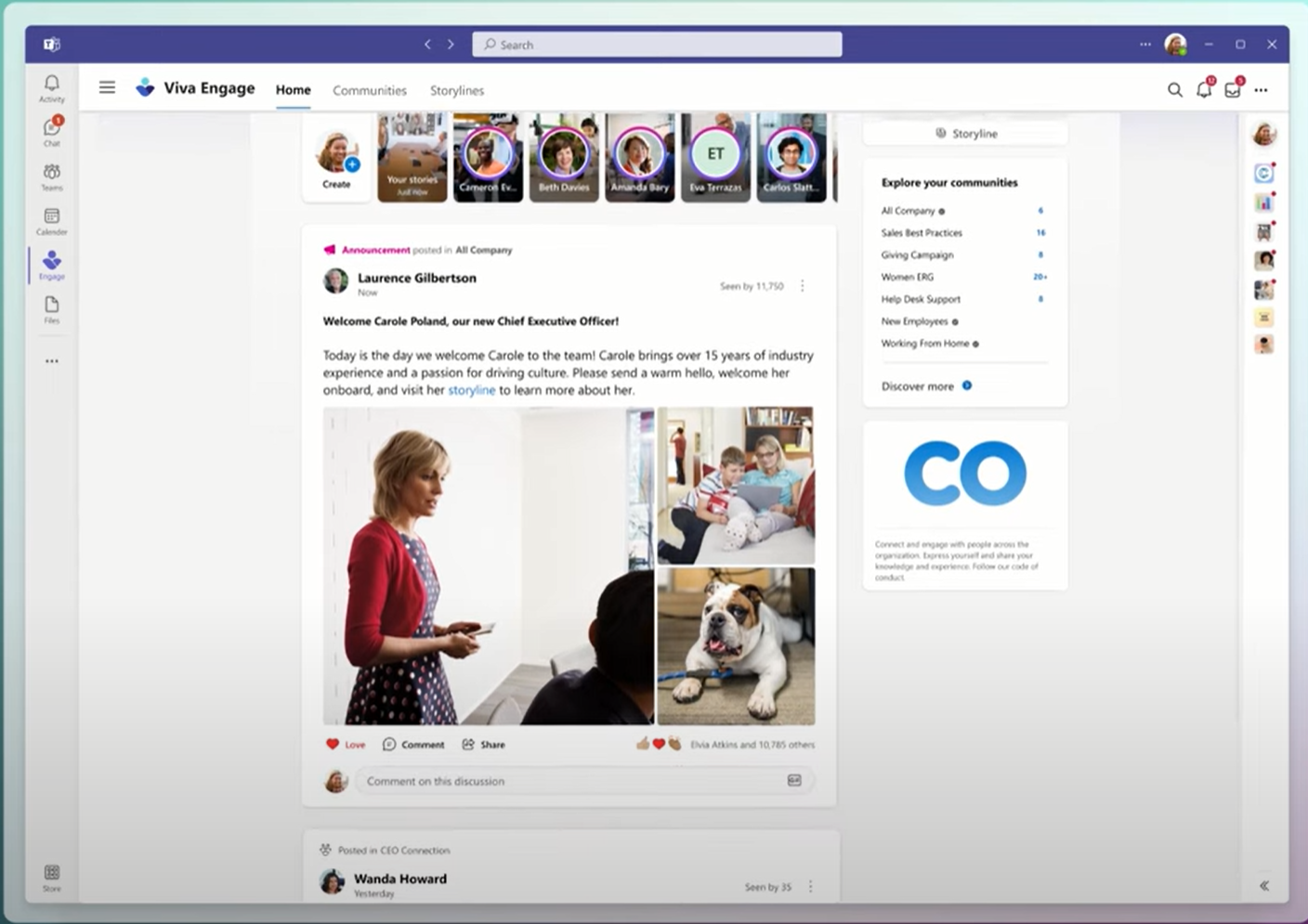
Microsoft have added another member to the Viva family – Microsoft Inspire 2022 saw the announcement of Viva Engage. It’s hard to hear that and not picture Captain Jean Luc Picard isn’t it?!
Built on the existing Yammer Communities app, it’s another way for employees to connect within an organisation and will include “stories” and “storylines” to enable sharing of thoughts, ideas etc. – very “social media-esque”.
The Yammer Communities app in Teams will be re-branded “Viva Engage” and all content, networks, customer branding etc. will remain in place. Being licensed for Yammer is a requirement to use Viva Engage so current Yammer users shouldn’t lose anything in this change/rebrand.
Conclusion
This is another step on the journey of making Viva more important to the fabric and wellbeing of organisations – Microsoft clearly want Viva to be integral to the smooth operation of the business/employee relationship. Viva is going to be a core pillar of Microsoft’s business within a few years, bringing HR and employee satisfaction parts of a customer into Microsoft’s world too.
It also further the positioning of Teams as the central point for business communication and the focal point for each user’s day.
Some new M365 F5 Security bundles made available – further expanding what’s possible for protecting frontline workers.
Microsoft Sustainability Manager added. This is what we’ve been calling Microsoft Cloud for Sustainability…it seems that will be now an umbrella term and Sustainability Manager will come under that.
Clarification that the SQL Server Enterprise SA benefit of running Power BI Server applies in a fail over OSE too
Tidying up of various clauses and terms.
No mention of the major changes they announced for cloud BYOL rules around Windows Server, Windows desktop, and Office.
Their aim is to “serve as a trust fabric for the entire digital ecosystem” – Microsoft really looking ahead to the future and setting themselves up to be a big part of that once again.
The product is Microsoft Entra Permissions Management – built on the CloudKnox acquisition from 2021. It does things such as “help detect, right-size, and monitor unused and excessive permissions” and enforces the principle of least privilege across Azure, AWS, and GCP. It will integrate with the Defender for Cloud dashboard too.
This will be a standalone product available from July 2022.
Decentralised Identity
The product here is Microsoft Entra Verified ID, which aims to make “portable, self-owned identity possible” and to give more control over what information is shared and also it taking back that data.
This will be a standalone product available from August 2022.
Security is a huge focus for governments, organisations, and individuals right now and, as more things become more digital, it will only continue to be so. Creating a safe and secure platform for digital interaction – both B2B & B2C – is a great business move from Redmond but may well also serve to help the “digital revolution” to carry on and succeed.
However, for those of us who must navigate Microsoft’s products and licensing – this only serves to confuse matters! We have Priva, Purview, and now Entra…what’s next?