Private GA of Azure Future Capacity Reservations added…”Azure Future Capacity Reservations allow Customers to request capacity for specified Microsoft Azure resources in a specified region, with a scheduled start date and reservation term”
Minor update to Responsible Use of Microsoft AI Services Web IQ added to Privacy & Security terms M365 G3 & G5 added as eligible pre-requisites for M365 Copilot Minor renaming of Microsoft Defender Expert services Updates to terms around Professional Services
Slightly bigger is the clarification/addition to terms that customers with SA who enable Azure Arc are eligible for ESU (Extended Security Updates).
There are some other changes that weren’t in the Product Terms:
A group of software developers collaborate around computers with AI interfaces in a modern office
From June 1st, GitHub Copilot usage will start to consume GitHub AI Credits. Microsoft say that, as Copilot use has changed and become more complex, inference costs have increased and they can no longer sustain the current premium request unit (PRU) model.
Copilot features that consume AI credits include Copilot Chat, Copilot CLI, Copilot cloud agent, Copilot Spaces, Spark, and third-party coding agents.
Every Copilot plan will include an amount of GitHub AI Credits, and paid plan users will be able to purchase additional credits if needed. Microsoft say that “usage will be calculated based on token consumption, including input, output, and cached tokens“.
Copilot Business: $19/user/month, including $19 in monthly AI Credits
Copilot Enterprise: $39/user/month, including $39 in monthly AI Credits
There will be higher credits included for June, July, and August:
Copilot Business: $30 in monthly AI Credits
Copilot Enterprise: $70 in monthly AI Credits
1 AI credit = $0.01 USD so the standard inclusions are:
Plan
Total AI credits per user per month
Copilot Business
1,900
Copilot Enterprise
3,900
As is becoming common in FinOps for AI, the choice of models used for tasks will become much more important with this change. For example:
GPT 4.1 is $2 per input token and $8 per output token
GPT 5.5 is $5 per input token and $30 per output token
Claude Haiku 4.5 is $1 per input token and $5 per output token
Claude Opus 4.7 is $5 per input token and $25 per output token
Significant price differences for sure! See more here.
Usage will be pooled across an organisation which may help reduce the impact of this, depending how uniformly your teams use these features. A “Preview Bill Experience” has been introduced earlier in May to give users a view of what your consumption bill will look like. (That’s quite a good idea but more than a 1 month run up would have been better).
A few key things to note:
Base plan pricing isn’t changing.
Code completions and Next Edit suggestions will not consume AI credits.
Credits do not roll over from month to month.
Fallback experiences will no longer be available.
Copilot code review will consume GitHub Actions minutes AND GitHub AI Credits.
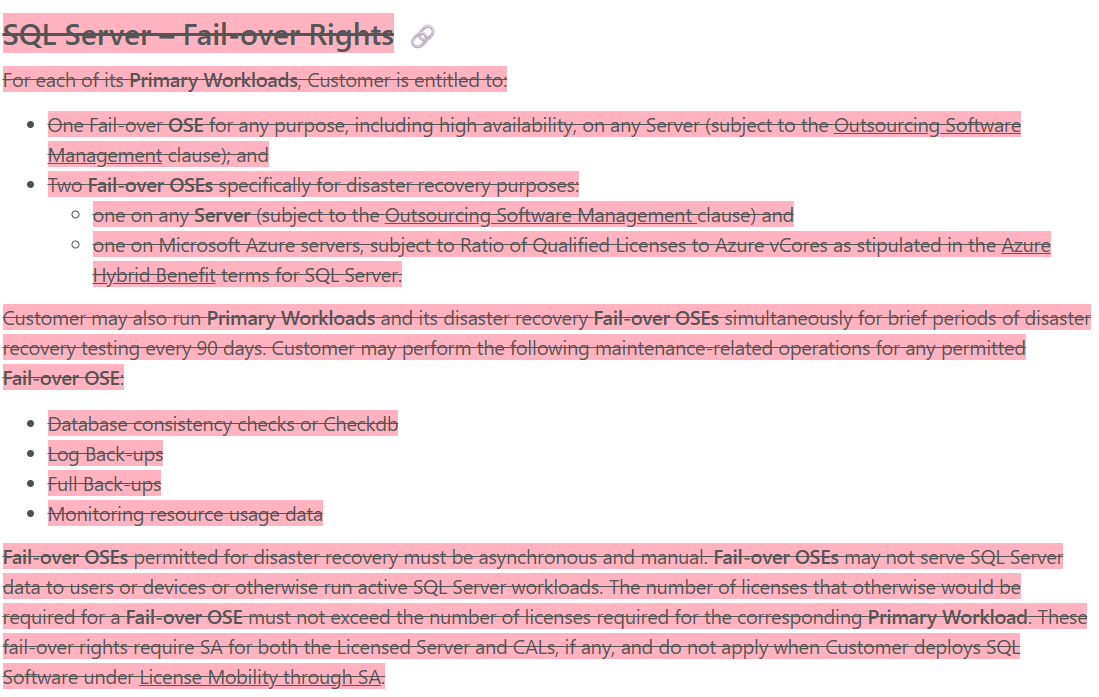
Microsoft released SQL Server 2025 on November 18th 2025 and updated the Product Terms. However, the update has caused confusion and consternation amongst the Microsoft community – as it seems to suggest that failover rights as a Software Assurance benefit have been removed!!! 😱 (Spoiler alert – it’s almost certain they haven’t).
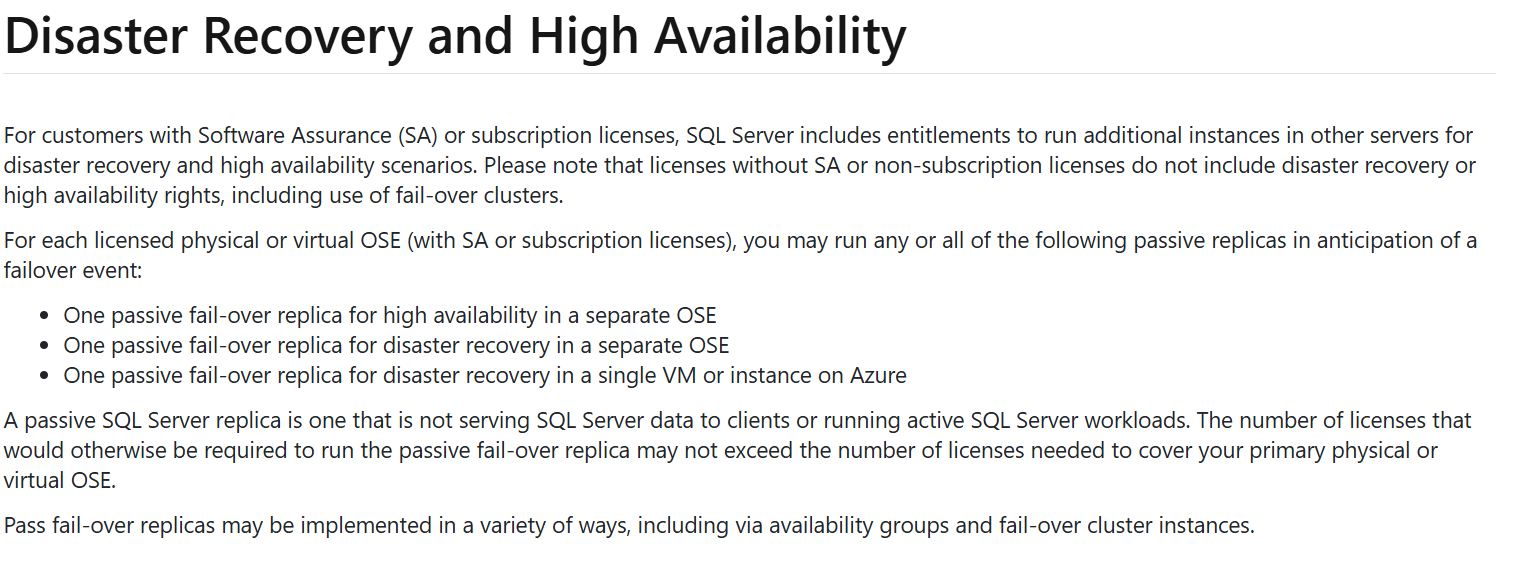
If you’re not familiar with this right it means, in a nutshell, that organisations who purchase SQL Server licenses with Software Assurance (SA) may license additional servers at no extra cost, as long as those servers are used only for disaster recovery/failover purposes. This is a long standing and widely used benefit – removing this right will mean one of 2 things:
Organisations’ SQL Server licensing will double/triple by millions of £/$/€ more per year
Organisations will be forced to have less resilient SQL Server systems, potentially leading to more downtime and lost revenue
Ultimately, if either of those were the case, I believe it would lead to a mass exodus of SQL Server customers. Microsoft may hope they would move to SQL Azure/SQL Server enabled by Azure Arc but I’d expect many to explore other options – Oracle, Postgres, Amazon RDS etc.
Largely because of that, and the fact that we have seen an increase in Product Terms errors over the last couple of years, I’m of the opinion that it is an error and will – eventually – be corrected…but it is worth looking at anyway.
As I was about to press publish, Peter Van Uden has commented on LinkedIn that he’s had confirmation that it is an error and will be corrected in the coming days.
Fellow Microsoft watcher Alex Golev noticed that the whole section had been deleted without replacement:
Other parts of the Product Terms still refer to this section which suggests this is an erroneous deletion…but it could also mean that they just didn’t edit those sections correctly.
I genuinely believe this is an error. It is a huge change that would have significant consequences for most Microsoft customers, including their largest and most significant customers. Making this change would be an enormous risk and to do so without any official announcement or warning is unbelievable. I’m sure we’ll see a reversal in the coming days and that’s why I haven’t posted about this already.
However, I feel it does highlight the increasingly slapdash approach that has been taken to the Microsoft Product Terms since it became an online site, rather than document downloads. It seems likely to me that updates are being made by people with little understanding of software licensing and so they don’t see the consequence of their actions.
The fact that it’s 4 days since this change was made and there has been no word from Microsoft is disappointing – but hopefully that correction will appear soon.
So, don’t panic but do remember that these things happen and that Microsoft experts like me, Alex, Peter and more can be very useful in these scenarios. 😁
Update: The missing text has been reinstated so the panic is over. It does highlight the need for us all to be vigilant in the future though.
It’s been rumoured for a while that Microsoft would release a new product/license for AI Agents called Agent 365 and we have the first public acknowledgement of this from Redmond.
Microsoft 365 Message MC1183300 is titled “Microsoft Teams and Microsoft 365 Copilot: Discover and create agentic users from Teams and M365 Agent Store” and gives us some initial information.
Starting in mid-November 2025, we will get “AI-powered Agentic Users” that will have “full organisation identities”. Users will be able to request agent templates but, at least for now, admins will control the creation and licensing.
What are AI Agents?
Microsoft differentiate them from bots and say:
Agentic Users are provisioned as full-fledged user objects with their own:
· identity in the organization’s directory (via Entra ID or Azure AD)
· email addresses
· Teams accounts
· presence in the org chart
They can participate in meetings, send and receive emails and chats, access and act upon enterprise data, and learn from interactions to improve over time. They have the ability to “proactively reason and act without explicit instructions”.
Exchange Server 2016 & 2019 and Skype for Business Server 2016 & 2019 go out of support in October 2025 (4 months at the time of writing).
The new Subscription editions have been announced as Generally Available by Microsoft (although not yet added to the Product Terms) but not all organisations are ready to make the move. To help with that, from August 1st, 2025, customers can contact their Microsoft account teams to purchase a 6-month Extended Security Update (ESU).
What to know
Any Critical/Important Security Updates released after the end of support will be privately provided to ESU customers.
Microsoft are not committing to release any updates during the ESU period.
The ESU will run for 6 months until April 14th, 2026 and – in Microsoft’s somewhat snarky words – “This period will not be extended past April 2026 (you do not need to ask).”
Microsoft announce new cloud options for Europe. There is an increasing push back from European organisations, particularly Government, against so many critical services and so much data all being run out of the US…this has been accelerated by the current geo-political situation too.
These announcements are Microsoft’s attempt to pre-emptively stem the flow of European customers away from their cloud services.
Altogether we’ve got:
Sovereign Public Cloud
Sovereign Private Cloud
National Partner Clouds
Microsoft 365 Local
Data Guardian
External Key Management
Regulated Environment Management
Microsoft 365 Local is interesting but the MS announcement only talks about productivity workloads like Exchange Server & SharePoint Server. Does M365 Local include Teams, Stream, ClipChamp, Planner etc.? 🤷♂️
Sovereign Public Cloud
Will be offered across all existing European datacentre regions, for all European customers, across enterprise services such as Microsoft Azure, Microsoft 365, Microsoft Security and Power Platform.
Customer data stays in Europe, under European Law, with operations and access controlled by European personnel, and encryption is under full control of customers.
Sovereign Private Cloud
Will support critical collaboration, communication and virtualization services workloads on Azure Local. This solution now integrates Microsoft 365 Local and the security platform with Azure Local, providing consistent capabilities for hybrid or air-gapped environments to meet resiliency and business continuity requirements
National Partner Clouds
Available in France (Bleu) & Germany (Delos Cloud), these will offer comprehensive capabilities of Microsoft 365 and Microsoft Azure in an independently owned and operated environment.
Microsoft 365 Local
Microsoft 365 Local provides customers with additional choice by bringing together Microsoft’s productivity server software into an Azure Local environment that can run entirely in a customer’s own datacentre.
This provides a simplified deployment and management framework for organizations to run Microsoft’s trusted productivity servers in environments they fully control. It remains to be seen exactly what is included and how the licensing works…
Data Guardian
Data Guardian will add an additional level of assurance by ensuring that only Microsoft personnel residing in Europe control remote access to these systems and adds additional human and technical oversight whenever engineers outside of Europe need access.
All remote access by Microsoft engineers to the systems that store and process your data in Europe is approved and monitored by European resident personnel in real time and will be logged in a tamper-evident ledger.
External Key Management
With external key management, customers can connect Azure to keys stored on their own Hardware Security Module (HSM) on-premises or hosted by a trusted third party.
Regulated Environment Management
The Regulated Environment Management service will allow customers to easily manage all these features in one place (for instance, configuring Data Guardian policies or reviewing access log entries).
Microsoft have launched a new addition to the Copilot family, confusingly called Microsoft 365 Copilot Chat.
Copilot Chat was already a thing (that is different to Copilot Biz Chat) and this seems to be a re-positioning as they add some new capabilities too. It is a basic, entry point tool that sits below Microsoft 365 Copilot.
Microsoft 365 Copilot Chat is free and has access to internet info to give “web-grounded” responses. Additionally it can interact with Agents (more on that later) and also has elements of the “Copilot Control System” to help with corporate data privacy.
The table below shows how it stacks up against the “full” Microsoft 365 Copilot product:
One of the new additions is that users of this free product can use 2 types of agents on a Pay As You Go (PAYG) basis, they are:
“Tenant Graph” grounded agents
Autonomous action agents
“Tenant Graph” grounded means agents that can access internal company data as well as internet information, giving answers with additional, organisation specific info and context. This is an additional PAYG per-message cost for M365 Copilot Chat users but is included within the M365 Copilot license – adding a new variable to consider when pricing up licensing options.
Autonomous actions are where the agent uses “generatively orchestrated triggers, topics, data connectors, and workflows” to act on behalf of a user. This is an additional PAYG per-message cost for all users – it is an additional cost even for users licensed with M365 Copilot.
For more info and details on the PAYG per-message pricing model – see my post here.
Copilot for M365 prerequisites updated to include new SKUs as eligible base licenses. The line-up is now: Microsoft 365 Business Basic/Standard/Premium/F1/F3/E3/A3/E5/A5
Office 365 F3/E1/E3/A3/E5/A5
Entra ID Governance F SKU added
Entra ID Governance can be added to M365 Business Premium
Microsoft Viva Pulse added
Azure AI Studio added, although it’s still in public preview
No changes to Dynamics 365 for the first time in about 9 decades!