Microsoft have made two acquisitions recently, both of which show where their focus lies when looking ahead.
Clear Software
Acquired for an undisclosed amount, Clear Software focus on business process solutions that integrate into Oracle and SAP systems. Microsoft have acquired them because their:
“API access and system knowledge will strengthen Microsoft Power Platform’s integration with outside systems and accelerate how customers leverage data and processes that reside beyond Microsoft first-party services”
Microsoft state this will make it easier for users to create Power Apps and Power Automate flows that connect into Oracle & SAP. This will make Power Platform even more attractive to citizen developers across the world and also increase the 3rd-party license non-compliance risks that organisations may face.
and it will be used to power a new module within Microsoft Viva alongside Connection, Insights, Learning, and Topics. The new functionality will also be integrated through Office, Power BI, and the wider set of Microsoft 365 apps.
This is further proof that Microsoft see the Employee Experience (EXP) sector as a big new direction for them and that Viva will likely grow to be a key part of the Microsoft stack.
Microsoft’s latest financial results, those for Q1 FY22 (July – August 2021) are in and – as has been the case for the recent memory – they smashed it again.
Revenue for the quarter was $45.3 billion – a year-on-year increase of 22% and operating income was up 27% to $20.2 billion.
The overall “Microsoft Cloud” area broke $20 billion quarterly revenue for the first time with growth of 36% to reach $20.7 billion. However, Microsoft Cloud gross margin did drop slightly to a mere 71%!
During the earnings call, Satya Nadella said:
“Digital technology is a deflationary force in an inflationary economy”
Which helps explain why the cloud, and technology like Power Platform, keeps growing…they’re helping level the playing field and help smaller organisations grow and compete.
Productivity & Business Processes
This division was up 22% to $15 billion for the quarter, driven by growth in various elements:
Office 365 Commercial was up 23%
LinkedIn was up 42%
Dynamics 365 was up 48%
This is strong growth in several key areas for Microsoft and they don’t believe it will slow down next quarter either.
Intelligent Cloud
Revenue here was $17 billion driven by Azure growth of 50%. The rise of Azure doesn’t seem to be slowing down!
More Personal Computing
Windows OEM was up 10%, despite the ongoing supply chain issues for PCs and laptops…but Surface was down 17%. This is perhaps due to the constraint issues impacting more on higher end devices at the moment.
Other areas of interest
There were various additional statements made during the earnings call including:
Power Platform reaches almost 20 million monthly active users (MAU) – up 76% year-on-year (YoY). Of that, Power Apps makes up 10 million MAU and grew 202% YoY…Nadella states it is in use within 91% of the Fortune 500.
Satya Nadella made several references to the size of organisations that are using products such as Power Platform and Teams – pointing out how many 10,000+ and 100,000+ user organisations are customers.
Microsoft now have over 650,000 customers using their security solutions. How many of those are using more than Defender in Windows 10 would be interesting to see…
Office Commercial licensing decreased by 13%, continuing Microsoft’s ongoing transition of their customer base from on-prem to cloud.
Enterprise Mobility + Security is now at 196 million seats.
Amy Hood revealed that Microsoft have increased headcount by 14% YoY, which is a pretty significant hiring drive.
Microsoft have introduced a new way to help organisations manage their SQL licenses when using Azure Hybrid Benefit – scope-level management.
Scope-level management
Rather than assigning Hybrid Benefit usage at an individual resource level, you tell the Azure portal how many SQL licenses w/SA you have and these are then auto-applied to SQL resources running in the subscription or billing account.
Both SQL Server Standard and Enterprise licenses can be used to off-set costs in Azure but the licenses are “worth” different amounts. In effect, this means that 1 x SQL Server Enterprise license is equivalent to 4 x SQL Server Standard licenses when applying them to Azure services.
Normalized Core Licenses (NCL)
The new concept of NCLs makes it easier to work out how many Azure vCores your on-premises licenses give you. Keeping track of the different licenses and what they equate to in Azure can be confusing so now, when using scope-level management:
1 x SQL Server Standard core license = 1 x NCL
1 x SQL Server Enterprise core license = 4 x NCLs
This means if you have, for example, 6 SQL Standard core licenses w/SA and 9 SQL Enterprise core licenses w/SA you will have 42 NCLs to use across Azure services.
Things to know
You can’t currently use this new centralized management option with:
Azure Data Factory – SQL Server Integration Services (SSIS)
A couple of decent additions this month – new products across EXP (Employee Experience) and Security as well as (some) clarity around support offerings.
Viva new products
Microsoft Viva Insights & Viva Insights Capacity SKUs were added. Not only do we get a new product but we also get a new licensing piece to watch out for…the idea of additional capacity SKUs for Viva Insights analytics. I go into more depth here.
A growing security portfolio
2 x Privacy Management SKUs added – “Risk” and “Subject Rights Request”, furthering increasing Microsoft’s security position. It does, however, look like there was some confusion between “Office 365” and “Microsoft 365” for the pre-requisite licenses as they list “Microsoft 365 E1” which doesn’t exist…yet!
Support info
Microsoft have added a range of information about their support offerings including Unified Support and Premier Support, as well as some of the additional services that are available to purchase. Making this information publicly available will be a big benefit for customers and partners alike, as it hasn’t always been easy to know what was included etc.
A change that snuck past me initially in July is that Microsoft 365 Apps for Enterprise (formerly Office 365 ProPlus) is no longer classed as an “Enterprise Product” and is now an “Enterprise Online Service”. This means it is no longer required to be purchased enterprise-wide.
The Product Terms site now lists a whole host of information about the support offerings that are available through Volume Licensing – with links to supporting documentation too. Finding any information on Microsoft Support has always been surprisingly difficult so this update makes a welcome change!
In this post, I want to look at the information made available by Microsoft and explore what’s on offer. There are two main flavours of Microsoft support, giving access to different services and priced in different ways.
Microsoft Unified Support
This is the latest addition to Microsoft’s support portfolio, introduced in 2019, and Microsoft made a concerted effort to move as many customers as possible from the existing Premier Support (discussed below) to the new Unified Support. This wasn’t a particularly popular move as it generally led to significant price increases for organisations.
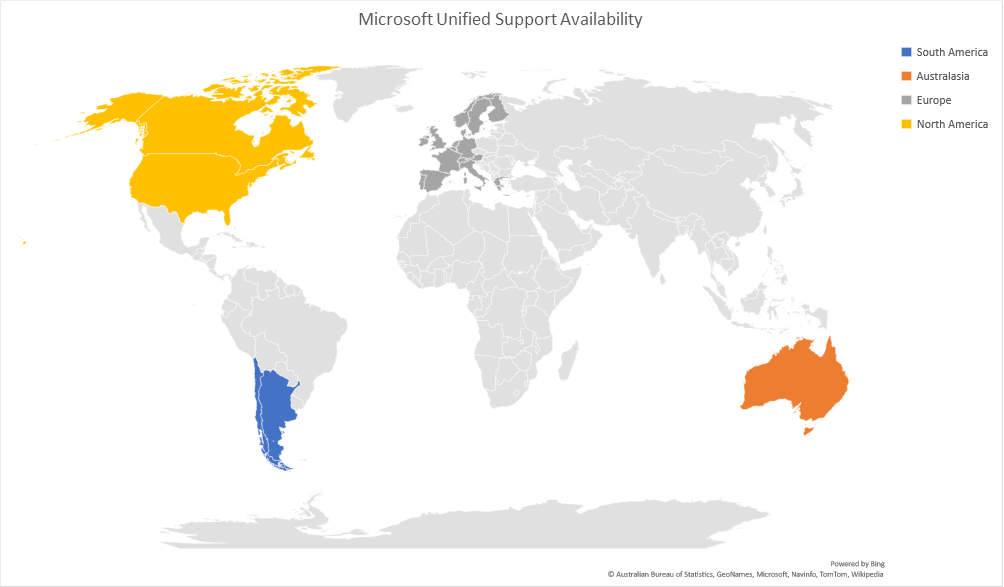
First of all, it’s worth noting that Unified Support has a relatively limited reach as it is only available in 22 countries globally:
There are three flavours of Unified Support:
Unified Advanced Base
Unified Performance Base
Unified Enterprise Base
The first two, Advanced and Performance, are governed by the “Support & Consulting Services Description (“SCSD”)” which is available here – while Unified Enterprise is governed by the “Unified Enterprise Support Services Description (“USSD”)”, available here.
What’s included?
Previous information, and in fact the current SCSD, break down Unified Support into 3 options:
Core
Advanced
Performance
but as you can see above, the Product Terms list:
Advanced
Performance
Enterprise
It looks like there has been a change to the levels of support but I’ve not seen an announcement saying as much.
Flex Allowance
Calculated as a percentage of your contract’s list price, this can be used for Proactive services, enhanced services and solutions, Support Technology Advisor, Proactive credits or Custom Proactive Services.
Proactive Services
Although not included with Unified Enterprise, they are all available via Flex Allowance or as a separate, additional purchase.
Unified Enterprise Pricing
Microsoft calculate your “Product Spend” aka “P” which is comprised of:
Cloud services purchases in previous 12 months
Software Assurance purchases in previous 12 months
License only purchases in previous 60 months
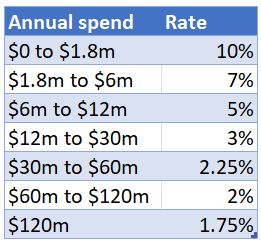
and then they price Unified Support as a percentage of that spend. For Azure, it is calculated as:
while for other products it is:
Microsoft state that:
Rates are graduated, so if a customer has $6M in annual Azure spend, it would be calculated as 10% of the first $1.8M and 7% of the next $4.2M ($6M-$1.8M).
So in Microsoft’s example of $6m Azure spend, the Unified Support cost would be:
10% of $1.8m = $180,000
7% of $4.2m = $294,000
Total = $474,000
The publicly available Microsoft documentation doesn’t provide pricing information for the “Advanced” and “Performance” levels but, based on previous information (like this), it will be the same format as above but with lower percentages.
Microsoft Premier Support
Premier Support offerings are detailed in the “Enterprise Services Description of Services” which you can download here. The document gives a pretty thorough overview of all the different services available under Premier Support including:
Architecture services
Digital Advisory
Implementation & Optimization
With the introduction of Unified Support, Microsoft have been working to migrate as many customers as possible across from Premier. However, it is still possible to remain on Premier Support…although it doesn’t appear to be particularly easy.
What’s included?
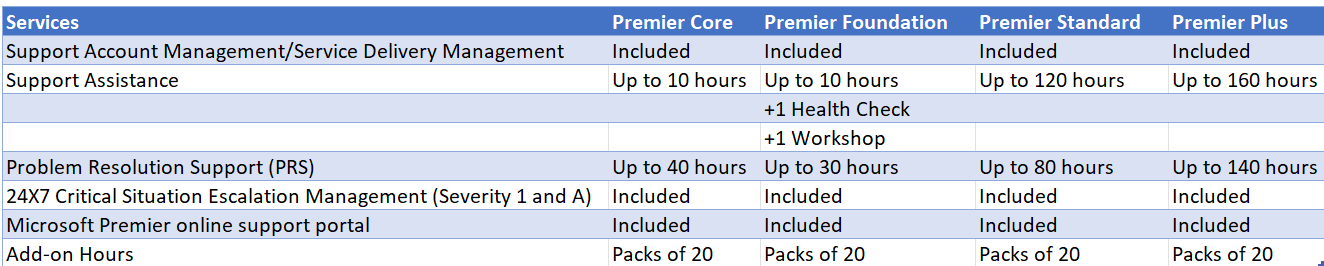
There are different levels of Premier Support listed in the Product Terms:
although, as mentioned, this isn’t Microsoft’s preferred option anymore.
Optional Enhanced Services & Solutions
Additional paid services are available, these include:
Designated Support Engineering (“DSE”): DSE services are delivered as described in the applicable services description (SCSD or USSD)
Rapid Response services are delivered as described in the applicable services description (SCSD or USSD)
Microsoft Azure Event Management (“AEM”) services (Unified Support only)
Office 365 Engineering Direct services (Unified Support only)
Developer Support services
Support for Mission Critical services (Unified Support only)
You can see this, and more info, in the Product Terms here.
Conclusion
It’s good that Microsoft is making this information available – anything that enables customers and partners to do more research and be better prepared for sales conversations/renewals etc is a good thing. However, it isn’t complete and does seem to contradict some of the longstanding info regarding the support levels etc. so there’s still a fair amount of confusion.
If anyone has anything they can add to this and/or any corrections, please let me know.
Microsoft have released more information about the upcoming Viva Learning via Message Center post MC287944 (that I can’t actually find in there at the moment).
Viva Learning will hit General Availability in “early November” meaning that a new pre-installed Viva Learning app will become available in Teams. A basic Viva Learning subscription will be available free of charge to Microsoft 365 users (the exact licenses are still to be confirmed) and will grant access to:
Microsoft Learn
Microsoft 365 training
125 x LinkedIn Learning courses
There will then be a Viva Learning Premium (expected to be around the $4 pupm mark) that will give features including:
Learning Management System (LMS) integration
Third-party content integration
Additional admin capabilities
and more
As more info becomes available, I’ll be sure to update you!
For more info on Microsoft Viva as a whole – check out my post here.
Microsoft announced this month ( April 2021) that they’ve acquired Nuance Communications for $19.7 billion – their 2nd biggest acquisition behind LinkedIn.
You may be familiar with Nuance for their Dragon Naturally Speaking speech recognition software and/or Power PDF but the focus for Microsoft is their work in the Healthcare sector – much of which is built on Azure. It follows Microsoft’s announcement of their “Cloud for Healthcare” vertical offering and clearly indicates they see it as a growth market for them; they believe it will bring their Total Addressable Market to $500 billion in the healthcare provider space – even a small piece of that will make that $20 billion seem like small change!
Going forward, Nuance will be included within Microsoft’s “Intelligent Cloud” division and Nuance will retain its CEO, Mark Benjamin, who will report into Scott Guthrie – executive vice president of Cloud & AI at Microsoft.
A new Office 365 license for “Premium Messaging” which requires F1/F3/E3/E5 as a pre-requisite. Can’t currently see any other info about this but I’ll keep looking!
Retirement of Windows Thin PC as an SA benefit.
Removal of text around converting Training Vouchers into Planning Services days.
Clarification around SQL + containers.
Clarification around From SA licenses.
Updates to reflect the various Office/Microsoft 365 related name changes.
With the SQL clarification, nothing has changed so I wonder if this “clarification” is Microsoft’s way of giving everyone a reminder of the rules before they start to enforce them in compliance checks and audits?
This month’s Product Terms has got a few cool additions – one in particular!
Microsoft Defender Advanced Threat Protection for Servers
This was previously only available via an Azure Security Center subscription but can now be obtained via EA/EAS and CSP. It covers Windows Server 2008 R2/2012R2/2016/2019.
In order to purchase MDATP for Servers, organisations must have a combined minimum of 50 licenses of:
Microsoft Defender ATP
Windows E5/A5
Microsoft 365 E5/A5
Microsoft 365 E5 Security
Interestingly, if ATP for Servers customers decide to migrate to using Azure Security Center (ASC) on those same servers, active ATP for Server licenses will be credited against the ASC price.
New Microsoft 365 SKUs
April 2020 sees the introduction of:
E5 eDiscovery & Audit
E5 Information Protection & Governance
E5 Insider Risk management
Prerequisites
For eDiscovery & Audit and Insider Risk Management, the license prerequisites are:
Microsoft 365 (any)
Office 365 (any)
Exchange Online
SharePoint Online
OneDrive for Business
For Information Protection & Governance, the prerequisite licenses are:
Microsoft 365 (any)
Office 365 (any)
Exchange Online
SharePoint Online
OneDrive for Business
Azure Information Protection
EMS E3/A3
Office / Microsoft 365 F1 & F3
Microsoft have renamed the old F1 licenses to F3, and introduced a new F1 SKU to sit underneath, with limited capabilities as it only includes EMS E3 and “limited” Office services. The F1 license is pretty much just Teams really – no email, no Onedrive etc.
Microsoft licensing for Robotic Process Automation (RPA)
I’ve saved the best ’til last here – in my opinion at least! RPA is a growing area of business – the idea of using bots, rather than humans, to perform repetitive tasks to increase efficiency and, when used properly, job satisfaction. However, it’s also a licensing minefield – and Microsoft have been very quiet on this subject…until now! Well, actually, they’re still being quiet because these new additions were just slipped into the April Product Terms without any other mention – it strikes me as odd because these new licenses could herald a pretty significant change.
What have they added?
The Product Terms now contains:
Microsoft 365 E3/A3 – Unattended license
Power Automate per user with attended RPA plan
Power Automate unattended RPA add-on
There’s not a huge amount of extra info in the Product Terms but it does say that the E3/A3 unattended license includes Office 365 E3/A3, Windows 10 E3/A3, and EMS E3/A3 – no mention of them being restricted or limited at all.
Some definitions
The OST (Online Service Terms) gives more information. Microsoft’s definition of RPA is:
“An application (or set of applications) used to capture data and manipulate applications to perform repetitive tasks. Bots operate upon any UI element of Windows 10 within an OSE and/or operates upon any Office application in any OSE.”
Attended bot = This is a bot that “assists a person to execute automation on the person’s local and/or remote workstations.” They go on to say that “it operates concurrently with the person on the same workstation/s to accomplish repetitive tasks and is triggered by explicit actions of that person“.
In this scenario, it sounds like you would assign a regular M365 license to both the user and the bot?
Unattended bot = “Any bot that doesn’t strictly conform to the definition of an attended bot“.
The Power Automate unattended RPA add-on can be added onto the Power Automate per user with attended RPA plan and Power Automate per flow plan.












 Cloudy with a chance of Licensing