Microsoft Vine beta to end


Microsoft Vine, their online service aimed at helping people stay in contact during times of emergency, is coming to an end on October 11th 2011.

I signed up to the beta when it was announced and had a cursory look around…and then never logged in again. I suspect this is what the majority of people did and that will be a big factor in it being shut down.

I think the problem comes in that it isn’t really needed on a day-to-day basis; people have Twitter/Facebook etc to stay in contact and then, in times of emergency, logging into Microsoft Vine is almost certainly the last thing anyone will think of. No –one is quite sure what it does, it isn’t ubiquitous at all (in the way Twitter is) and so never gets used.

The full email sent out is:

Thank you for your valuable collaboration and participation in the Microsoft Vine beta program over the past year.
Releasing products and services in beta form gives us a way to learn and adapt our technologies in a real world environment, to gather valuable feedback from our customers and partners and ensure that new models are sustainable. And more specifically, the Microsoft Vine invitation-only beta program was designed to garner participation and subsequent feedback from consumers, communities and governments about the challenges they face today and explore how technology can improve and enhance communications.
Despite positive feedback from customers like you over the course of Vine’s private beta, Microsoft has made the decision to discontinue Microsoft Vine effective October 11, 2010. After this date, you will no longer be able to access Microsoft Vine. We suggest that you record any contact information currently stored in Vine, prior to October 11th.
The decision to discontinue future development of Microsoft Vine was not easily made. Multiple options were thoroughly explored and evaluated with rigor and in the end it was determined that Microsoft Vine is not sustainable as a standalone offering.
Thank you again for your valuable feedback on this product. The key learnings acquired over the past year from the Vine beta will be used to inform and strengthen future product concepts and offerings.  If you have any questions or concerns, please email vinemail@microsoft.com.

“determined that Microsoft Vine is not sustainable as a standalone offering”

This could well mean that parts of this experiment will be integrated into future offerings…perhaps Office Talk (should that ever come about)…maybe even Outlook and Sharepoint?

If you used Vine – let us know!

Microsoft Windows InTune: Computers Overview


image

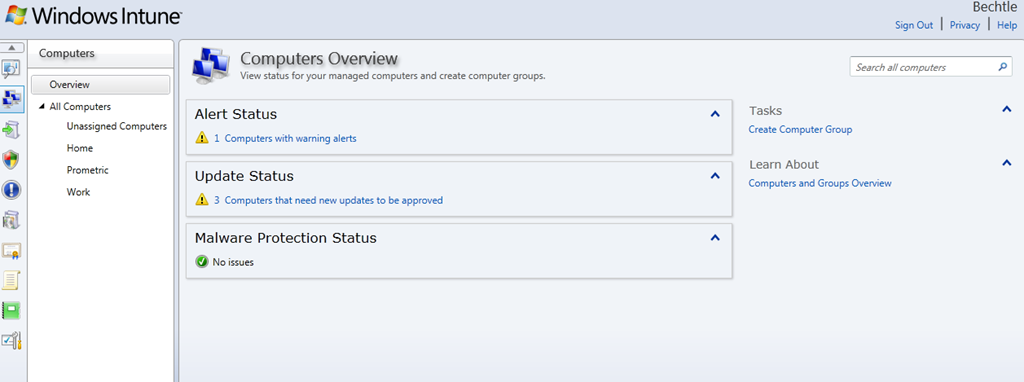
This is the second screen in the Windows InTune Console:

Computers

On the left you can see a list of all the computer groups that I’ve created. These machines are on 3 different networks but they all appear in this one central view, which makes administration very easy!

Selecting a group on the left takes you into a new view where you can see much more granular detail on the machines. At the minute, I’ve only got one machine in each group but you get the idea Smile

image

The “View Properties” button takes you deeper into that machine, with more sections available to view:

image

The first few tabs are all quite self explanatory…but the final two are very interesting.

Hardware

This gives an amazingly detailed list of the hardware in and related to the machine. For my laptop, this information includes:

  • Model
  • Serial Number
  • BIOS Name & Version
  • CPU Name/Type/Speed
  • Number of disks
  • Disk model
  • Disk Size
  • Number of partitions
  • Network adapter
  • IP Address
  • MAC Address
  • Monitor Resolution
  • Printers (including Soft printers like OneNote)

and more. It’s similar to the free ware program CPU-Z (which you may be familiar with) in that it gets really deep into you machine to give you all the information you could possibly need!

Software

This gives a list of all software installed on the machine…in this case:

image

It then gives you an idea of the category such as Browser, OS, Utility etc and also tells you if it’s a Virtual Application.

You can export these lists to either .csv or .html files for use with other applications and systems.

This feature fits really well in to the whole Software Asset Management piece, as organizations will have a complete, current list of all software installed on all machines. It’s very quick to update with added/removed software which will enable companies to be confident of compliance at all times.

Groups:

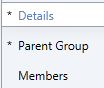
Creating a group is very straight forward. It has 3 sections, each with just one selection to make:

image

Details = Group name (and an optional description field)

Parent Group = Choose which group this will link off from. Either “All Computers” or one of your own.

Members = Choose which machines to add to the group.

Done.

I’ll cover deploy software to machines etc in a later post.

Microsoft Sharepoint 2010 and VMWare Error


I installed Sharepoint 2010 on a Virtual Server last week, set up some new site collections and then when I came to use it, got a very strange error:

”The trial period for Sharepoint Foundation has expired”

Strange because this wasn’t a trial and because it wasn’t Sharepoint Foundation…it was full server 2010!

I did a little searching round the web and saw something on the Microsoft forum that suggested it might be related to Windows Web Server. I checked and yes, our System Admin had built the VM with Windows Web Server…but than itself was weird…why did he do that?

I went downstairs and asked him…he didn’t make a web server, it was Windows Server Std 2008 R2 but by the time it got to me, it had magically morphed into a Web server…WTF?

The media being used was from MSDN and contained Std, Ent & Web in one image and you choose which one you want during the installation. The Sys Admin built a Svr Std machine, converted it to a VMWare template, deployed it again and gave it to me…and there was the problem. We tried again and this time, COPIED it to a template (rather than converting) and hey presto, it all worked perfectly. The VM was a Svr Std box and, after re-installing it, Sharepoint 2010 was up & running straight away Smile

I don’t know if this is a known problem and perhaps it seems really obvious to some, but it had me stumped for a while so I thought I’d share it on here…just in case.

Microsoft Windows Intune: Online Systems Management


Microsoft Windows InTune is the new Cloud based systems management tool from Microsoft, formerly known as “System Center Online” and has been long awaited. The ability to manage multiple locations/organizations from one central, online point is attractive to a lot of people for a lot of reasons…so let’s take a look @ InTune.

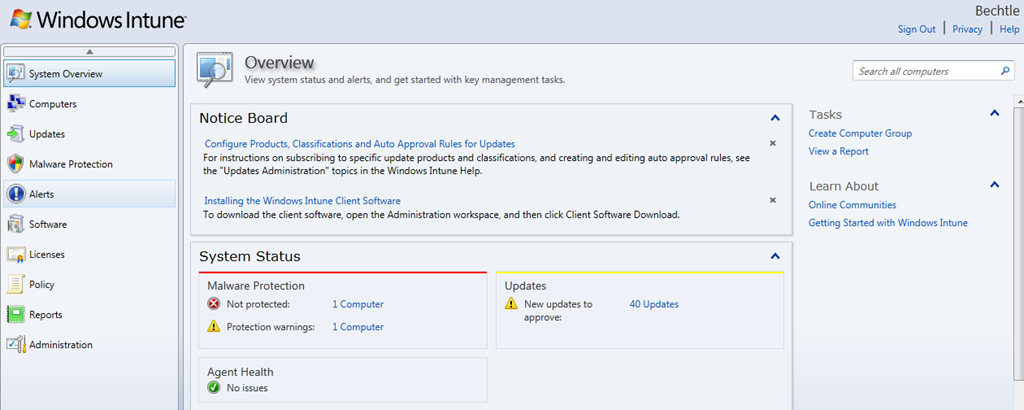
There are at least 10 sections inside InTune so I’m going to cover them in a number of posts, we’ll start with – System Overview:
image

image

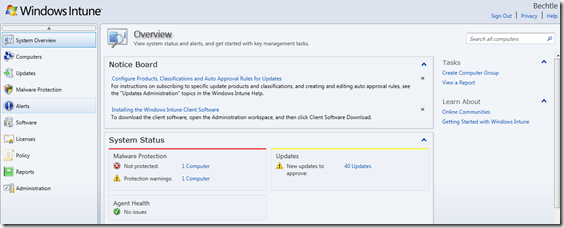
This is the first screen you see when you log in to the Windows InTune Admin Console and it immediately gives you a great overview of yours systems. It shows:

  • If Machines are infected/unprotected
  • If there are updates for your machines
  • A number of other alerts

Malware Protection:

From here you can see which machines have Malware protection turned off completely and also if they have overdue scans or specific parts of the protection, such as USB device scanning, turned off.

1 click takes you to a list of machines, from where you can turn on protection.

Updates:

This, not surprisingly, gives you a list of all the updates that are available for you machines be they for the OS or applications.

One issue with this is that, as default, it shows you ALL possible updates:

image

however, these can easily be filtered:

image

image

Another problem I have noticed is that it wants to give my laptop updates for Office 2007, as well as Office 2010; oddly, this doesn’t happen with my other 2010 machines. I had a number of issues when upgrading Office versions and I’m inclined to believe that there are some Office 2007 remnants on the machine that are being picked up by Intune.

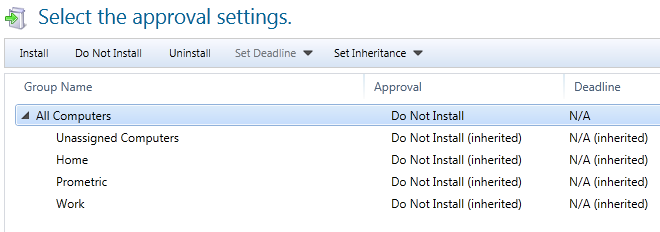
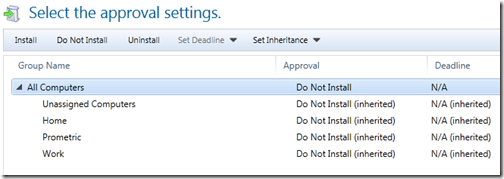
Should you choose to approve an update for a machine/machines, you then reach this screen:
image

Choose the groups on which you want to install the updates, click approve and job done!

I feel it would be a smoother experience and require less clicks, if you could see the machine names on the same screen as all the updates. Currently, you must:

  • Select the update
  • click on “x computers need this update”
  • Check the groups/machines
  • Go back to the previous screen
  • Approve Update

Showing the machines names/groups on the initial screen would remove a lot of that.

You can also access the updates via the individual machine screen, I’ll cover that in a later post.

Alerts by Type:

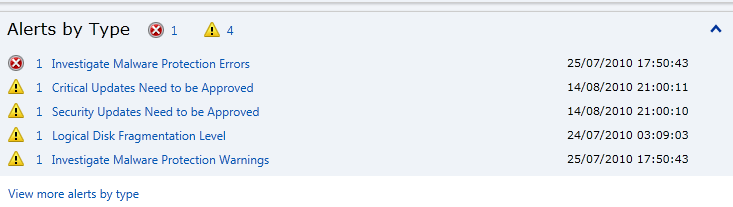
This section, as well as the above, also includes other types of alerts…not just updates and malware. This is where InTune starts to differentiate itself from other products, for example:

image

If I click through, it tell me:

image

That is pretty cool, and something that is very useful for System Admins. I didn’t expect InTune to cover things like this, certainly not in the beta, so I’m pleasantly surprised Smile However, you can’t initiate the defrag from InTune.

The 2 options on the right hand side “Create Computer Group” and “View a Report” will be covered in later posts.

Summary:

This is a brief look at just the first screen of Microsoft Windows InTune but I’m sure you will agree that it already looks very interesting. So stay tuned for the remaining posts in this series (at least 9!) and ask any questions you may have in the comments Smile

Cheers

Rich

Microsoft VLSC N-2 Media Downloads


Microsoft’s VLSC (Volume Licensing Service Center) is the central portal for volume licensing customers to manage and download licence keys and media.

Microsoft’s Volume Licences all include “Downgrade Rights” which let you run previous version of the software, for instance:

Buy Windows 7, install XP or Buy Office 2010, install 2007

However, Microsoft have only ever provided the media for 1 previous version AKA N-1 so:

Windows 7 = Vista

Office 2010 = Office 2007

Exchange 2010 = Exchange 2003

If you needed to downgrade further than that, you were required to provide your own media…usually from a previous install.

That being said, Microsoft are now changing that!

From July 2010, VLSC users have been able to access:

  • Windows XP
  • Windows Server 2003 R2

and from September 2010, the following N-2 downloads will be made available:

  • Office 2003
  • SQL Server 2005
  • Exchange Server 2003

This will make it easier for organizations who still need to run these older versions.

(via Eric Ligman)

Microsoft BPOS Wave 14: Client Support


BPOS, Microsoft’s Online Services offering, obviously plugs in to their Office suites but there are restrictions about which versions you can use. Currently Office 2003/2007 & 2010 are all supported but, once the new online release happens, that will change.

Based on current rules, partners are expecting Office 2003 support to end by early 2011 but, based on the MS Online Service post here, that may not be the case:

“We are currently investigating Office 2003 support and will publish a list of supported capabilities in the future”

which indicates at least some functionality will still be available to organizations running Office 2003. There are a HUGE number of reasons why upgrading to 2010 is a great idea, but that’s for another time 🙂

The full list of supported products is:

Operating Systems:

  • Windows XP SP3 with RPC over HTTP patch
  • Windows Vista SP2
  • Windows 7
  • OS X 10.4 (Tiger)
  • 10.5 (Leopard)
  • 10.6 (Snow Leopard)
  • *Windows XP Home and Windows Media Center edition are supported but will not support federated identity.

    Office Client:

  • Office 2007 SP2 or Office 2010
  • Office 2008 for Mac & Entourage 2008 Web Services Edition
  • .NET 2.0 or later
  • Microsoft Communicator “14”
  • Mac Messenger 9
  • *Office client is not required for customers who choose browser-only access. Office Communicator ‘14’ will be generally available later this year.

    Browser:

  • Administration Center and My Company Portal
    • Internet Explorer 8 for Windows XP
    • Internet Explorer 7 or higher for Windows Vista and Windows 7
    • Firefox 3.x
    • Safari 4.x
  • Outlook Web App
    • Internet Explorer 7 or later
    • Firefox 3 or later
    • Safari 3 or later on Macintosh OS X 10.5
    • Chrome 3 or later
  • Outlook Web App Light
    • Internet Explorer 5.5 or later
    • Firefox 2 or later
    • Safari 3 or later
    • Opera
  • The news that Office 2003 won’t be killed off completely is good news, as it allows partners to position BPOS separately to Office upgrades…and allows customers to keep the costs apart!

    Microsoft BPOS: More new features


    Microsoft BPOS has, yet again, been something of a star of the Worldwide Partner Conference and a bunch of new features have been confirmed/announced. They are:

    Exchange Online:

  • Voice mail with Unified Messaging
  • Integrated archiving
  • Retention policies and legal hold
  • Transport rules
  • Multi-mailbox search
  • Conversation View
  • MailTips
  • Enhanced Web-based administration
  • Role-Based Access Control
  • Remote PowerShell
  • Free/busy between cloud and on-premises
  • Cross-premises management
  • Native migration tools


    Sharepoint Online:


  • Portal site templates
  • Extranet access
  • Anonymous Access
  • Multi-Lingual UI
  • Office 2010 integration
  • Tagging, Rating, Tag Cloud
  • Activity Feed, Social Networking, Note Board
  • Improved Wikis & Blogs
  • Content publishing
  • Navigation controls
  • Cross site-collection search
  • Phonetic search
  • People search
  • Visio Services
  • Excel Services
  • Sandboxed Solutions
  • Improved workflows
  • Improved SharePoint Designer 2010
  • Access Services
  • Better controls of FQDNs


    Office Communications Online:


  • P2P A/V across firewall
  • File transfer across firewall
  • Presence with pictures
  • Federation
  • IM with Windows Live


    Platform Updates:


  • Free/Busy co-existence
  • Single Sign On
  • Identity federation
  • Redesigned admin interface
  • More administration and access control

    There are some really awesome additions here, which will make BPOS hugely more attractive and credible to users in the mid-market segment. Some of the game changes are, in my opinion,:

    Exchange Online:

    • Transport Rules
    • Legal Hold
    • Unified Messaging
    • Remote Powershell

    Sharepoint Online:

    Extranet & Anonymous Access

    Cross Site Collection Search

    Visio, Access & Excel Services

    Office Communications Online:

    Federation.


    These new features bring Microsoft’s Online Services so much closer to feature parity with their existing on-premise brethren which is what I, and most people, have been waiting/asking/pleading/clamouring for. The number of times I’ve had a customer opportunity collapse due to BPOS missing a standard and relatively basic feature isn’t funny!

    This is a very positive move from Microsoft which will make the world of Online Services a much better place for Microsoft, it’s partners and our customers 🙂

  • Microsoft BPOS July Service Update


    Microsoft’s BPOS updates usually bring great features and July 2010 is no different:

    Hosted Blackberry Admin Centre:

    While Microsoft have offered Blackberry hosting for a while, most of the admin features required you to raise a ticket with support. Now however you will be able to:

    • Add/Delete users from licences
    • Activate Devices
    • Perform Remote Wipes

    all through the portal. This makes Microsoft’s Blackberry offering much more attractive.

    You will also be able to increase your number of Blackberry licences via the portal, removing the need for paper orders. Decreasing now just requires a support request.

    Live Meeting LifeCycle:

    The Live Meeting client will now be supported for 18 months from release, and there are quarterly releases of the (free) client.

    There is also a new version of the Live Meeting Outlook Add-in which goes about:

    • Improving the ability for users to respond to access control prompts when sharing control for Application Sharing.
    • Retaining the scheduled meeting on the Office Live Meeting service when an attendee has been removed from an invitation created by the Outlook Add-in.
    • Displaying invitees’ tracked responses for recurring meeting series that were converted to Office Live Meeting via the Add-in.

    The Microsoft Online Services Blog is here:

    Service Update- July 2010 Release Availability, Features Announced

    Microsoft Windows Intune: Second Beta


    Microsoft Windows Intune is a new product aimed at managing pcs in a new way. My original post can be found here:

    Read Windows Intune

    The initial beta was restricted to the US, Canada, Mexico & Puerto Rico and 1000 participants. Microsoft have now opened that up to another 10,000 users in the following countries:

    image

    To be eligible you need to deploy it to at least 5 machines and start within 1 week.

    If you’re interested, go and sign up here:

    http://www.microsoft.com/windows/windowsintune/windowsintune-experience.aspx

    Pricing

    The pricing of Windows InTune has now been confirmed for the States and it is:

    $11 per user per month

    That gets you:

    • Cloud based Desktop Management service
    • Anti Virus and Anti-Spyware
    • Windows 7 Enterprise Desktop Upgrades

    and, for an extra $1 per user per month, you can get the whole MDOP suite too. More MDOP info here:

    Read Microsoft MDOP

    Partner Features

    Many partners will be looking to InTune to provide them with a new way of generating revenue, through the ability to remotely manage their customers machines. This will reduce the need to travel thus saving money on hotels and petrol and increasing profit margins. Microsoft have quickly, and cleverly, added in a new feature aimed at making this as easy as possible…the “Multi – Account Console”:

    This will allow partners to quickly and easily see a top level view of all the customers they manage and, through filtering, spot those needing urgent assistance immediately.

    Feedback:

    There is already a lot of positive feedback on Windows InTune from the first beta, such as:

    “I save about 40% of the time I used to spend managing PC updates, thanks to Windows Intune. It frees me up to focus on developing more custom applications—and bring on more customers”

    “I think we could expand our customer base by at least 10-15 percent immediately”

    “It accelerates their (customers) decision to make the move (to Windows 7)”

    The Future:

    Early 2011 will see the general availability of Windows Intune in the countries listed in the 1st screenshot above. It will then move to more European & Latin countries as well as “select” Asian locations.

    I’ve signed up to the beta and will hopefully have some post following up on that experience soon.

    The MS Blog post can be found here.

    Microsoft Product Activation: How to contact


    Microsoft Product Activation are the guys you need to contact for anything to do with licence keys.

    For instance say you’ve bought Project 2010 but want/need to downgrade to 2003 (for some reason!). You’ll only get 2010 & 2007 in VLSC so to get a 2003 licence key you’ll need to speak to Product Activation. For me at least it’s one of those numbers that I’ve used in the past but I can NEVER remember it and although I ALWAYS make a note of it each time I find it, I can NEVER find that either! So having just done it again I thought I’d do a quick post to make it easier for me, and everyone else to find 🙂

    The UK number is:

    0800 018 8354

    and the complete list can be found at:

    http://www.microsoft.com/licensing/existing-customers/activation-centers.aspx

    ps: If downgrading 2 or more versions, you’ll also need to provide your own media.