Extended Security Updates (ESUs), available for Windows Server 2008/R2 and SQL Server 2008/R2, were introduced in 2019 to extend available security support for 3 more years beyond the end of the products’ extended support periods.
It’s now less than 12 months until the end of the ESU period for SQL Server 2008/R2 and Microsoft have announced they will be providing 12 additional months of cover – but only for workloads running in Azure. This will also apply to Windows Server 2008/R2 – the end of ESU dates are:
SQL Server 2008/R2 – July 12, 2022
Windows Server 2008/R2 – January 10, 2023
End of support for 2012 Server versions
They have announced the availability of ESUs for the 2012/R2 releases of SQL Server and Windows Server. Extended Support for these ends:
SQL Server 2012 – July 12, 2022
Windows Server 2012/R2 – October 10, 2023
It’s now less than 12 months until SQL Server 2012 goes out of support so if you’re using that within your organisation, you need to come up with a plan to:
A new member of the 365 family has joined us – alongside Office 365, Microsoft 365, and Dynamics 365 – we now have Windows 365.
Formerly known as Cloud PC, this latest offering enables you to stream an entire PC – including the OS, apps, and settings – from the cloud to any device. This means Windows 10 and 11 will be easily available on any device – including MacOS and Linux.
Although clearly driven by the COVID-19 pandemic and the rapid, global shift to hybrid working, something like this has been a long time coming in many regards. It’s also driven by the changing security landscape…Microsoft also see this as a way to help organisations combat the rise of security threats – let Microsoft take care of securing your desktops so you don’t have to.
Although specific pricing information hasn’t been released yet, it’s expected there will be a range of pre-set options, making it more of an “off the shelf” SaaS offering than the current Azure Virtual Desktop (AVD). Different SKUs and plans will offer different amounts of storage, processing power, memory etc. for organisations to choose from, with Satya Nadella stating this offering would be applicable to businesses of any size.
while users with non-Windows Pro endpoints require:
Windows VDA E3 + EMS E3
Alternatively, both scenarios can be covered by licenses for:
Microsoft 365 F3/E3/E5/Business Premium
Technical requirements
It’s not quite as straightforward as just having those licenses, you will also need:
Azure subscription
Azure Virtual Network
Azure Active Directory sync
Certain ports open
to ensure that everything works optimally.
More information on the requirements and how to provision can be found here.
Finally…
Not surprisingly, there will be 2 flavours available:
Windows 365 Business
Windows 365 Enterprise
and it is set to launch on August 2, 2021. I look forward to seeing more information as it becomes available…and hopefully trying it out myself!
Update
While Microsoft are yet to announce official pricing, pricing for 1 SKU has been revealed. For a desktop with 2vCPU/4GB RAM/128GB storage it will $31 per user per month ($372 per year) – which strikes me as quite expensive…
Microsoft 365 Education Insights Premium listed as an add-on for Office 365 A1/A3/A5 and Microsoft 365 A3/A5
The “Third Party re-imaging clause” has been added to the Microsoft Customer Agreement (MCA), although I’m not 100% sure why at the moment.
Windows “Get Genuine” licenses have been added to the Microsoft Customer Agreement – is this related to the above addition perhaps?
Various terms and clauses updated – including one which clarifies that Azure Virtual Desktop (AVD) access rights in Window 10 licenses are limited to customers’ own tenant.s
M365 E5 security/compliance add-ons removed as pre-requisites for Premium Assessments.
Professional Direct Support added for Power Platform. Licenses must be acquired for every Dynamics 365 and Power Platform license on the agreement – but has a maximum of 250. Any licenses above that are covered without additional licenses being required.
Microsoft announced on July 1, 2021 that they’re cutting the price of Power Apps in half(ish) from October 1, 2021.
Power Apps per User
This was $40 per user per month but will be $20 from October 1, 2021.
Power Apps per App
This was $10 per user per app per month but will $5 from October 1, 2021. However, it should be noted that the features have been reduced too – currently it gives access to:
2 x Apps and 1 x Portal
But under the new rules, each license will allow access to:
1 x App or 1 x Portal
Meaning certain scenarios may not see a real price reduction.
Customers with licenses purchased before October 1, 2021 will retain the current entitlements until renewal.
For organisations looking to purchase before October 2021, there are two promotions which have been extended:
Power Apps per user Promo
$12 per user per month with a minimum purchase of 5,000 licenses.
Power Apps per app Promo
$3 per user per app per month with a minimum purchase of 200 licenses.
There is also promotional pricing available for Power Apps Portals login capacity – both for Tier 4 (25,000+ logins per month) and Tier 5 (100,000+ logins per month).
It seems that Microsoft are gearing up to position CSP (Cloud Solution Provider) as a replacement for Enterprise Agreement Level A.
In a recent blog post from Dan Truax, General Manager for Partner Digital Experiences and Programs, Microsoft revealed some very interesting information. The post talks about how the current purchasing experience across the various licensing programs is “fractured” as each program has its own terms, prices, consoles, sales processes etc. It states that all customers will sign the “Microsoft Customer Agreement” (MCA) which is currently only for CSP and there will be two “motions – Breadth (CSP) and Enterprise. The desire to simplify licensing is far from new but the blog post goes on to state:
“Partner economics in the breadth motion will be optimized for deals below 2400 seats for new commerce seat-based online service offers, or Azure deals below $1M USD annualized consumption”
Now, “Breadth motion” = CSP and 2,400 seats is the starting point for Enterprise Agreement Level B pricing. This seems to indicate that Microsoft will re-level pricing, and partner rebates and incentives, to make CSP the more attractive option for organisations below 2,400 seats. This is a fairly significant change, furthering Microsoft’s move to make Enterprise Agreements the domain of the large customers with more bespoke needs.
A few years ago, they raised the EA Level A entry point from 250 to 500 seats and I’ve long expected it to be increase to 1,000. In the above post, Microsoft state that the new incentives and pricing changes won’t be implemented before March 2022 at the earliest so perhaps we won’t see any changes until then.
Despite us all believing that Windows 10 was the last version of Windows…here we are with Windows 11 announced and fast approaching.
What do we know?
Microsoft have said “holiday season 2021” so I’d imagine it will be available in time for Black Friday with things really ramping up for Xmas.
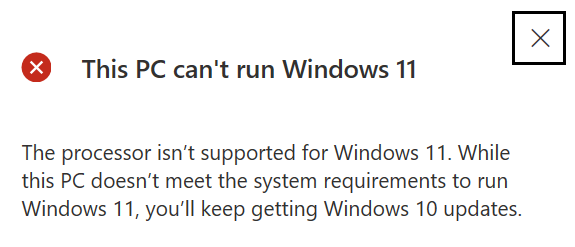
Not all devices running Windows 10 will be able to run the new OS:
You can download the Health Check app here to find out. There is a requirement for TPM (Trusted Platform Module) chips and, according to TechRadar, many devices that have one may have them disabled by default – which means the Health Check app fails machines which, ultimately, will be able to run Windows 11. Before you go an buy a new machine, take a look and see if you’ve got a TPM chip to enable!
One has to wonder what this might mean for businesses – is Windows 11 going to require a big wave of hardware refreshes? If so, I can see Windows 10 becoming the new Windows XP!
What’s new?
Some of the key changes include:
Keyboard optimised for touch and tablet use
Snap layouts – let you arrange multiple windows in various configurations, you can see some of the options here:
You will also be able to create multiple fully separated desktops.
“Chat from Teams” integrated into the taskbar and the ability to use 2-way SMS messaging.
Revamped Microsoft Store which will include Android apps via a partnership with Intel and Amazon.
Annual updates rather than the current 2 per year.
The Taskbar will be centered and, it seems, will have to be positioned at the bottom of the screen. I’ve had mine at the top for years (it’s the best place to have it!) and can imagine this being enough to keep me on 10 for a while! 🤣
There was a pretty big change this month as Microsoft removed a key requirement for “From SA” licenses. These allow organisations that have on-premises licenses with Software Assurance (SA) to migrate to Microsoft 365 at a reduced price – taking into account the investment in SA.
Back in early 2020, Microsoft added a clause that customers had to retain their existing on-premises licenses throughout the “From SA” subscription period. This presented a barrier for organisations in Europe looking to engage in the 2nd-hand software market and re-sell their (now unwanted) on-premises licenses.
However, in June 2021 Microsoft said:
For customers who choose to purchase “From SA” licenses, we removed the requirement that customer retain the corresponding Qualifying Licenses throughout its From SA license subscription period
It’s a very interesting move from Microsoft and I am keen to see what related announcements we might see at their Inspire conference in July.
Further changes include:
Windows 10 Enterprise/E3 has been removed as a pre-requisite for the M365 F5 add-on SKUs.
Remote Work Starter Plan added to CSP <– This seems to have launched in Japan in August 2020 and looks to be basically a “Teams+OneDrive” SKU
Customers with Microsoft Project Plan 1/3/5 are only permitted to use Universal Resource Scheduling to schedule Project and Task tables within the context of a project
Here are the Microsoft Product Terms changes for May 2021:
M365 Business Basic/Standard/Premium added as pre-requisite licenses for Audio Conferencing and Phone System
Microsoft 365 Career Coach USL has been added for Academic customers
Microsoft 365 Scheduler has been added. This includes a “human-assisted AI Service” for complex scheduling requests.
Microsoft Teams: Terms added to confirm licenses are not required to join meetings/live events hosted by licensed users. Also that external users don’t need a license for Guest access via AAD External Identity.
Power Platform: All Power Platform licenses now have “extended term eligibility” under EA/EAS/SCE
A relaxing of the terms around Project for the web and how the data can be viewed.
Microsoft’s financial results for Q3 FY21 (Jan – Mar 21) are in and, as usual, they’re pretty impressive.
Revenue = $41.7 billion – up 19%
Operating income = $17 billion – up 31%
Looking at the different product divisions we can see:
Productivity & Business Processes
Revenue = $13.6 billion – up 15%
Office 365 Commercial was up 22%, LinkedIn increased 25%, and Dynamics 365 was up 45%.
Microsoft Teams is up to 145 million daily active users, almost doubling YoY and Office 365 Commercial has nearly 300 million paid seats. Office Commercial products (on-premises Office) was down 25% – continuing its downwards trend as organisations continue to move to the cloud.
Satya Nadella revealed that Power Platform now has almost 16 million monthly active users, an increase of 97%, and revenue has increased by 84%. Amy Hood (CFO) called out Power Apps and Dynamics 365 Finance & Operations as strong performers.
Intelligent Cloud
Revenue = $15.1 billion – up 23%
Azure growth was 50% yet again, with Amy Hood highlighting an increase in the number of large, long-term Azure contracts.
On-premises server products grew 3%, although that seems to largely be due to year on year currency fluctuations, and the EMS install base grew again, now sitting at 174 million seats.
SQL Server on Azure VMs grew 129% YoY alongside Cosmos DB growth too.
More Personal Computing
Revenue = $13 billion – up 19%
Again there was a big difference in Windows OEM as Pro revenue declined 2% but non-Pro grew 44%.
Microsoft announced this month ( April 2021) that they’ve acquired Nuance Communications for $19.7 billion – their 2nd biggest acquisition behind LinkedIn.
You may be familiar with Nuance for their Dragon Naturally Speaking speech recognition software and/or Power PDF but the focus for Microsoft is their work in the Healthcare sector – much of which is built on Azure. It follows Microsoft’s announcement of their “Cloud for Healthcare” vertical offering and clearly indicates they see it as a growth market for them; they believe it will bring their Total Addressable Market to $500 billion in the healthcare provider space – even a small piece of that will make that $20 billion seem like small change!
Going forward, Nuance will be included within Microsoft’s “Intelligent Cloud” division and Nuance will retain its CEO, Mark Benjamin, who will report into Scott Guthrie – executive vice president of Cloud & AI at Microsoft.