Microsoft CSP price changes: October 2022


Photo by Alexander Mils on Pexels.com

October 2022 will see some Microsoft price changes and new options added to the Server Subscriptions for Azure on the CSP program:

  • Windows Server 2022 Std 8-core license pack (1yr) drops from $272 to $213.60
  • Windows Server 2022 RDS User CAL (1yr) increases from $56.04 to $77.04

They are also adding Windows Server Datacenter 8-core license packs in 1 & 3 year variants, to complement the existing Windows Server Std offering.

Microsoft also state that, “over time”, the 1-year software subscriptions via CSP will be aligned with pricing on SPLA – meaning some products will increase while others decrease.

Microsoft cloud licensing changes coming October 2022


Photo by Aleksandar Pasaric on Pexels.com

Back in May 2022, Microsoft announced a range of upcoming changes to licensing in cloud environments and now, September 2022, we have more details.

Flexible Virtualization

This new benefit will allow customers with Software Assurance or subscription licenses to use their existing licenses to install and run on any (but not Listed Provider) infrastructure – whether it’s dedicated or shared.

Windows Server virtual cores

Customers will be able to license Windows Server by virtual core on 3rd party infrastructure. There will, of course (!), be a per VM minimum. The Microsoft announcements don’t mention Listed Providers for this element so perhaps this new licensing option will be available with Amazon, Google, and Alibaba…although it seems unlikely!

Desktop virtualization

Microsoft 365 E3/E5/F3 users without a primary device with a Qualifying Operating System (QoS) will be able to virtualize Windows 10/11 on 3rd-party infrastructure (but not Listed Providers) without needing the VDA add-on.

Cloud Solution Provider – Hoster

This new variant of the CSP program replaces the QMTH (Qualified Multi-Tenant Hosting) program. It will enable hosting partners to pre-build hosted desktop & server environments for customers and either provide the licenses or use customer provided licenses – giving greater flexibility for organizations. Customers will need to show proof-of-license for BYOL scenarios – verification of which I assume will be done by the partner. Initially it will only be available for Direct partners but Microsoft “look forward to expanding program eligibility over time“.

Microsoft state these will go live from October 1st so we should see them added to the Product Terms on that date too. I’ll of course be updating on that asap 😊

Check out the Microsoft post here.

Microsoft Product Terms: September 2022


Photo by Markus Winkler on Pexels.com

Not much this month at all:

Teams Rooms Standard & Premium swapped for Basic & Pro
Qatar added as a data location
Clarified terms for Azure Databox & Stack Edge

Microsoft also revealed further details around the upcoming cloud licensing changes (which I’ll post about separately) but these aren’t in the Product Terms this month…will likely be October.

Microsoft Product Terms: August 2022


Photo by Markus Winkler on Pexels.com

The Product Terms were on time this month (😊) but not a huge amount has happened (as expected).

The M365 F1 & F3 maximum screen size limitation is increased from 10.1″ to 10.9″ – this expands the devices available to F SKU users and – perhaps – widens the scope of who can be assigned such a license?

“Home Use Program” is renamed “Workplace Discount Program” – no changes to terms…yet…

Microsoft Defender Experts for Hunting added (although the specific page currently has an error)

Still no sign of the rule changes around 3rd-party cloud licensing that were announced in May…

Microsoft Product Terms: July 2022


Photo by Markus Winkler on Pexels.com

After a bit of a wait for Redmond to publish, the latest update is here. Not surprisingly, given the time of year, there’s nothing major – mainly just a bit of tidying up this month:

Added/updated terms for:

Windows AutoPatch
MCA cancellations
Azure Limited Access Services

Removed old references for:

Business Voice
GitHub Learning Lab for Organizations
Office 365 Add-ons

Change to show 3.5K AI Builder Credits are included per SharePoint Syntex license

Academic plans added to Cloud for Non-profit qualifying licenses

Microsoft Sustainability Manager


Photo by Akil Mazumder on Pexels.com

Microsoft’s “Cloud for Sustainability” is here (released June 2022) in the guise of Microsoft Sustainability Manager – a new tool/platform aimed to help organisations with their journey to net zero and bolstering their ESG (environmental, social, and governance) capabilities.

Sustainability & ESG is a growing focus for business leaders across the globe and this is just the start of Microsoft’s plans in this area. Sustainability Manager focus on several areas:

Unify data intelligence

Build a sustainable IT infrastucture

Reduce environmental impact of operations

Create sustainable value chains

What does it do?

It helps organisations track their emissions across the business, automate the collection and analysis, and present it to the business via analytics and dashboards. It covers Scope 1, 2, and 3 emissions – for those of you not familiar with those (as I wasn’t until relatively recently), here’s a quick overview:

Scope 1

Emissions from sources that an organisation owns/controls like fuel used in company vehicles

Scope 2

Emissions indirectly caused by a company when energy it purchases/uses is produced. An example being the emissions from the generation of electricity that is used to power electric company vehicles.

Scope 3

Emissions not covered by the above but where a company is indirectly responsible across the supply chain such as using/disposing of products from suppliers.

I used this page from the National Grid to get the above definitions.

Scope 3 emissions can make up the bulk of emissions for an organisation but they are also the hardest to reduce.

Pricing & licensing

It is priced at $4,000 (USD) per tenant per month – although Microsoft do point out that additional capabilities added to the product may incur additional charges in the future. That price includes Dataverse capacity which is capped at:

  • Database – 10GB per month
  • File – 20GB per month
  • Log – 2GB per month

and if additional capacity is needed, add-on licenses will need to be acquired.

It is available in 32 languages and can deployed from the US and Europe.

Further Reading

Microsoft page

Microsoft Docs info

Microsoft Viva Sales – another new member


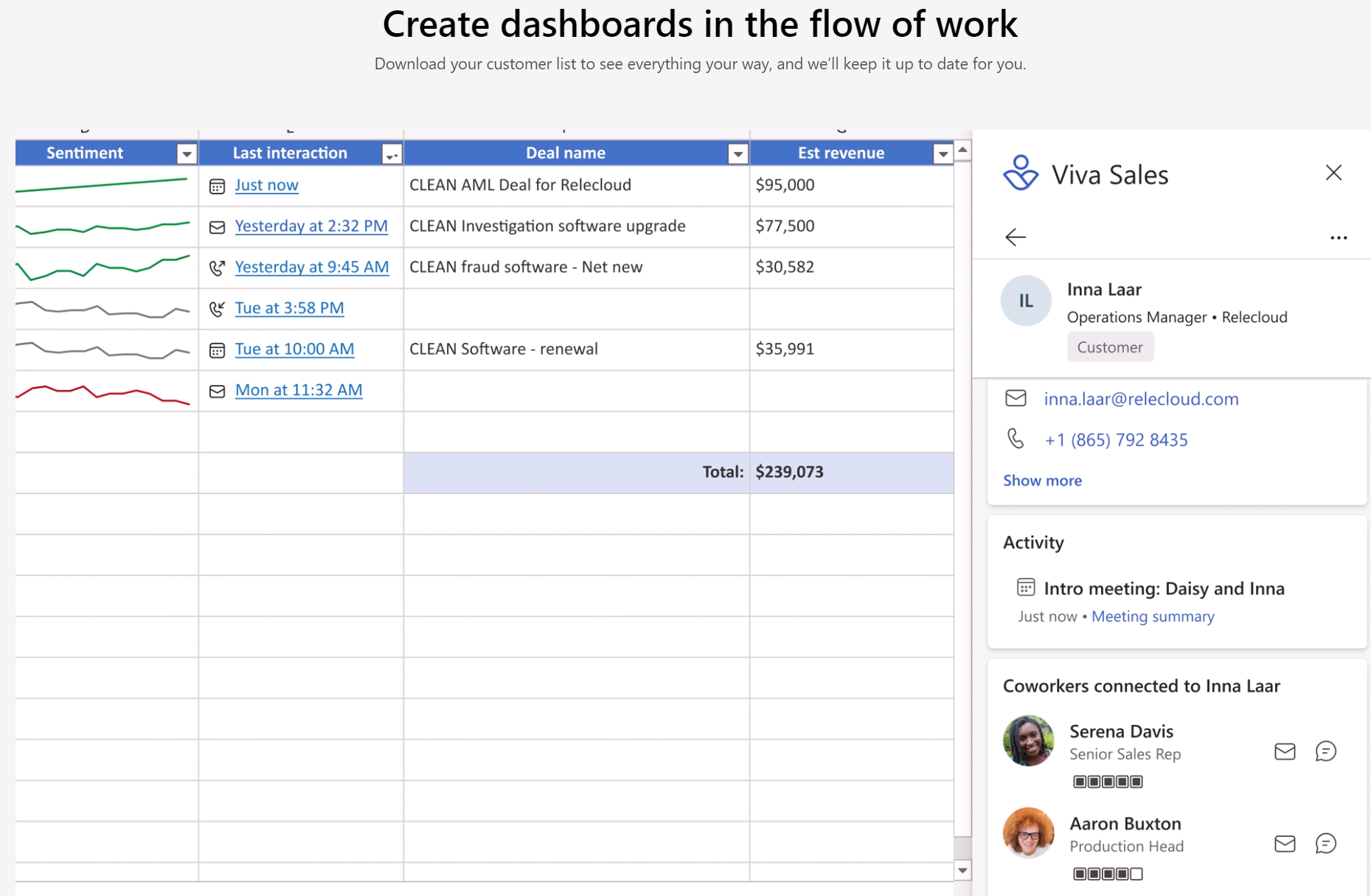
Hot on the heels of Viva Goals, Microsoft have introduced Viva Sales. This latest family member is a “new seller experience” that brings Microsoft 365 & Teams together with “any” CRM system to streamline processes for salespeople…it also adds a hint of AI into the mix.

Areas it helps with include:

  • AI organised data and tasks
  • Inbuilt sentiment analysis
  • Surfacing unstructured data from Office documents
  • Automated data capture
  • Reminders

and more, with Microsoft describing it as a sales coach that helps move deals along. It will also surface “business context” data within Outlook and Teams and allow salespeople to update their CRM from those platforms too.

Much of this is, as with many other products, about keeping people within Teams as much as possible – making it the “collaboration hub” for users across organisations.

A feature called Sales Conversation Intelligence (SCI) will help sellers byl:

  • Generating meeting summaries
  • Tracking customer sentiment
  • Suggesting action items

all to keep deals on track and moving along.

Licensing and pricing

Viva Sales is free for users already licensed with Dynamics 365 Enterprise and Premium – for everyone else it will be $40 per user per month. It hits General Availability on October 3rd, 2022 and is NOT part of the Viva Suite.

I like the sound of what Viva Sales can do and am keen to check it out further – as anything that makes sales and customer management easier is a good thing. No matter the CRM you use, it’s never as intuitive and easy to use as users would like…perhaps Viva Sales will go some way to alleviating that. Or perhaps it will just be one more thing to add to the mix?!

Further Reading

Microsoft Announcement

Microsoft Viva Sales page

More info on features and pricing

Microsoft Product Terms June 2022


Photo by Markus Winkler on Pexels.com

Some new M365 F5 Security bundles made available – further expanding what’s possible for protecting frontline workers.

Microsoft Sustainability Manager added. This is what we’ve been calling Microsoft Cloud for Sustainability…it seems that will be now an umbrella term and Sustainability Manager will come under that.

Clarification that the SQL Server Enterprise SA benefit of running Power BI Server applies in a fail over OSE too

Tidying up of various clauses and terms.

No mention of the major changes they announced for cloud BYOL rules around Windows Server, Windows desktop, and Office.

Microsoft Intelligent Data Platform


At Microsoft Build 2022, they have introduced us to the new Intelligent Data Platform.

They say this will help in “removing points of friction between your databases and analytics systems while automatically mapping and governing your full data estate” and allow developers/organisations to “Focus on building innovative apps—and spend less time managing your data“.

Is it a new product?

No – instead it’s a collection of existing products that MS position as forming a better, cohesive eco-system for organisations. Those products are:

  • Azure SQL
  • Azure Cosmos DB
  • SQL Server 2022
  • Azure Arc
  • Azure Synapse Analytics
  • Power BI
  • Azure Machine Learning
  • Microsoft Purview

The latter enabling comprehensive governance of data across all these different locations, products, and use cases.

For many organisations across a variety of verticals, data is the key to success. However, given the increasing regulatory pressures and growing threat of cyber attacks – not managing that data effectively can be one of the largest risks a business faces. The dual concept of helping organisations better connect their data to extract more useful insights more quickly AND securing all that data will surely seem a particularly attractive offering for a lot of customers. Several other organisations, including Amazon and Google, are heavily focusing on data too – it’s the next frontier for winning/losing customers in many ways – and I’m sure Microsoft will continue to enhance this area of their business. I’m also sure they will be selling this concept, and the underlying products, heavily during renewals and customer briefings etc.

Further Reading

Intelligent Data Platform page

Microsoft IDP announcement

Microsoft Power Pages


Microsoft may have taken a trip to Greyskull as, to paraphrase He-Man they:

“Have the Poweeeeerrrrr…Pages”

The newest member of the Power Platform family, Power Pages is a upgraded version of Power Platform Portals – moving from a component to a fully-fledged standalone product.

What does it do?

Power Pages is designed to help easily create websites using drag & drop plus a range of templates available. Microsoft are positioning it as good for uses including FAQ sites, self-service portals, support sites and more.

https://powerpages.microsoft.com/en-gb/?wt.mc_ID=Build2022_fld_us_bl_oo_bl_PowerPlatform

Making it easier to create better, more powerful and nicer looking websites will actually be pretty useful for (parts of) organisations of all sizes.

Licensing

There are 2 options based on authenticated and anonymous users:

Authenticated users per website

This starts at $200 per 100 users per site per month with volume pricing available:

As it is per site, users authenticating against multiple sites will use additional capacity.

Anonymous users per website

This starts at $75 per 500 users per site per month with volume pricing available:

As it is per site, users browsing multiple sites will use additional capacity.

Further Reading

Power Pages announcement

Power Pages capabilities – more here

Pricing info