Microsoft Copilot Dashboard


Since the introduction of Copilot for Microsoft 365, one of the big questions I, and others, have been asking is “how do you determine value?”. I laid out my initial concerns, questions, and actions here and now want to look at Microsoft’s offerings to enable this kind of insight. Currently available in preview (https://insights.cloud.microsoft/#/CopilotDashboard) – although I couldn’t get it to work – Microsoft’s Copilot Dashboard is their option to get the much needed insights.

Microsoft Copilot Dashboard

Microsoft aim for this to help customers across the 3 stages of the adoption journey:

It will show:

  • Who is eligible for Copilot for M365
  • How people are currently using M365 apps
  • How people are using Copilot and in which different apps
  • Information on how Copilot is impacting productivity
https://techcommunity.microsoft.com/t5/microsoft-viva-blog/new-ways-microsoft-copilot-and-viva-are-transforming-the/ba-p/3982293

Access to this information and data will be key for businesses looking to make informed decisions on where Copilot can offer real benefits and ROI.
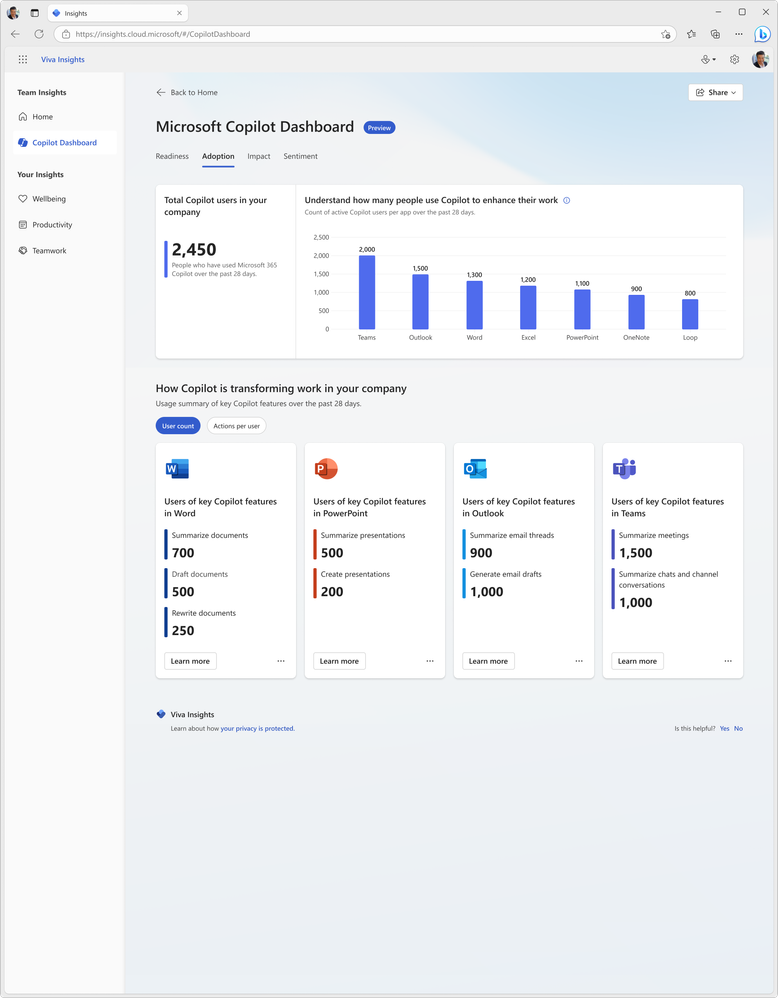
https://techcommunity.microsoft.com/t5/microsoft-viva-blog/new-ways-microsoft-copilot-and-viva-are-transforming-the/ba-p/3982293

Being able to see where it can get involved to help users is helpful for getting started:
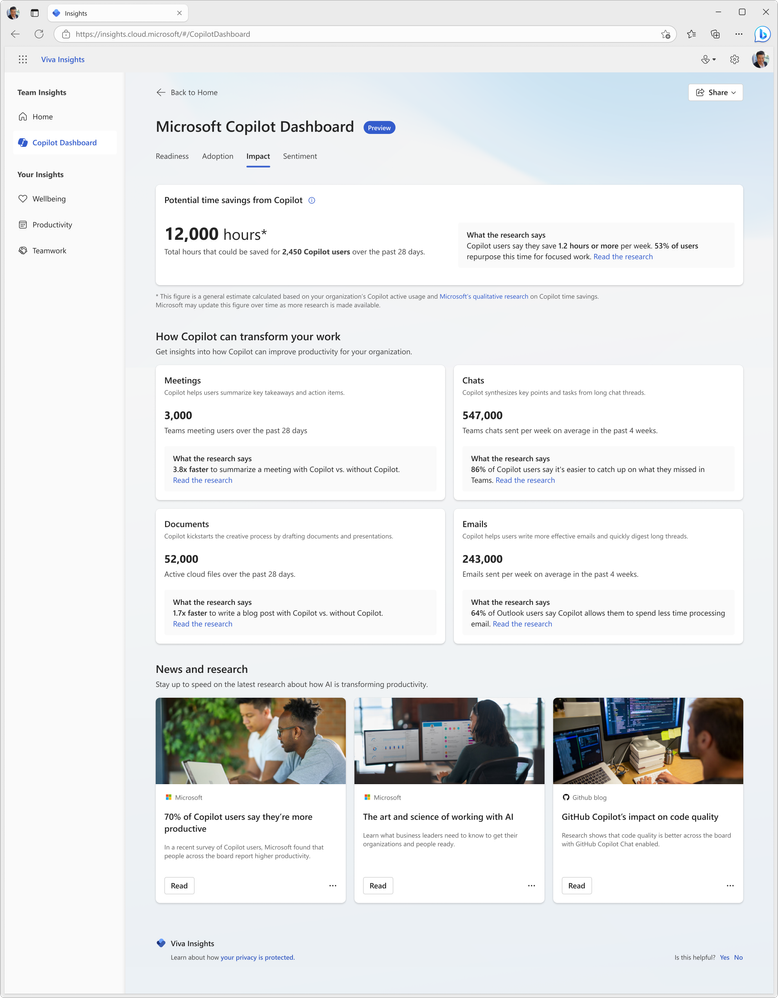
https://techcommunity.microsoft.com/t5/microsoft-viva-blog/new-ways-microsoft-copilot-and-viva-are-transforming-the/ba-p/3982293

Viva gives more features

Microsoft are referring to it as “Microsoft Copilot Dashboard, powered by Viva” and from “early 2024” there will be additional dashboard features available to users with Viva Insights licenses. According to Microsoft, these will include:

Copilot adoption and usage metrics combined with collaboration data, out-of-the box reports for organizational leaders, before and after behavioral data and even insights from employee surveys.”

and will also show time spent in meetings, processing emails, and creating content with before and after Copilot information.

All in all, the Copilot dashboard will be useful for organisations looking to understand more about their Copilot readiness and then their Copilot usage. However, some may have concerns about the reliability and objectivity of the data and reports generated by Microsoft on their own software. Ideally, Microsoft will be transparent and accountable in how they collect, process, and share the data from the Copilot dashboard. They should also provide ways for users to verify, challenge, or complement the data with their own sources and feedback.

Microsoft Copilot and Microsoft MACC


Photo by Donald Tong on Pexels.com

I’ve recently recorded a couple of videos with Nathan Miller, Microsoft Program Manager at Bytes.

In the first, we discuss Copilot for Microsoft 365 (we recorded this in October 2023 but it took me ages to edit it!):

We talk about the General Availability of Copilot for M365 as well as tips for preparing for deployment.

We then talk about the Microsoft Azure Consumption Commitment (MACC): agreement:

where we explain what the MACC agreement is, how it works, and the potential pros and cons for customer organisations. We also talk about the Azure cloud marketplace and the impact this will have on customer procurement processes and also the wider IT channel.

I hope you find the videos useful and informative – as there are more planned! Let me know if you have requests for topics and also if you’d like to jump on a video or podcast with me at some point. I usually focus on blog posts but am looking to get all multimedia on you in 2024 so this is just the start 😁

Microsoft Copilot for Service


Microsoft have announced a new Copilot – we now have Copilot for Service.

Copilot has been within Dynamics 365 for a few months already and now Microsoft bring the ability to “synthesize[s] vast amounts of data already available from an organization’s trusted knowledge sources to provide relevant, timely guidance to agents in their flow of work” to users of other CRM and Contact Centre solutions including Salesforce and ServiceNow, and Zendesk.

How does it work?

Microsoft say that it will very easy:

“Organizations can simply point to their data—such as public websites, SharePoint, knowledgebase articles, and offline files—and in a few minutes unlock generative AI-powered conversations across all of their data”

It will enable customer service agents to ask natural language questions of their data, whether in Teams or another client. Further down the line additional features will include email summaries, email drafts, and meeting recaps as well as automating common CRM tasks based on emails and context.

Interestingly, this product will include the much hyped Copilot for Microsoft 365 – meaning these users will also have access to Copilot across their Office suite.

Pricing and availability

Copilot for Service will be $50 per user per month (pupm). Remember that this includes Copilot for M365 which is priced at $30 pupm alone.

Copilot for Service is currently in public preview in US-based environments only, and the Copilot for M365 features may not be available during preview.

Announcement here and more info sign up form here.

Microsoft Financial Results: Q3 FY23


Photo by Essow K on Pexels.com

Microsoft announced their Q3 FY23 (Jan – Mar 23) results recently – let’s take a look at the numbers.

Overall revenue for the quarter was $52.9 billion – an increase of 7% while net income was up 9% to $18.3 billion. The latter something of a turnaround from the 12% decrease the previous quarter.

Productivity & Business Processes

Revenue = $17.5 billion…up 11%

  • Office 365 Commercial up 14%
  • LinkedIn up 8%
  • Dynamics up 25%

A little higher than Q2 but still lower than we’ve been seeing for the last couple of years.

Intelligent Cloud

Revenue = $22.1 billion…up 16%

Azure growth was 27% again, a decent increase but continuing the ongoing shrinking of the percentage increase each quarter.

Earnings Call

Satya Nadella stated that Microsoft continue to focus on 3 priorities:

  • Helping customers to get the most value out of their digital spend
  • Investing in AI to increase their Total Addressable Market (TAM) and be the leader
  • Aligning their cost structure with their revenue growth

We are now in the era of ChatGPT and AI – an area where Microsoft are expected to do very well in the coming months and years – and Nadella stated in the earnings call that they have over 2,500 Open AI Azure customers which is a 10x quarter on quarter increase. He also mentioned that ChatGPT runs on top of Microsoft’s CosmosDB.

Further updates include:

  • Azure Arc is up to 15,000+ customers which is 150% up year on year (YoY).
  • Power Platform is up to 33 million Monthly Active Users (MAU) – almost 50% up YoY.
  • Teams has broken the 300 million MAU mark.
  • Almost 60% of Enterprise customers are buying Teams Phone, Teams Rooms, and/or Teams Premium.
  • Almost 600,000 customers have deployed at least 4 Microsoft security workloads – a 35% YoY increase.
  • Amy Hood stated that, at the end of April 23, total headcount was 9% more than a year prior.

Satya mentioned Copilot several times and, in response to an analyst question, stated that:

“We do plan to monetize a separate set of meters across all of the tech stack, whether they’re consumption meters or per-user subscriptions. The copilot that’s priced, and it is there, is GitHub Copilot. That’s a good example of incrementally how we monetize the price lists out there, and others are to be priced, because we are in preview mode. But you can expect us to do what we’ve done with GitHub Copilot pretty much across the board”

Satya Nadella, Q3 FY23 earnings call

and that gives a good idea of what Copilot licensing may look like. I think my expectation of add-ons to E3 and E5 is pretty accurate.

While Microsoft’s revenue and profits are looking great, and they’re excited about all the growth ahead of them, the shine is dimmed somewhat by 2 things: the memory of the layoffs of circa 10,000 staff in January and the recent news that there are to be no pay raises across Microsoft. Give the increases in cost of living, energy, and inflation – wages staying flat can be seen as a pay cut in many ways.

You can see all the details here.

Microsoft Product Terms: November 2022


Photo by Markus Winkler on Pexels.com

This month we’ve 2 new M365 data related SKUs:


M365 Advanced Data Residency
M365 Cross-tenant User Data Migration

There is also the removal of:
Microsoft Threat Experts
SharePoint Advanced Management Plan 1

The SharePoint SKU was only added last month but there was very little info available, so it seems likely it was added in error. Let’s see if/when it reappears.

A nice addition – Azure Active Directory Basic now allows unlimited SSO (Single Sign On) – the previous limit was 10 apps so à really significant change.

There is a 50% off promo for Defender for Endpoint on EA from Nov 1, 2023 to June 30, 2023

Microsoft’s new licensing rules for Cloud Providers


Microsoft have just announced a range of changes to their rules around using their software in SOME cloud environments, aimed at reducing some of the heat they’ve been receiving from European cloud providers – including complaints to the European Commission – and also heading off potential issues with the EU Digital Markets Act.

The changes include CSP access, more support for providers from Microsoft, and some changes to Software Assurance licensing rules too.

Background

Microsoft have been under fire from various angles due to their licensing rules that restrict which products can be used within 3rd-party datacentres…particularly when compared to Microsoft Azure. It recently came to light that ‘OVHCloud’ lodged a complaint with the European Commission in 2021 and many of the “Fair Software Licensing Principles” were seen to be aimed at Microsoft too.

The current BYOL (Bring Your Own Licensing) rules of Microsoft restrict certain on-premises licenses from being used in cloud environments (apart from Azure) which, for some customers, causes frustration and higher costs…and in some cases it means a project cannot be completed.

What’s changing?

Microsoft have announced a big new focus on ‘European Cloud Providers’ (ECP) – giving them expanded access to CSP (Cloud Solution Program) as well as creating a new internal team to focus on supporting them and their customers.

Cloud providers can host more products

The ECPs will be able to offer hosted desktop solutions containing Windows desktop and Office – including Office 365 Apps for Business/Enterprise. They will offer this via their own “unified solutions” and also by hosting customer-owned licenses – hugely expanding the available options for customers.

Microsoft are also expanding the availability of long-term fixed pricing for these providers, removing some of the pricing volatility from them and their customers.

Software Assurance changes

This is a pretty big one – Microsoft are adding ‘License Mobility’ rights to Software Assurance for Windows Server, Windows desktop, and Office. This means customers can use their on-premises licenses in 3rd-party ECP datacentres (but not AWS, GCP, or Alibaba), something that wasn’t possible before.

New Windows Server licensing option

Windows Server is licensed based on the physical CPUs and cores within the server. Microsoft are now introducing the ability to license just the virtual capacity you need, regardless of the underlying hardware. Whether this will be available globally and across all licensing programs, or restricted to just ECP datacentres, is something we are yet to discover.

European Cloud Providers – and more?

Although Microsoft’s announcement was careful to keep referring to ‘European Cloud Providers’ – it seems a Microsoft spokesperson has confirmed that the CSP and Software Assurance changes apply globally (via Mary Jo Foley). This means the vast majority of cloud providers are now able to offer something to their customers that they couldn’t previously.

On the flipside of that though, the main takeaway is that this doesn’t help customers looking to run software on AWS, Google, and Alibaba (the Listed Providers) and, in all honesty, that’s where I see most of the customer issues in this area. However, perhaps Microsoft hope that not only will these changes placate the EU but that they will also divert business away from the Listed Providers to smaller partners instead. In the new world, Microsoft may see that as a win…sure, they’re not on Azure…but they’re not on AWS either.

Update:

Microsoft have confirmed here that these changes do NOT apply to the Listed Providers – Amazon, Google, and Ali-Baba.

Other changes

Microsoft have outlined their 5 “European Cloud Principles”:

https://blogs.microsoft.com/eupolicy/2022/05/18/microsoft-responds-to-european-cloud-provider-feedback-with-new-programs-and-principles/?s=09

and also discussed their plans to further partnerships around providing sovereign clouds for various European governments.

Microsoft’s full announcement is here.

Microsoft Product Terms: December 2020


Photo by Markus Winkler on Pexels.com

As you’d expect, it’s a quiet month.

Microsoft 365 Business Voice, the SMB cloud telephony package, is added. Available via CSP and requires Microsoft 365 Business Basic/Business Standard/Business Premium.

The various name changes (ATP = Defender etc.) have (finally) been updated.

2 x Power Apps promotions that could be quite interesting have been added:

“Power Apps per App” promo = Available to new/existing EA/EAS/CSP customers & has a minimum purchase of 200.

“Power Apps per User” promo = Available to new/existing EA or EAS (not CSP) customers & has a minimum purchase of 5,000.

Microsoft and Nutanix hybrid cloud


Microsoft have announced a partnership with Nutanix to help organisations develop multi-cloud and hybrid cloud scenarios. Nutanix clusters will be added into Azure datacentres – extending on-premises Nutanix environments into the cloud:

https://www.nutanix.com/blog/hybrid-cloud-solutions-with-nutanix-and-microsoft-azure

Software and nodes will be paid for via “Microsoft Azure Consumption Commitment (MACC)” or PAYG, as well as existing Nutanix licenses being portable into Azure. Azure Hybrid Benefits can be utilised on the “Nutanix Clusters on Azure” and Microsoft’s Extended Support Updates are available too. Additionally, via Azure ARC, various Azure services – including Kubernetes – can be run in on-premises Nutanix environments.

Microsoft are really working to extend Azure to as many organisations as possible – VMware on Azure, Azure Stack, Azure Arc, and now this. It seems very much the approach they took to Office software on mobile devices – if you allow people to use your service alongside those from competitors, you end up in a better position that forcing them choose one or the other.

The service is currently in public preview – more info is available here and you can sign up to the waiting list here.

Microsoft & SAP Embrace


Photo by cottonbro on Pexels.com

Project Embrace is a new initiative from SAP to help their customers move to the cloud, and digitally transform, quickly and easily. Microsoft are a key part of this, particularly around SAP S4/HANA running in the Azure cloud. The 2 vendors have created a joint roadmap with guidance to help organisations move from on-premises to the cloud. This new phase takes things further whereby Microsoft & SAP will align their partner ecosystems and collaborate around customer support.

This seems similar in many way to the partnership Microsoft announced with Oracle earlier this year, continuing the trend of “co-ompetition” between some of the largest players in the new cloud world. It can also be seen as a revival of the SAP/Microsoft “Duet” partnership – a joint product they launched many years ago to facilitate collaboration for companies using SAP and Microsoft SharePoint.

It’s interesting that Microsoft talk about being the first global cloud provider to support Project Embrace, although the SAP statement includes Amazon AWS and Google Cloud alongside them.

You can see more from SAP, and the others involved, here.

Microsoft: Windows & AI – all change


On March 29th, Microsoft announced another company re-org. This one sees some big changes to the Windows side of things and gives a good overview of where Microsoft’s sees its future.

The biggest news is that Terry Myerson – Executive Vice President of the Windows & Devices Group (WDG) is leaving, and the team is being divided across two new entities.

Experiences & Devices

This team will be led by Rajesh Jha, who’s been at Microsoft since 1990, is a member of the Senior Leadership Team and most recently headed up engineering for Office 365.

In his email to Microsoft employees, Satya Nadella says:
“Computing experiences are evolving to include multiple senses and are no longer bound to one device at a time but increasingly spanning many as we move from home to work and on the go”

Hopefully, this gives an idea of where this team is heading – creating software, and devices, that work together in ways that match how people want to use them. Software experiences that work seamlessly across multiple devices – of different types and with different operating systems – are what more people are looking for. As the consumerisation of IT continues, users having multiple devices with Windows, iOS and Android will more and more become the norm within business settings.

As Nadella goes on to say in his missive:
“These modern needs, habits and expectations of our customers are motivating us to bring Windows, Office, and third-party applications and devices into a more cohesive Microsoft 365 experience.”

It’s interesting that 3rd party apps are included here. He could be referring to managing them via EMS (the 3rd element of Microsoft 365) or is he perhaps hinting at something else?

Cloud & AI

Scott Guthrie (often seen in a red shirt) will lead this team. Guthrie has been at Microsoft since 1997 and is known for his work in many areas, including .NET. Satya Nadella says the goal of this team is to “drive platform coherence and compelling value across all layers of the tech stack” – this will include things such as “distributed computing fabric”, AI infrastructure, tools, and higher-level services around knowledge and cognition.

Other changes

There are more teams being created and more people being moved, all to support the drive towards a better device/app experience and to further the growth of cloud and AI. These include:

Panos Panay

The man in a large part responsible for the success of the Surface product line is now “Chief Product Officer”, tasked with “creating new categories and opportunities for the entire ecosystem”. This is an interesting move – what other devices, that wouldn’t come under the Surface banner, could be on the horizon?

Joe Belfiore

He will continue leading Windows experiences and “drive Windows innovation in partnership with the PC and device ecosystem”. Satya also says that “Joe will share more about the Windows roadmap at Build” – with the recent talk of multi-user editions of Windows (to facilitate access to remote desktops without requiring Windows Server), I’ll certainly be paying attention between May 7-9.

Windows Platform Team

This team will move into Azure team and help “accelerate (Microsoft’s) efforts to build a unified distributed computing infrastructure and application model”. Interestingly, the team led by Roanne Sones, which deals with technical engagement with OEMs, ODMs and silicon vendors, will also join the Azure team.

New teams

Two new teams have been created:

• AI Perception & Mixed Reality
• AI Cognitive Services & Platform

Which certainly show that Microsoft’s focus on Artificial Intelligence and Mixed Reality (such as HoloLens) is becoming ever more integral to Microsoft’s future aspirations.
As part of this, Harry Shum (EVP, AI & Research) & Brad Smith (Chief Legal Officer) have created the AI & Ethics in Engineering & Research (AETHER) committee, to help keep Microsoft’s AI technologies in check.

Further Reading

https://news.microsoft.com/2018/03/29/satya-nadella-email-to-employees-embracing-our-future-intelligent-cloud-and-intelligent-edge/