Microsoft SQL Server 2025 Failover Rights – staying or going?


Microsoft released SQL Server 2025 on November 18th 2025 and updated the Product Terms. However, the update has caused confusion and consternation amongst the Microsoft community – as it seems to suggest that failover rights as a Software Assurance benefit have been removed!!! 😱 (Spoiler alert – it’s almost certain they haven’t).

If you’re not familiar with this right it means, in a nutshell, that organisations who purchase SQL Server licenses with Software Assurance (SA) may license additional servers at no extra cost, as long as those servers are used only for disaster recovery/failover purposes. This is a long standing and widely used benefit – removing this right will mean one of 2 things:

  • Organisations’ SQL Server licensing will double/triple by millions of £/$/€ more per year
  • Organisations will be forced to have less resilient SQL Server systems, potentially leading to more downtime and lost revenue

Ultimately, if either of those were the case, I believe it would lead to a mass exodus of SQL Server customers. Microsoft may hope they would move to SQL Azure/SQL Server enabled by Azure Arc but I’d expect many to explore other options – Oracle, Postgres, Amazon RDS etc.

Largely because of that, and the fact that we have seen an increase in Product Terms errors over the last couple of years, I’m of the opinion that it is an error and will – eventually – be corrected…but it is worth looking at anyway.

As I was about to press publish, Peter Van Uden has commented on LinkedIn that he’s had confirmation that it is an error and will be corrected in the coming days.

Fellow Microsoft watcher Alex Golev noticed that the whole section had been deleted without replacement:
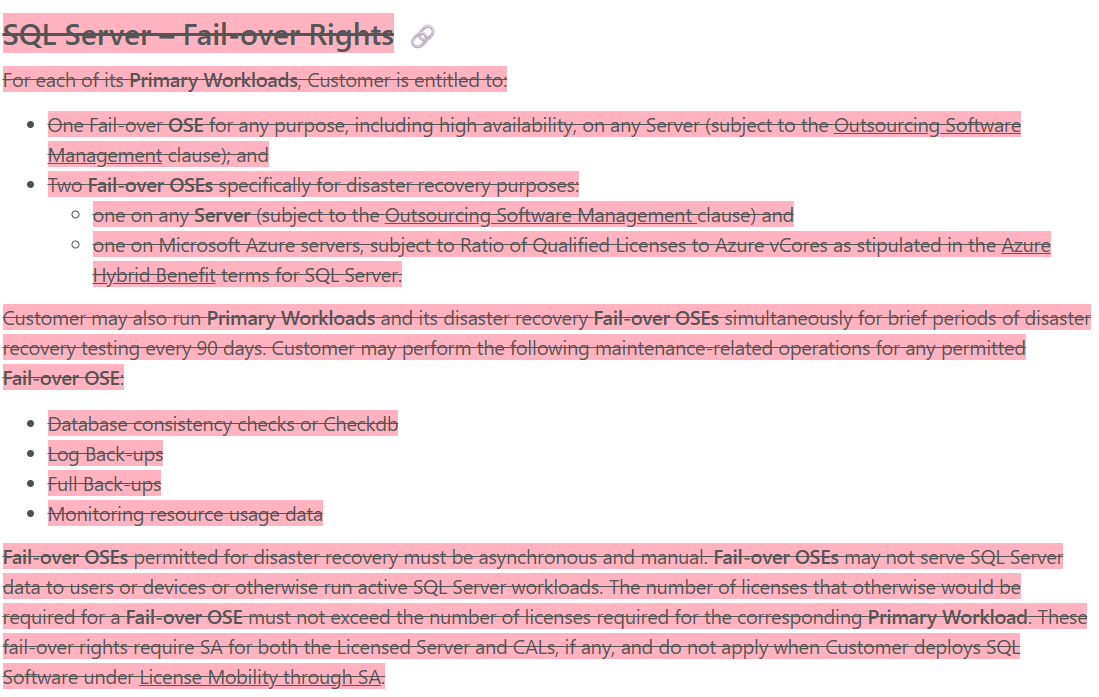
Other parts of the Product Terms still refer to this section which suggests this is an erroneous deletion…but it could also mean that they just didn’t edit those sections correctly.

This Microsoft page – https://www.microsoft.com/licensing/guidance/SQL?msockid=144db73d53b469e721fda347528468b6 which is licensing guidance for SQL Server 2025 still contains the failover rights information:
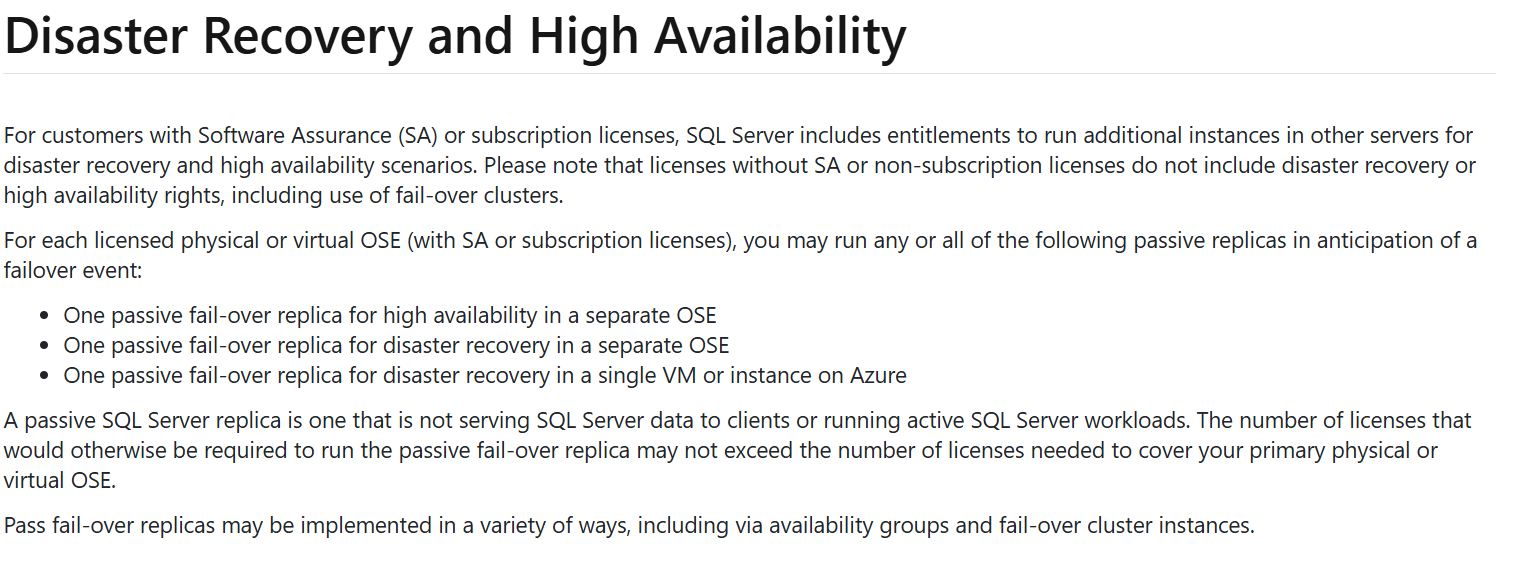
I genuinely believe this is an error. It is a huge change that would have significant consequences for most Microsoft customers, including their largest and most significant customers. Making this change would be an enormous risk and to do so without any official announcement or warning is unbelievable. I’m sure we’ll see a reversal in the coming days and that’s why I haven’t posted about this already.

However, I feel it does highlight the increasingly slapdash approach that has been taken to the Microsoft Product Terms since it became an online site, rather than document downloads. It seems likely to me that updates are being made by people with little understanding of software licensing and so they don’t see the consequence of their actions.

The fact that it’s 4 days since this change was made and there has been no word from Microsoft is disappointing – but hopefully that correction will appear soon.

So, don’t panic but do remember that these things happen and that Microsoft experts like me, Alex, Peter and more can be very useful in these scenarios. 😁

Update: The missing text has been reinstated so the panic is over. It does highlight the need for us all to be vigilant in the future though.

Microsoft announce new European Cloud options


Microsoft announce new cloud options for Europe. There is an increasing push back from European organisations, particularly Government, against so many critical services and so much data all being run out of the US…this has been accelerated by the current geo-political situation too.

These announcements are Microsoft’s attempt to pre-emptively stem the flow of European customers away from their cloud services.

Altogether we’ve got:

  • Sovereign Public Cloud
  • Sovereign Private Cloud
  • National Partner Clouds
  • Microsoft 365 Local
  • Data Guardian
  • External Key Management
  • Regulated Environment Management

Microsoft 365 Local is interesting but the MS announcement only talks about productivity workloads like Exchange Server & SharePoint Server. Does M365 Local include Teams, Stream, ClipChamp, Planner etc.? 🤷‍♂️

Sovereign Public Cloud

Will be offered across all existing European datacentre regions, for all European customers, across enterprise services such as Microsoft Azure, Microsoft 365, Microsoft Security and Power Platform.

Customer data stays in Europe, under European Law, with operations and access controlled by European personnel, and encryption is under full control of customers.

Sovereign Private Cloud

Will support critical collaboration, communication and virtualization services workloads on Azure Local. This solution now integrates Microsoft 365 Local and the security platform with Azure Local, providing consistent capabilities for hybrid or air-gapped environments to meet resiliency and business continuity requirements

National Partner Clouds

Available in France (Bleu) & Germany (Delos Cloud), these will offer comprehensive capabilities of Microsoft 365 and Microsoft Azure in an independently owned and operated environment.

Microsoft 365 Local

Microsoft 365 Local provides customers with additional choice by bringing together Microsoft’s productivity server software into an Azure Local environment that can run entirely in a customer’s own datacentre.

This provides a simplified deployment and management framework for organizations to run Microsoft’s trusted productivity servers in environments they fully control. It remains to be seen exactly what is included and how the licensing works…

Data Guardian

Data Guardian will add an additional level of assurance by ensuring that only Microsoft personnel residing in Europe control remote access to these systems and adds additional human and technical oversight whenever engineers outside of Europe need access.

All remote access by Microsoft engineers to the systems that store and process your data in Europe is approved and monitored by European resident personnel in real time and will be logged in a tamper-evident ledger.

External Key Management

With external key management, customers can connect Azure to keys stored on their own Hardware Security Module (HSM) on-premises or hosted by a trusted third party.

Regulated Environment Management

The Regulated Environment Management service will allow customers to easily manage all these features in one place (for instance, configuring Data Guardian policies or reviewing access log entries).

The Microsoft announcement is here.

Microsoft vs CISPE: An agreement


Microsoft & CISPE have come to an agreement which takes some of the legal pressure off Microsoft and should lead to a more diverse cloud market…to a point.

Background

CISPE (the Cloud Infrastructure Service Providers in Europe) is, as its name suggests, a group comprised of, and working for, European Cloud hosting organisations including AWS, OVH, and Aruba.

In November 2022, CISPE filed a formal complaint with the European Commission about Microsoft’s “anti-competitive licensing practices” in the cloud. CISPE said:

“the new contractual terms imposed unilaterally by Microsoft on 1st October 2022 add new unfair practices to the list. Microsoft’s ongoing position and behaviours are irreparably damaging the European cloud ecosystem and depriving European customers of choice in their cloud deployments.”

The crux of the issue is that Microsoft’s licensing rules make it cheaper to run Microsoft workloads in Azure than any other cloud environment, thus giving them an unfair advantage against their competitors.

What’s happened now?

The two parties have signed a Memorandum of Understanding (MoU) where Microsoft have committed to make changes to address the claims and so CISPE have agreed to withdraw its complaint and also that they “will not initiate or support complaints on these issues in Europe or elsewhere”. Microsoft have also agreed to pay $22 million to CISPE to reimburse them for the last 3 years’ of “cost of litigation and campaigns for fair software licensing”.

Central to the agreement is Microsoft agreeing to release “Azure Stack HCI for Hosters”. This new Azure Stack HCI offering will include:

  • Multi-session virtual desktop infrastructure based on Windows 11
  • Free Extended Security Updates (ESU)
  • Pay-as-you-go licensing for SQL Server

Enabling 3rd-party cloud providers to close the gap between their services and those available in Microsoft Azure – a key part of the complaint.

There is a clock ticking for Microsoft now, as changes must be made within 9 months. They must release this new offering and/or solve the issues another way within that timeframe otherwise the complaint will be refiled with the European Commission.

It must be noted that CISPE state:

“Amazon Web Services, a CISPE member, was excluded from these negotiations and it, along with Google Cloud Platform and AliCloud, will neither benefit from nor be bound by these terms

This means Microsoft’s “Listed Provider” exclusion still applies to this change.

European Cloud Observatory (ECO)

This new body, established by CISPE and including Microsoft, will monitor the development of “Azure Stack HCI for Hosters” and the fairness of Microsoft’s cloud licensing.

Reception

Not everyone is happy with this outcome. It has been reported that Google made an offer to CISPE worth almost $500 million, comprised of licenses and cash, for them to continue their compliant against Microsoft.

Additionally, Google’s Head of Platform, Amit Zavery, has said:

“Microsoft’s playbook of paying off complainants rather than addressing the substance of their complaint hurts businesses and shouldn’t fool anyone

while an AWS spokeperson stated:

“Microsoft selectively making these changes for some CISPE members shows that there are no technical barriers that prevent Microsoft from making its software more easily available to rival cloud providers”

What’s next?

The Azure Stack for Hosters product will enable cloud providers to offer new features and capabilities that are attractive to customers, which is good. The main issue that many people may have is that this agreement excludes Amazon AWS and Google Cloud Platform, so their customers are no better off than before.

While that is true, I think it is also representative of what I believe is CISPE’s main aim – to help boost the non-hyperscaler cloud market in Europe. They want to help companies like OVH, Irideos, and UpCloud more so than Amazon and Google.

This is certainly not the end of this story. The cloud is going to be a battleground for many years to come and so licensing and competitive advantages will be a key issue for some time…

Microsoft Cloud for Retail: Pricing and licensing


Photo by Pixabay on Pexels.com

Microsoft have added another Industry Cloud to the Product Terms – this time it’s Microsoft Cloud for Retail.

I’m still working through some of the info and it doesn’t necessarily all seem complete yet but here’s the overview I can give so far.

Licensing

It is available as an add-on SKU, currently only Dynamics 365 Customer Insights is listed as an eligible base license to purchase the add-on. The Microsoft Docs site lists other licenses that are required in order to use certain elements of the retail cloud solution, these are:

Retail cloud featureRequired license
Omnichannel for Customer ServiceDynamics 365 Commerce / Dynamics 365 Customer Service
Microsoft 365 for Frontline WorkersMicrosoft 365 (F or E SKUs)
Power Virtual AgentsPower Virtual Agents

as well needing an Azure subscription to use:

  • Synapse Analytics
  • Cognitive Search
  • Intelligent Recommendations

Pricing

The Microsoft datasheet lists it as being $20,000 per tenant per month but also states that you “only pay for what you don’t already own“.

This makes sense as they won’t want to penalise customers who are already investing in some of these products but does suggest negotiations will be needed to get pricing…leading to the potential for different rates at different points of the year.

Availability

Available only via EA/EAS, Microsoft Cloud for Retail can currently be deployed from:

  • USA
  • Canada
  • United Kingdom
  • Singapore
  • Australia

and is available in English and French – the latter only being an option in Canada at the moment though.

Further Reading

Microsoft Cloud for Retail datasheet

Microsoft Docs page

Microsoft Cloud for Retail Product Terms page

Things I DIDN’T see at Microsoft Inspire 2017


There were LOADS of announcements and updates at Microsoft Inspire but equally, there were some things that weren’t mentioned very much, or even at all. This is a run down of the things I noticed by their absence and I’d love to hear your thoughts. If you DID hear about some of these things, then please let me know!

Azure Stack

Much talked about for the last couple of years has been Azure Stack. The next iteration of Hybrid Cloud, it allows organisations to run Microsoft Azure services within their own datacentre. In the weeks leading up to MS Inspire 2017, information around the licensing models and costs was released online. I was VERY excited (which to be fair isn’t that unusual) but I also saw a fair amount of interest from partners and end users, across Twitter and LinkedIn.

I thought we’d be seeing plenty of talk about Azure Stack in the Inspire keynotes but, unless I missed something, it wasn’t mentioned at all. There were a few sessions being run by the Azure Stack hardware vendors such as Dell EMC and one licensing related session, but that was it.

Workplace Analytics

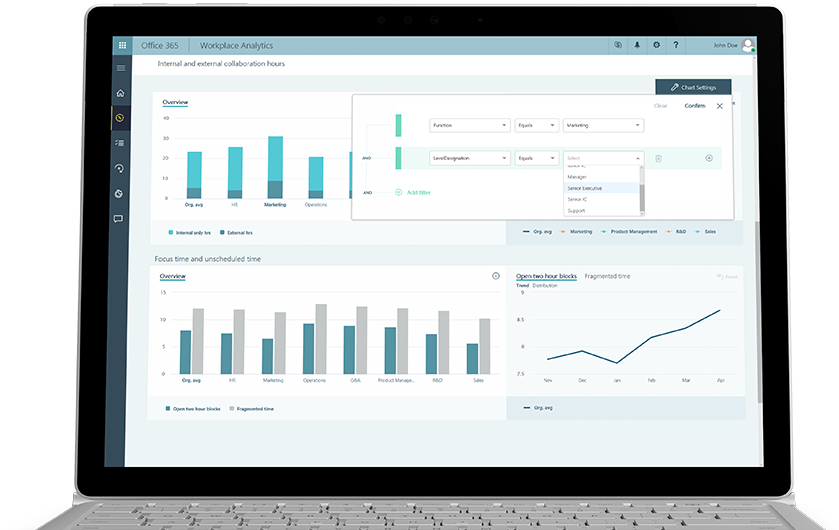
A little before Inspire, Microsoft started to release information about Workplace Analytics, which uses Office 365 data to help:

business leaders understand collaboration patterns across organizations that influence productivity and employee engagement

Workplace Analytics

With its aim of making collaboration more fruitful and efficient, and to help with hiring staff and building teams, it seems like it could be a key product for many organisations. I expected to see talk of this in one of the keynote sessions but again, it didn’t appear to get a mention. I also didn’t see any sessions talking about Workplace Analytics.

Perhaps it was felt that the the product didn’t fully fit with the messaging around the four solution areas of:

  • Modern Workplace
  • Business Applications
  • Applications & Infrastructure
  • Data & Artificial Intelligence

Whatever the reason, I was surprised not to hear more about it.

Windows 10 Mobile

This one didn’t surprise me to be honest. While it’s clear that Microsoft are still very much working towards the “Cloud First, Mobile First” mantra – it’s also become clear that a mobile phone OS isn’t high up on the list…if it’s on the list at all!

There were lot of sessions aimed at the mobile world. Sessions on building apps with Xamarin, managing mobile devices with EMS and how BlockChain can integrate with the mobile world were all on show…but nothing specifically on the Windows mobile OS.

Conclusion

Microsoft have so many products and threads to their business, and Inspire is a relatively short amount of time in which to get important messages across, that – of course – not everything can be covered in huge detail. However, these 3 stuck out as quite conspicuous by their absence.

Were there products or topics that you thought were under represented? What are your thoughts on the above?

New apps added to Office 365 Business Premium


Microsoft are adding a range of new apps to Office 365 Business Premium – and by extension – to the newly announced Microsoft 365 Business (more on this in another post). These are:

Microsoft Connections

This Mailchimp-esque tool is designed to help organisations create email marketing campaigns with a host of templates for different scenarios.

Connections.jpg

It also features many of the key metrics needed to track the success of an email campaign, such as:

  • Open rate
  • Clicks
  • Sign ups
  • Unsubscribes

and more. Connections will be available via the web and also Android & iOS apps.

Microsoft Listings

This tool helps business manage their business information across a range of key sites including Facebook, Google and Bing.

Listings

Updating once in Microsoft listings will push the changes out to the various platforms and the web dashboard will also give a single place to see page views and reviews.

Microsoft Invoicing

Another tool aimed at making business easier for smaller organisations, this tool helps create and track invoices and also connects with PayPal and QuickBooks for added functionality. Invoicing can be accessed via the web and Android & iOS apps.

Invoicing

Microsoft Business Center

This is a web based, unified dashboard for the newly added apps – giving organisations one place to see their outstanding invoices, the success of their email campaigns, their online standing and more.

Business Centre

Availability

These are currently rolling out in Preview to users in US, Canada & UK, starting with those set to “First Release”.

MileIQ

Microsoft purchased MileIQ in 2015, and a now adding it into Office 365 Business Premium. The iOS/Android app is used for mileage logging, when using a personal car for business purposes, and making it easier to claim back the expenses.

Microsoft’s aim

These new additions are aimed at making things easier for smaller businesses and, as Microsoft say, to make Office 365 Business Premium “more valuable for your small business”. Microsoft are looking to move this far beyond “hosted email” and for organisations to see Office 365 as an integral tool across multiple parts of their business – helping them win new business and reduce costs at the same time.

Adding new features and increased value is a key aspect of success for vendors in the new, SAAS world as every year, customers have the option to choose to leave. As a manufacturer, if your product isn’t giving your customers what they want, it is now often easier for them to move to a competitor than ever before.

Further Reading

https://blogs.office.com/en-us/2017/07/10/new-business-apps-in-office-365-business-premium-help-you-run-and-grow-your-small-business/

https://www.microsoft.com/en-us/microsoft-365/business

Microsoft 365


What

First we had Enterprise Cloud Suite (ECS) and then we had Secure Productive Enterprise (SPE)…now we have Microsoft 365.

As with the previous iterations, Microsoft 365 is a single SKU that combines:

  • Windows 10 Enterprise
  • Office 365
  • Enterprise Mobility + Security (EMS)

but Microsoft 365 does bring a change: there are now 2 versions – Enterprise & Business.

Enterprise

Aimed, not surprisingly, at larger organisations, Microsoft 365 Enterprise comes in 2 flavours: E3 and E5 – where each includes the components of the same level.

Business

This is a combination of:

  • Windows 10 Pro
  • Office 365 Business Premium
  • Enterprise Mobility + Security (EMS)

and features some new tools such as Microsoft AutoPilot and the ability to automatically deploy Office apps to Windows 10 PCs.


OneDrive up the storage


OneDrive – Microsoft’s personal Cloud storage offering – has, with Office 365, offered 1TB of storage PER USER… but not anymore. Microsoft have increased that to…UNLIMITED!

This really helps with Microsoft’s attempts to position OneDrive as a top contender for Cloud storage among businesses of all sizes.

Read more here:

https://blog.onedrive.com/office-365-onedrive-unlimited-storage/

Adding Azure to an Enterprise Agreement


It’s now easier than ever for customers to add Windows Azure to their Enterprise Agreement (EA).

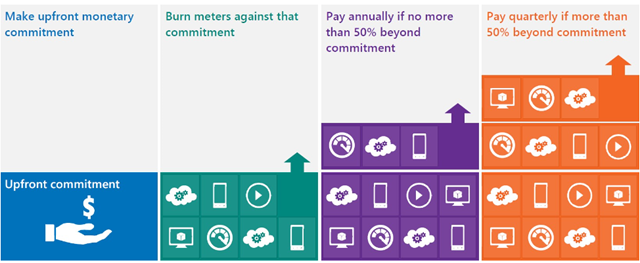
You commit upfront to a monthly amount that you feel will cover all your needs, and that monetary commitment can be utilised in any way within Azure.

image

Previously, you would receive great payment terms for your monetary commitment but – should you go over that amount (known as “overage”) – the extra usage would be charged at much higher rates. This effectively punished organizations who thought “wow, this Azure stuff is cool” – but no more, Overage is now charged at the same rates as the initial agreed amount. This makes increasing the usage of Azure a much more compelling proposition.

See Josh Waldo’s full post here:

http://www.digitalwpc.com/Community/Perspectives/Pages/Windows-Azure-added-to-Enterprise-Agreement-Use-it-to-power-your-solutions-.aspx?wt.mc_id=corp_mpn_tw_dwpc_joshwaldoazureagreement#fbid=7Lt8ur4Ygjd

Microsoft after PDC 2008


Where is Microsoft after this year’s PDC Conference?

I think Microsoft is in a very strong position-at the head of many points of the market, and hot on the heels of the leaders in others..Cloud computing, Web applications, Desktop OS, Collaboration and more..

Windows Azure & Windows 7 have had a massive amount of buzz around them, and it nearly all seems to be good! I’ve got a few colleagues in the “Anti-Vista” camp but even they are cautiously optimistic about what Win7 will bring us…I am ridiculously excited and everyone else is looking forward to it 🙂

Azure instantly puts MS in the top 3 players in the Cloud space, and I don’t think it will be long before the No.1 spot is theirs.

Office Web Apps shows that Microsoft ARE taking the web seriously and as an answer to Google, it’s a pretty good one! This will bring online apps to a whole new section of users..I don’t use Google Apps for many reasons..but I’ll definitely use Office Web…

Live Mesh was another big part of PDC 2008 and this could seriously make peoples lives easier, faster and more fulfilling…if it’s executed correctly. Mesh isn’t a huge concern for me personally (at the moment) but could be important for so many others.

All in all I think the most important thing that PDC 2008 has done is breathe new life into Microsoft, it’s partner eco-system and the end users, who let’s face it are the ones that REALLY matter! People once again believe in Microsoft, are excited by Microsoft and dare I say it, people LIKE Microsoft!!! 🙂

As Steve Clayton says, this really is Microsoft 3.0.

So hats off to Bill, Steve(s), Ray and the 1000’s of others who have helped with this and long may it continue!