Microsoft have introduced a new SKU for Education – Microsoft 365 A1 for devices. It costs $38 per device for 6 years and provide the full M365 suite of apps plus Minecraft and cloud management capabilities.
The announcement seems to be aimed at Google due to the mention of “providing more for students and educators relative to competitive offerings at the same price” but, as Mary Jo Foley points out, Google’s most expensive EDU offering is $5 per student per year. Perhaps Microsoft are banking on education establishments seeing a very high ratio of students to devices?
Microsoft have released more information about the upcoming Viva Learning via Message Center post MC287944 (that I can’t actually find in there at the moment).
Viva Learning will hit General Availability in “early November” meaning that a new pre-installed Viva Learning app will become available in Teams. A basic Viva Learning subscription will be available free of charge to Microsoft 365 users (the exact licenses are still to be confirmed) and will grant access to:
Microsoft Learn
Microsoft 365 training
125 x LinkedIn Learning courses
There will then be a Viva Learning Premium (expected to be around the $4 pupm mark) that will give features including:
Learning Management System (LMS) integration
Third-party content integration
Additional admin capabilities
and more
As more info becomes available, I’ll be sure to update you!
For more info on Microsoft Viva as a whole – check out my post here.
After all the excitement of the price increases and CSP changes during August, the actual Product Terms changes this month are minimal.
Various terms have been clarified including Online Services step-ups and Azure Virtual Desktop. Also a statement that the Glossary terms apply.
Windows Get Genuine licenses appear to have been removed.
A mid-month update saw a new version of the Data ProtectionAddendum, the “Microsoft Products and Services Data Protection Addendum” (formerly called the “Microsoft Online Services Data Protection Addendum“) published. This also means that a variety of data collection related updates were made throughout the Product Terms.
Microsoft recently announced a range of upcoming changes to CSP via their “New Commerce Experience” and it’s safe to say that it’s caused some consternation among Microsoft partners – and rightly so really.
Westcoast invited me onto their “Cloud Talk” podcast to talk through some of these changes, what they mean for partners, and what the future might look like. We also talk about the Microsoft 365 price increases.
I had a great time talking to Tom about all this and hope you find the podcast useful and interesting – we cover quite a bit in 34 minutes! Check it out on Spotify here:
Microsoft have announced the preview of “Microsoft Defender for Endpoint Plan 1”.
Microsoft Defender for Endpoint (MDfE) is the new name for “Microsoft Defender Advanced Threat Protection” (MDATP), which is the differentiator between Windows 10 E3 and E5. The existing version of MDfE will become Plan 2 and the newly introduced Plan 1 will contain a subset of features.
Microsoft’s upcoming “New Commerce Experience” (NCE) is bringing some changes to the CSP world, which will mean things are different for partners and customers.
Longer term contracts
3 year terms will be available for Microsoft 365 & Dynamics 365 on CSP – a change from the current max. of 12 months. This will enable orgs to protect against price increases over a 36 month period and makes a lot of sense, given Microsoft’s aim to move many Level A Enterprise Agreement (EA) customers to CSP from 2022 onward.
Flexibility costs money
Microsoft say that there will be “new monthly-term offers with a price premium for customers who need term and seat-count flexibility“. One very attractive feature of CSP has always been the ability to reduce/cancel license quantities at a moment’s notice without penalty…the above statement suggests that customers who still want that will have to pay for the privilege.
Customers will be able to combine short/long term licenses, which is great for industries where seasonal fluctuations bring a short term increase to the user base. This is something that was addressed in the MPSA several years ago, before it lost its mantle as the “next big thing” to CSP.
There are various other changes to help partners offer a better service to customers including:
Streamlined trial conversion
Add-ons available separately
Enhanced management capabilities
All changes hit General Availability on October 1, 2021 although some won’t be available in Brazil until February 2022.
Microsoft have announced their intention to add unlimited dial-in minutes to a wide range of Office/Microsoft 365 SKUs. Currently available with E5, the expanded range will cover:
Microsoft 365 E3/F1/F3
Office 365 E1/E3
Microsoft 365 Business Basic/Standard/Premium
Further extending Microsoft’s telephony offering to a wider range of businesses and users – which has to be a good thing right?
For those that haven’t seen, Microsoft have announced increases to the list pricing of Office/Microsoft 365 that will take effect from March 2022. The new per user per month pricing will be:
Microsoft 365 Business Basic (from $5 to $6)
Microsoft 365 Business Premium (from $20 to $22)
Office 365 E1 (from $8 to $10)
Office 365 E3 (from $20 to $23)
Office 365 E5 (from $35 to $38)
Microsoft 365 E3 (from $32 to $36)
Note, there are no prices increases for Microsoft 365 E5 or the “F” SKU products. Microsoft have stated that they “want to make it more economically transparent that E5 represents the best value” and that this increase reduces the gap between M365 E3 and E5.
While price increases are never anyone’s favourite thing, and a 25% increase for E1 is certainly pretty sizeable – my main feeling is that, actually, this isn’t the end of the world or VENDOR LOCK-IN writ large. These are the first such price increases in about a decade and I don’t think that they are unreasonable or an example of Microsoft abusing their position or their customers.
In a nutshell, Microsoft have added a LOT of stuff to O/M365 over the years and it is better than it used to be. Microsoft say they have added 24 new apps and over 1,400 new features since Microsoft 365 was introduced. These include:
Teams
Stream
Yammer
OneDrive
Visio
Microsoft also include the Power Platform apps but, as they’re relatively new and pretty limited without extra licensing, I’m not sure how much value they’re adding right now tbh.
Taking Teams as an example, it is miles ahead today of Teams on Day 1 as so many new features and capabilities have been added. I’d say that most customers have probably found an extra $2-$4 (pupm) value from the additions over the years…if you’ve started using OneDrive or Teams for example.
Product Utilisation
Often, people will say something like “no-one is using every feature in their subscription” as a “gotcha” in these cases – that’s absolutely true and will always be the case. No person or organisation will ever use every feature in everything – and they don’t have to. An organisation simply needs to use enough of a product that it adds value to their business by helping them do something new/faster/better etc.
I haven’t watched everything on Netflix and I never will, but as long as I keep watching enough each month, and they keep adding new content, that I’m getting value – that’s fine. It’s well known that product adoption can be more difficult that expected for organisations, and it often becomes more difficult the larger the user base. That said, if an organisation truly hasn’t seen an increase in value that far outstrips this price increase, a review of what they’re buying and how they introduce new software to their users is urgently required.
Setting a precedent?
All this said – if these price increases become a regular thing from Microsoft – every 1 – 3 years for example – then my tune will surely change! However, if they continue to add new apps and features and keep price increases few and far between (and at a reasonable level) – it seems fair enough to me if I’m honest.
However, doing it a month after announcing almost $70 billion annual operating income isn’t the greatest timing! While I think the principle is sound, if you can make that much money…do you really need to increase the price? Just because you can doesn’t mean you should…
For end user organisations, this is absolutely a great opportunity to review your Microsoft spend and strategy though.
Take a look at what you’re buying and compare that to what you’re using. If the gap is too big, work out what changes can be made and when, depending on your contract.
Start to define your negotiation strategy – can you work with MS to get a deeper discount to (partially) offset these price increases? Be wary however, of what you might have to commit to in order to get them…it’s likely they’ll be pushing M365 E5 pretty hard.
Get external help from partners and consultants to help you make the best decisions as quickly as possible.
We have confirmation of Windows 365 Enterprise base license requirements:
Windows 10 Enterprise
Intune
Azure AD P1
and the bundles that count too:
Microsoft 365 F3/E3/E5/A3/A5/Biz Prem/Student Use
Microsoft note that swapping a user’s Win365 license (by “resizing”) is not “license reassignment” and so can be done as frequently as required.
Also, you can’t use it for “digital asset transaction validation workloads” (aka Bitcoin mining I assume).
We also get confirmation that Windows 365 Business has no license pre-requisites (unlike Enterprise) although Windows 365 Business w/Windows Hybrid Benefit requires a Windows 10 Pro primary device (which is used periodically).
Azure Arc SQL has been added and Hybrid Benefit can be used…but prevents use on Listed Providers infrastructure.
There is a $0 license offer for Azure Virtual Desktop (until December 31, 2021) where you “serve Azure Virtual Desktop Customer Solutions to third parties on Azure”.
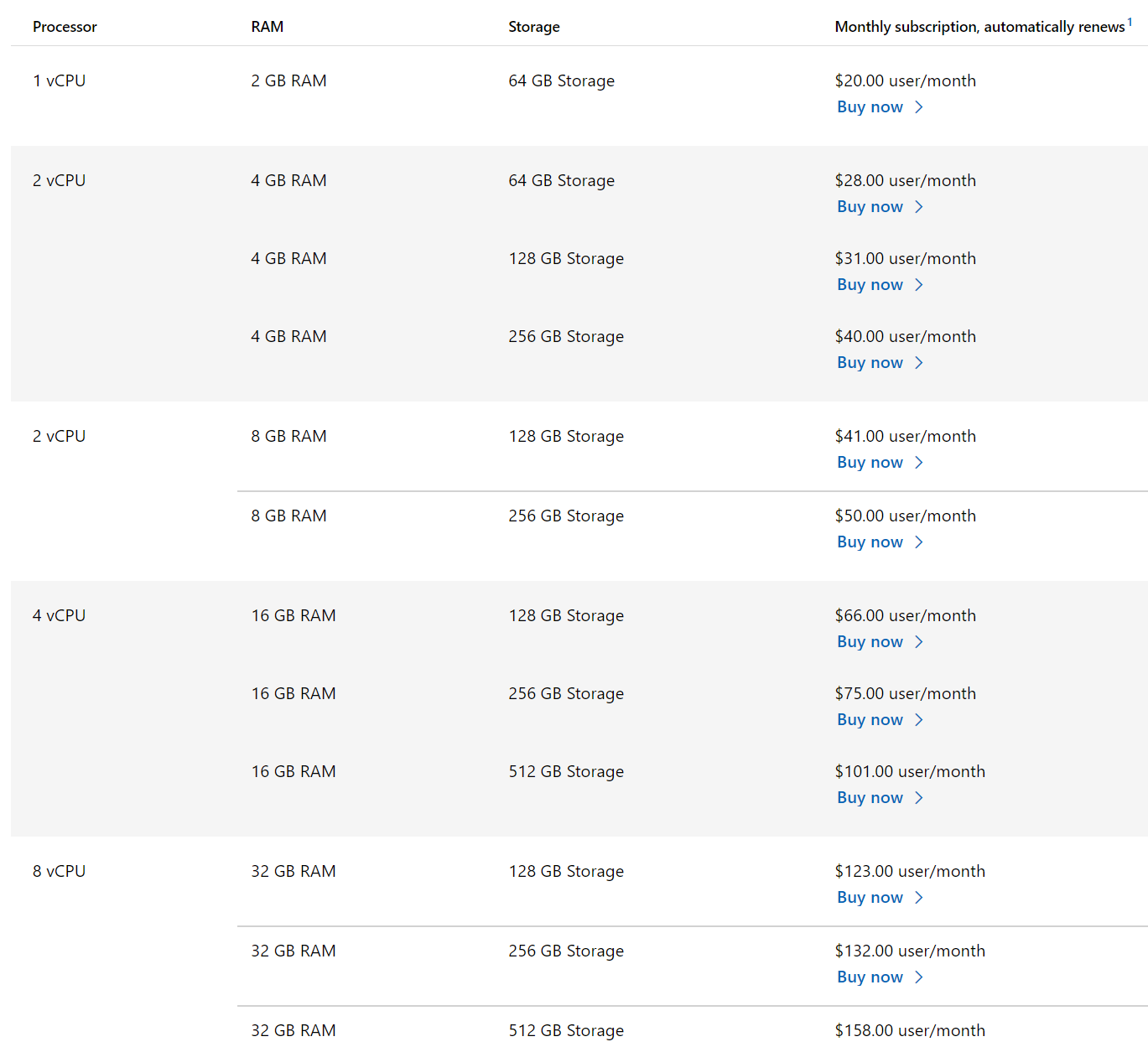
Now that Windows 365 has hit General Availability, Microsoft have also listed the public pricing online.
Pricing is per user per month and ranges from $20 to $162, the entry level giving you:
1vCPU/2GB RAM/64GB storage
and the most expensive providing:
8vCPU/32GB RAM/512GB storage
You are able to upgrade to a more powerful machine by “resizing” however, the ability to downgrade the machine is not currently available.
Microsoft also make it clear that Azure Bandwidth charges (see them here) will apply on top of any Windows 365 Enterprise charges. For the Business version, there is a monthly per user outbound data cap that ranges from 12GB to 70GB, depending on your plan.
Furthermore, Windows 365 Enterprise requires license pre-requisites including:
Windows 10/11 Enterprise
Intune
Azure AD P1
but Windows 365 Business has no such requirements – it is a standalone offering.
Windows 365 also introduces a new term “Windows Hybrid Benefit” (not to be confused with “Azure Hybrid Benefit”).
Windows Hybrid Benefit (WHB)
Applicable to Windows 365 Business (the sub-300 license offering), this gives a discount of up to 16% for users who are the primary user of a Windows 10 Pro device – that is also their primary work device. Said device must be accessed at least once during the license subscription term.
Here’s a screenshot of the full range of pricing for Windows 365 Business. Although WHB says it can save up to 16%, you can see below that all the WHB prices are simply $4 per user per month cheaper.












 Cloudy with a chance of Licensing