Microsoft Enterprise Agreement: Updated for the Cloud


Microsoft’s top level licensing model, the Enterprise Agreement, has recently been overhauled to make it more cloud friendly…which is a good thing for organisations looking to adopt this new model now, or in the future.

What is an Enterprise Agreement?

The Enterprise Agreement (EA) is Microsoft’s highest level model, for companies of 250 seats and above. It requires an Enterprise Wide (EW) licensing commitment, includes Software Assurance (SA) on all licences and offers the best discounts.

The common way for an organization to licence under the EA is with the “Professional Desktop”, comprised of:

  • Windows OS
  • Office Pro Plus
  • Core CAL

The Core CAL itself is a bundle, comprised of:

  • Windows Server CAL
  • Exchange Server CAL
  • Sharepoint Server CAL
  • SCCM Client ML

With the exception of Windows Server & SCCM, all these products are now available online via Office 365 and Intune.

If a company with an existing EA wanted to take advantage of these products, they would be on top of their existing Professional Desktop licences, as they are required to maintain the Enterprise Wide commitment. This would mean double licensing, not an effective use of budget and of course, not the way customers want to do things.

So in a very quick move, Microsoft have produced an amendment to their Enterprise Agreement terms making it possible for organizations to “mix & match” between online & onsite licensing.

Product LineUp

Windows OS –> Windows Intune

Office –> Office 365 E3 or E4

Core CAL –> Core Bridge

Enterprise CAL –> ECAL Bridge

What’s a Bridge CAL?

Bridge CALs are a new licensing item that bridge the gap between the CAL suites and their closest online relatives.

For the Core CAL offering, the bridge CAL covers the organization for:

  • Windows Server CALs
  • SCCM Client MLs

thus completing the Enterprise Wide commitment, without duplicating any functionality and keeping them compliant with the contract terms.

Example

The following diagram gives a good example of how the online and onsite licensing models can co-exist within an organization.

image

There are certain differences when it comes to the Software Assurance benefits available with Online products too, for example:

Windows Intune does NOT give

  • Training Vouchers
  • TechNet Subscriptions

There are a variety of different combinations possible when it comes to these licensing scenarios, some more complex than others! I have left out a fair amount of information from this post as I don’t want to cause confusion, however if you have a specific scenario I would be more than happy to help Smile

It’s great to see Microsoft making such changes as this and at such a good speed. Many people criticised Microsoft for taking too long to update their licensing models to accommodate the changes brought about by Virtualisation and, while that may be true, Redmond are definitely ahead of the curve this time!

Microsoft Cloud Mobility Licensing Changes


Microsoft are making a big push with their hosted application offerings (BPOS & Office 365) but are also aware that many customers and partners base their businesses on 3rd party hosted solutions. In an effort to make that easier and more cost effective, the Redmond based company recently announced some changes to their licensing rule, referred to as “Licence Mobility”.

Essentially, these changes will allow customer organizations to deploy their licences in-house or hosted in a 3rd party datacenter. Not all products are covered with these changes, in fact, here are the products that are:

  • SQL Server
  • Exchange Server
  • Sharepoint Server
  • Lync Server
  • System Center Servers (note the plural – this seems to be any and all SC products)
  • Dynamics CRM

If these products are licensed with Software Assurance they

“can be run in service providers’ datacenters on shared hardware for that customer’s dedicated use”

Products that are NOT included are:

  • Windows Server Operating Systems
  • Windows Client Operating Systems
  • Desktop Applications
  • Developer Tools

Other Changes

Also, Microsoft are expanding the Subscriber Access Licences (SALs) for SA SKUs to cover Enterprise licences for

  • Exchange
  • Lync
  • Sharepoint

For more information, see here:

http://www.microsoft.com/licensing/about-licensing/value-of-volume-licensing.aspx#tab=4

Microsoft Exchange Online & Blackberry


Microsoft BPOS, the online versions of Exchange, Sharepoint et al has offered a Hosted Blackberry service for around 12 months now and it’s been pretty popular. The vast majority of organizations that use Exchange also use RIM’s Blackberry’s so offering them a way to push that off to the cloud certainly made the adoption of Exchange Online an even easier deal to sell. It was a pretty cost effective solution too, at £6/$10 per user per month.

As BPOS is soon transitioning to Office 365, with new versions of the MS software available in the cloud, there is also a change happening to the Blackberry service…well actually two changes.

1) The service will move over to be hosted, managed & supported by RIM.

2) The monthly cost is changing to £0/$0

That’s right, the service is going to become a free value add from Microsoft and not only that, it will be better than the current offering! From an email Microsoft sent to customers and partners this morning:

“administrators will be able to create and manage more device policies, change device passwords and settings, and search across large numbers of BlackBerry users at one time.”

The monthly cost is also changing for current customers right now, enabling them to take advantage of the zero cost straight away. This is a significant cost saving for companies, as an example – an organization with 150 Blackberry users would look like this:

£6 x 12 months x 150 users = £10,800 per annum

This move from Microsoft instantly saves almost £11,000 a year in the example above, and 150 BB users isn’t a particularly large installation either. Companies could/should use that money to invest in other areas of infrastructure…they could add Sharepoint Online for those users and still have nearly a 50% saving!

Current Customers

Current Blackberry Online subscriptions are being terminated on June 30, 2011 so if you’re currently using the Blackberry Online Service, there are steps that must be taken to ensure continuous service.

  1. Log in to Microsoft Online: Go to the Microsoft Online Customer Portal and log into your Microsoft Online account.
  2. Locate the Hosted BlackBerry service offer: Click Manage Subscription, choose an active BPOS or Exchange Online subscription*, select Buy Hosted BlackBerry from the Actions dropdown, and click Go.
    * This can be the same BPOS or Exchange Online subscription with which Hosted Blackberry was last purchased.
  3. Checkout: In the Shopping Cart, enter your total required number of Hosted BlackBerry seats** and accept the Hosted Blackberry Service Terms of Use (checkbox). Click Update, then click Checkout. The new $0/user/month pricing for all of your current seats for the Hosted BlackBerry service takes effect at new agreement signature. All users under the old terms of use are now covered by the new terms of use regardless of the user count entered.
    ** At a minimum, customers should enter the number of Hosted BlackBerry licenses in use today across all existing Hosted BlackBerry subscriptions. This number is visible in the Hosted BlackBerry Administration Console which is a part of the Microsoft Online Administration Portal.
  4. Cancel the old subscription(s): To cancel your previous subscriptions and avoid being billed for the Hosted BlackBerry service as of your next billing cycle, you must cancel any previously existing subscriptions through a Service Request, either by phone or through the service request form in your Microsoft Online Administration Console (MOAC). Service use will continue uninterrupted after cancelling the old subscriptions.

Bad News

The good news is that organizations can save £1000’s per year but there is some bad news. Unfortunately, RIM aren’t going to have the new platform ready for the General Availability (GA) of Microsoft Office 365; it will be “beginning in late 2011” according to Microsoft.

We’ve been told that companies on Office 365 will be unable to use Hosted Blackberry until the RIM platform is complete, so perhaps some 6 months after Office 365 becomes available. I am yet to get 100% clarification on this point but it appears this means that existing BPOS & Hosted Blackberry users must choose:

Stay on the BPOS platform with Hosted Blackberry for a further 6 months

or

Move to the new Office 365 platform and lose Hosted Blackberry for around 6 months

Not an ideal situation for anyone so I am looking to get more clarification around this ASAP and will update here. My hope is that although they are terminating subscriptions, Microsoft will keep their platform running for existing customers until such time that RIM get their act together…

Windows InTune V2


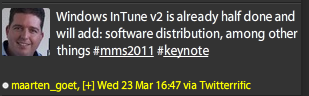
Windows Intune was released to General Availability (GA) today on March 23rd 2011 but already the next version is being worked on, at least according to Twitter.

image

I haven’t seen anyone else mention this but Maarten is a SCOM MVP and the hashtags indicate this came directly from today’s MMS2011 keynote speech, so I think it’s safe to believe it Smile Plus it is in no way unusual for Microsoft to be working on the next version of a product before they’ve even released the first edition…

If Windows Intune V2 does include Software Distribution, that will be pretty amazing. That will enable IT departments/Managed Service Providers (MSP’s) to deploy new software to users from a remote location via the web. Although it will of course be limited by internet bandwidth between the 2 points, this will make so many things so much easier for so many people! That could well be the point that sees InTune take hold in larger organizations…

Microsoft MDOP features and licensing changes


The Microsoft Management Summit has brought more great changes, this time involving MDOP.

The Microsoft Desktop Optimization Pack is a great set of additional tools aimed at making desktop management easier,faster and more dynamic – for more info, see this post:

https://richardgibbonsuk.wordpress.com/2009/09/05/microsoft-mdop/

MDOP 2011 will see both new products, feature enhancements and a change to the way the product is licensed.

Products:

Microsoft recently announced the “Microsoft Bitlocker Administration & Monitoring” tool aka MBAM (codename Malta), which makes the management of Bitlocker devices much easier across an organization; a big one being self-service recovery of keys…I’m sure many IT dept’s will be happy to lose that job!

This will be included in MDOP 2011 and the beta is available on Microsoft Connect here:

https://connect.microsoft.com/site1115/Downloads

Features:

DaRT – Diagnostics & Recovery Toolkit – is getting a new version with at least one new feature; the ability to do an offline remote boot, rather than needing to visit the physical machine. Again, another great time saver for some IT teams!

If you’re interested in this, the beta nomination form can be found here:

https://connect.microsoft.com/site1200/Survey/NominationSurvey.aspx?SurveyID=12358&ProgramID=6840

Licensing Availability:

Previously the only way to purchase MDOP was as an addition to having Windows 7 with Software Assurance (SA) but now it is also available to companies who have either the Virtual Desktop Access (VDA) licence or Windows InTune.

Thanks to Bridget Botelho for her article over at:

http://searchenterprisedesktop.techtarget.com/news/2240033610/Microsoft-sweetens-MDOP-deal-and-releases-Intune

Microsoft make changes to Core CAL Licensing


Microsoft Management Summit (MMS) 2011 is bringing announcement of a number of things such as new versions of System Center products, deeper integration between Microsoft products and, also Licensing.

Most Microsoft server products require a CAL (Client Access Licence) for each User/Device accessing the server software. To help reduce cost and licensing complexity, Microsoft offer 2 bundles that contain a number of these CALs: dsd

Core CAL

Enterprise CAL

The different products contained within have been, for some time:

clip_image002

but not any more!

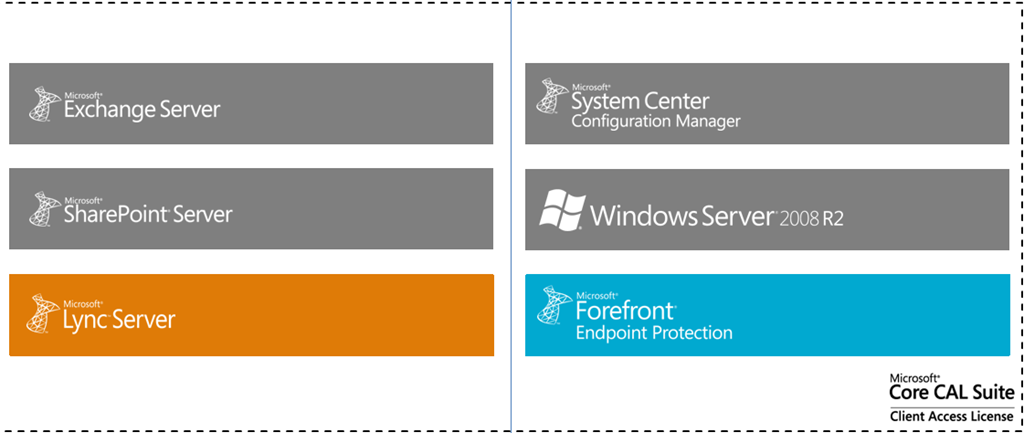
Core CAL will now include:

Lync Std CAL

Forefront Endpoint Protection

Notice that it is only “Forefront Endpoint Protection” that is being added to the Core CAL, if organizations require the other parts of the suite, they will still need to look at the Enterprise CAL.

image

Core CAL for the future

image

That is what the updated Core CAL will look like and these changes are going to take effect from the August 2011 price file. This will also see a slight increase in the price of the Core CAL, due to it’s increased product range.

Why do this?

The way people and companies use technology is changing, particularly there is a rapid increase in the use of Instant Messaging & Presence within organisations. Gartner say:

“By 2013, 95% of workers in Global 100 organizations will use the IM client as their primary interface for computer-based, real-time communications”

Microsoft are making it easier and more cost effective for organizations of ALL sizes to embrace these new technologies and reap the benefits they bring.

These changes are now reflected on the Microsoft site here:

http://www.microsoft.com/calsuites/en/us/products/default.aspx

Microsoft EES–Missing Licences


For all you schools out there looking to enroll into Microsoft’s new academic licensing program, EES (technically OVS-ES), I’ve just come across a small hiccup.

Remote Desktop Service (RDS) CALs, the new version of Terminal Service CALs, are missing from the price file, so resellers can’t give you a price for them. I’ve been told that they will appear in the May price file but that still leaves a 2 month window.

We’ve got customers who need to renew their agreements, which contain RDS CAL, before May so I’ve asked Microsoft what the official line is and will update ASAP.

Cheers

Rich

Microsoft SBS 2011 Licensing Changes


Microsoft have now released the new version of Small Business Server, SBS 2011 and as well as product improvements, they’ve also made some changes to the licensing.

In SBS 2008, you chose either SBS Standard OR SBS Premium and then purchased Standard CALs AND Premium CALs (for those users accessing the extra features).

However, with SBS 2011 even the server licences have a layered licensing model. This means you purchase:

  • SBS 2011 Std

and then, if you need the Premium functionality of a 2nd Windows Server and SQL, you must purchase ON TOP of the standard licence:

  • SBS 2011 Premium Add-on.

This is quite a change and one which was not communicated very well at all.

image

They have also introduced a new edition:

  • SBS 2011 Essentials

“a new, easy-to-use, first-server solution designed and priced especially for small businesses (up to 25 users) that can seamlessly integrate into online services such as Office 365, cloud backup and cloud management solutions. It is expected to release in the first half of 2011. “

Users don’t need CALs for the Essentials edition but it is hard locked at a maximum of 25 users.

Halo Reach “Noble” Map Pack


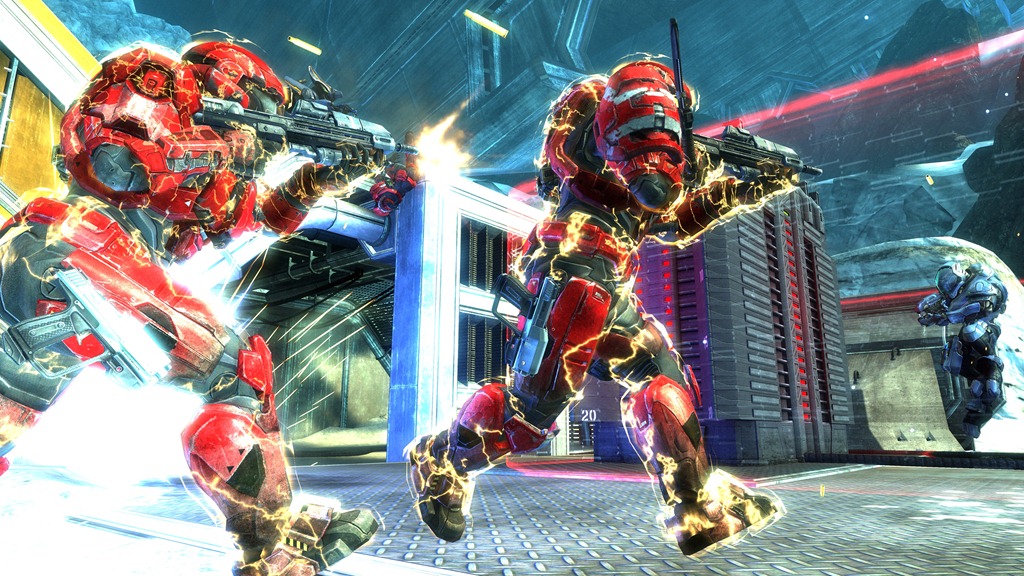
Halo Reach, Microsoft’s super successful final instalment in the Halo series has a new map pack. – Noble.

From the 30th of November, 800 Microsoft points will get you:

  • 7 new achievements, worth a total of 250 gamer score points
  • 3 new multiplayer environments

What are these new worlds? Find out below…

Tempest

Though we may never fully understand these devices, it is not our nature to leave ancient stones unturned.”

This abandoned shoreline facility bends both sea and sky to an unnatural purpose, but the ground itself has quickly become another all too familiar battlefield. Though the two opposing symmetrical bases may never reveal their ancient purpose, both now offer makeshift shelter and access to strategic routes perfectly suited for small and large scale skirmishes alike. Tempest supports 8 – 16 players and offers a variety of modes including Free for All, Team Slayer, Team Objective and Big Team Battle. Tempest also provides players with a huge Forge palette, allowing them to create new custom map variants that can be shared with the community-at-large.

Tempest_001

Anchor 9

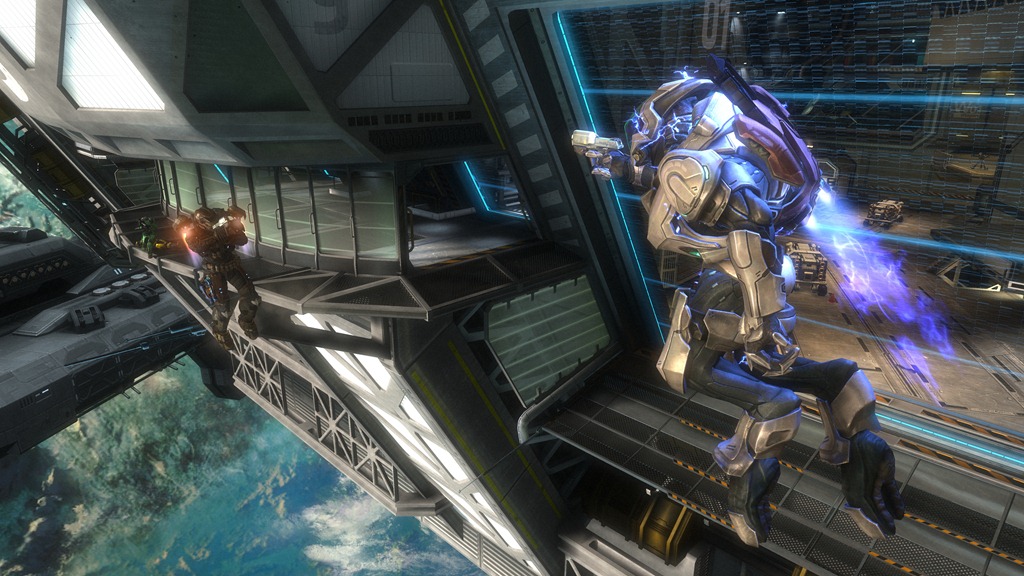
“Orbital dockyards provide rapid refuelling and repairs for a variety of UNSC vessels.”

Within the confines of this low orbit dry-dock, UNSC craft undergo rapid repair and rearmament in support of the enduring war effort.  But for the small squads of infantry who now fight over the mirrored interior hallways and open central hangar bay, this platform no longer provides any safe harbour – whether the close quarters combat is occurring inside or out of its artificial gravitational field. Anchor 9 allows 2-8 players to face off in game variants including Free for All, Team Slayer and Team Objective.

Anchor9_003

Breakpoint

“ONI officials believe the data buried within this artefact is key to our survival.”

Atop this icy precipice, the Invasion continues. These modular archaeological labs were never intended to withstand such a large scale onslaught of Covenant military power, but the information being extracted here may prove vital to humanity’s survival. In response to the imminent Covenant threat, UNSC ground and air assets have been deployed to bolster entrenched Spartan countermeasures. This dig site must yield salvation, or it will become a grave. Breakpoint offers multiplayer mayhem for 8-16 players, and supports the Invasion and Big Team Battle game variants.

Breakpoint_003

Kinect surpasses 2.5 million sold


Microsoft’s Xbox Kinect has sold more than 2.5 million units in just 26 days!

Don Mattrick, President of the Interactive Entertainment Business said:

“We are thrilled about the consumer response to Kinect, and are working hard with our retail and manufacturing partners to expedite production and shipments of Kinect to restock shelves as fast as possible to keep up with demand. With sales already exceeding two and a half million units in just 26 days, we are on pace to reach our forecast of 5 million units sold to consumers this Christmas”

Kinect is now available at over 60,000 retailers in over 38 countries…well poised to break the 5 million mark!