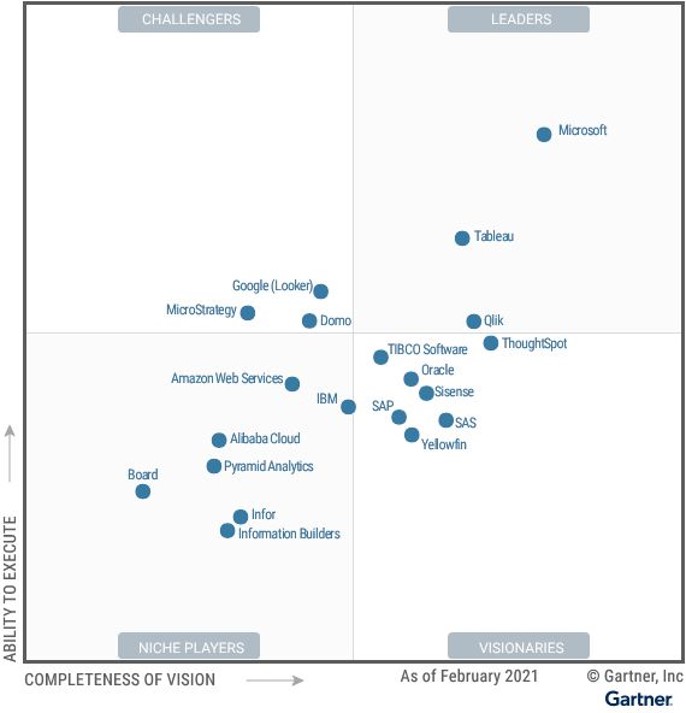
Microsoft financial results: Q2 FY21


Microsoft have, once again, had a stellar quarter (Oct-Dec 20) with overall results of:

  • Revenue up 17% to $43.1 billion
  • Operating income up 29% to $17.9 billion

Looking deeper into specific product categories and areas we can see:

Productivity and Business Processes

Revenue was up 13% to $13.4 billion which included:

  • Office 365 Commercial up 21%
  • Dynamics 365 up 39%
  • LinkedIn up 23%

Intelligent Cloud

Revenue was up 23% to $14.6 billion and Azure was revenue growth of 50%

More Personal Computing

The “other” parts of Microsoft’s business all saw success to with revenue up 14% to $15.1 billion. This included:

  • Windows Commercial up 10%
  • Xbox up 40%
  • Surface up 3%

Microsoft’s results are very consistent and are outperforming pretty much every comparable competitor you can think of…Oracle, SAP, and IBM are very far away from numbers like these! Amazon are still seeing great success with AWS – currently rising around 28% – but that is a greatly limited portfolio when compared to that under Satya Nadella’s control.

There are several areas of Microsoft’s product line-up which are at the very start of their evolution and will grow and continue these results for the foreseeable future.

See the full info from Microsoft here.

Microsoft Product Terms, February 2021


Photo by Markus Winkler on Pexels.com

Microsoft have stopped producing the standalone Product Terms document and have officially launched the Product Terms website as a replacement.

I’ve been a big fan of the Product Terms document for a long time and I’m not 100% happy about this change tbh! The ability to filter the site by program (EA, MPSA etc.) and product (M365, SQL etc.) will probably make it less confusing for many people – showing only the info that’s relevant to their search.

However, being able to see everything altogether was great for spotting any changes, missing bits etc. that Microsoft hadn’t highlighted and that isn’t as easy on the new site.

My initial concern was that not having a point in time downloadable copy would put customers and partners at a disadvantage, giving them nothing to reference in future conversations. However, having played with the site a little bit it turns out you can download a document from the site. It’s quite similar to the previous document although you have to filter by program, so you don’t get a document that allows comparison across the different licensing options.

The changes in February 2021 are:

  • Addition of Microsoft 365 F5 SKUs (more info here)
  • Planning Services & Training Vouchers SA Benefits have been removed
  • The free Audio Conferencing promos for EA/EES/CSP have been extended to June 30, 2021
  • Clarification that the Microsoft 365 E3/A3 Unattended license doesn’t require a Qualifying Operating System
  • Updates to terms for Azure Maps and Cognitive Services

Microsoft 365 F5 licenses


Starting February 2021, Microsoft have introduced 3 new “frontline” SKUs:

  • Microsoft 365 F5 Security ($8)
  • Microsoft 365 F5 Compliance ($8)
  • Microsoft 365 F5 Security & Compliance($13)

These are available as add-ons to the existing Microsoft 365 F1 and F3 SKUs and include “the majority of capabilities” from the E5 versions.

The Microsoft announcement is here: https://www.microsoft.com/en-us/licensing/news/new_f5_security_and_compliance_offer_for_frontline_workers

Microsoft 365 Security & Compliance additions


Image by Ryan McGuire from Pixabay

It seems Microsoft will be adding some new security and compliance SKUS in February 2021. According to a post from Bytes, a top UK Microsoft partner and LSP, we will soon be able to purchase:

Premium Compliance Assessments

There will be a range of over 150 assessments available which can be added to any Office 365 E5 or Microsoft 365 E5 plan, at a cost of $2,500 per assessments per month.

10-year audit log retention to Advanced Audit

This will enable organisations to retain audit logs for up to 10 years and can be added to:

  • Microsoft 365 E5
  • Microsoft 365 E5 Compliance
  • Microsoft 365 E5 eDiscovery & Audit
  • Office 365 E5

for $2 per user per month.

Data Connectors to E5

This looks like it will extend Microsoft 365 security and compliance capabilities to 3rd party services such as Slack and Zoom. It can be added to any Office 365 E5 or Microsoft 365 E5 plan and will cost $400 per 500GB of data.

Conclusion

The Data Connectors are, I think, the most interesting. Back in November 2019, Microsoft launched a preview of Azure Arc, which enables organisations to run Azure technologies and policies across other clouds such as Amazon AWS, and this new addition is the same thought process. The first time we saw this was when Satya Nadella opened up Office across Apple and Android – making Office available on those devices enables Microsoft to sell more Office 365 AND reach new customers…customers who may eventually purchase other Microsoft services.

While Microsoft would love everyone in every organisation to use Microsoft Teams, they’re pragmatic enough to realise that will never happen – their competitors’ products will always exist…so why not make some money out of it? 500GB of data isn’t much so that $400 a month will quickly start to become a pretty big number of organisations! It also helps Microsoft retain relationships with these organisations, ensuring they stay updated on respective changes and have reasons to talk – giving the chance for future sales…

I’ll keep an eye for more information and, hopefully, an entry in the February 2021 Product Terms.

Microsoft Product Terms: January 2021


Photo by Markus Winkler on Pexels.com

A very quiet start to 2021 from Microsoft:

  • No products have been added or removed
  • They’ve added a new column to show which perpetual software products are available via CSP
  • Details of the license pre-requisites for Workplace Analytics have been added on page 73

Microsoft Azure Purview


Image by Gerd Altmann from Pixabay

The latest Azure offering, Purview, is a “unified data governance” service to help organisations manage data across their ever expanding environments – including on-premises, IaaS multi-cloud (Azure, AWS etc.) and also SaaS services. According to Microsoft, Azure Purview will offer automated discovery and classification of data, a map of where it all resides and how it relates to each other, easy searching to locate data, and an overview of how data moves across your organisation.

Given the increasing amounts of data we all create and collect, combined with the rising threat of cyber attacks – at a personal, corporate, and national level – this is a welcome introduction.

Pricing

Azure Purview is (almost) free to try until February 28, 2021 but we can already see an overview of how it will be priced going forward.

First of all, you need to provision the “Data Map” – this is priced based on 2 things…Capacity Units and metadata storage.

Capacity Units

This is a set of resources provisioned in order to keep your Data Map up and running. One Capacity Unit can support “approx. 1 API call per second” and is currently priced at $0.342 per hour.

Metadata storage

This stores the metadata associated with the scanned assets which enables the searching capabilities within Purview. Microsoft talk about this being in a “graph” format – so this appears to be another element of the “Microsoft Graph” being surfaced as part of a product. Pricing is yet to be announced but will be on a per GB basis…I can well imagine many organisations finding themselves with a HUGE amount of this metadata storage!

Scanning

When it comes to scanning your environment, this is charged at $0.63 per “v-core hour” that you consume whilst actively scanning. Microsoft state there will be no “incremental charges” for connectors to 3rd party datastores.

Almost regardless of cost, I think many organisations will find it hard not to use this service – given the worries, risks, and potential fines that data mismanagement can bring. Microsoft have made another strong move to position themselves as an integral part of the future of business. Even if everyone stopped using Windows and Office tomorrow, Azure Purview (and other new services) would keep Microsoft at the forefront of many an organisation’s mind for years to come.

Further Reading

Azure Purview page

Azure Purview pricing

Microsoft Product Terms: December 2020


Photo by Markus Winkler on Pexels.com

As you’d expect, it’s a quiet month.

Microsoft 365 Business Voice, the SMB cloud telephony package, is added. Available via CSP and requires Microsoft 365 Business Basic/Business Standard/Business Premium.

The various name changes (ATP = Defender etc.) have (finally) been updated.

2 x Power Apps promotions that could be quite interesting have been added:

“Power Apps per App” promo = Available to new/existing EA/EAS/CSP customers & has a minimum purchase of 200.

“Power Apps per User” promo = Available to new/existing EA or EAS (not CSP) customers & has a minimum purchase of 5,000.

Microsoft Product Terms, November 2020


Photo by Markus Winkler on Pexels.com

Just 2 product additions this month:

Microsoft Cloud Healthcare Add-on:
This can be added onto M365 E3/E5, Power Apps/Automate/BI, or a range of D365 licenses

GitHub Enterprise Æ <– ðŸ‘€ Not sure if this is the actual name or a typo! As a couple of people have pointed out, it’s got a bit of an Elon Musk vibe 😂

Couple of promotions added too…

Free Audio Conferencing licenses for EA, EAS, and EES customers:
You need to have a paid sub with Teams.
Requires min. 20% Teams adoption within 6 months
Not available in China or India

Free audio conferencing for CSP & Web direct:
Free (up to) 12 months licenses are available via the admin portal, not in China or India.

Microsoft Office & Exchange 2010- end of support


Image by Gerd Altmann from Pixabay

3 more Microsoft products fell out of support on October 13, 2020:

  • Office 2010
  • Office 2016 for Mac
  • Exchange Server 2010

If you’re on these older versions, upgrading should certainly be on your roadmap. If not to Office 365, then to a more recent on-premises release. As corporate security becomes an ever greater focus, and ransomware becomes an ever greater threat, now is not the time to be running unsupported software that’s over a decade old!

The changes for access to Office 365 have kicked in too, meaning the only releases of Office that are supported to access Office 365 are:

  • Office 2016
  • Office 2019
  • Microsoft 365 Apps (formerly Office365 Pro Plus)

While Microsoft aren’t proactively blocking older versions, they’ve stated that as they fall further behind, performance and/or reliability issues may start to occur.

Further Reading

Office 2010

Exchange 2010

Microsoft Financial Results: Q1 FY21


Image by Gerd Altmann from Pixabay

As I think most of us expected, Microsoft’s strong financial results continued in Q1 FY21.

Headline figures

In July – September 2020, Microsoft saw:

  • Revenue up 12% to $37.2 billion
  • Operating Income up 25% to $15.9 billion
  • Net Income up 30% to $13.9 billion
  • Operating Expenses grew by 10% (primarily driven by investments in Azure)

This is a fantastic performance as Microsoft – unlike many of their rivals – continue to grow and thrive during the COVID-19 pandemic. While IBM, Oracle, and SAP are all reporting lacklustre numbers – Microsoft are doing very well. This is mainly due to Microsoft’s wide and varied portfolio – if you don’t want one thing, there are plenty of others they can sell you – but also due to the relevance of their product line-up.

Not only are Microsoft 365 and Azure hugely relevant right now, so are products like the Power Platform and Dynamics 365 as they enable new ways of working and digital transformation. This is a strength many of their competitors don’t have – if you don’t want to buy a big database or an ERP system, that dramatically reduces the options for Oracle & SAP for example.

Product Highlights

  • Office 365 commercial revenue was up 21%
  • Dynamics 365 again grew by 38%
  • Azure saw another quarter of 48% growth
  • LinkedIn was up 16%
  • Surface revenue rose 37%
  • Enterprise Mobility & Security install base has grown to 152 million+ seats

On the flip side – Office Commercial was down 30% showing the move away from on-premises perpetual to cloud-based subscriptions continues apace.

Microsoft also called out “continued weakness” in transactional licensing as they saw a 1% drop in “server products” revenue. To be honest, I’m surprised it isn’t a bigger drop than that…

Another drop in Windows Pro OEM sales (22%) while Windows non-Pro OEM grew by 31%. This will partly be due to organisations de-prioritising laptop refreshes right now but also, I suspect, by users working from home buying themselves new “work” devices. That latter aspect opens up some licensing issues – as volume licensing Windows licenses generally can’t be applied to Windows Home licenses.

Microsoft are in a very strong position and it’s further proof that Satya Nadella has overseen one of the greatest corporate turnarounds for a long time!

Further Reading

https://www.microsoft.com/en-us/Investor/earnings/FY-2021-Q1/press-release-webcast