Microsoft and TikTok – really?


https://pixabay.com/photos/tiktok-social-media-app-tik-tok-5323005/

This whole Microsoft buying TikTok thing strikes me as very strange…I don’t see that it would be successful for anyone involved. The rumoured price tag of $30 – $50 billion means it’s not something you can take a punt on – even with Microsoft’s revenues and profits, that’s not a trifling sum of money!

Xbox aside, Microsoft don’t have a great track record when it comes to consumer products – Skype brand recognition seems to have dropped off massively since MS’s acquisition, Windows Phone (as awesome as it was!) never properly made it, and earlier in 2020, Microsoft shuttered “Mixer” – their game streaming platform – less than 4 years after acquiring it.

While it’s fair to say that Microsoft are now (again) considered a “cool” company, that’s a relative statement…being “cool” to 30+ year old people in tech roles who use LinkedIn is not the same as being “cool” to teenagers!

Any attempts to “Microsoft-ize” the platform would surely be the beginning of the end of TikTok’s success – causing the big users (and thus their millions of followers) to migrate to the next platform (i.e. Triller) and reducing the available data…which may be the focus of the purchase. Even if they let it run as a totally separate entity, I can’t help but wonder if just the fact it’s owned by Microsoft would be enough to put the core users off?!

Distractions

Another problem with this purchase would be the distraction it causes. Microsoft have done a great job under Satya Nadella of becoming a “true” Enterprise company – very focused on business, their customers, their goals, and their roadmap. Bringing TikTok into the organisation will distract pretty much every aspect of Microsoft:

Leadership – potentially opening them up to a whole world of scandals and issues around content, censorship, election interference, cyber-bullying, data breaches and more. Things which surely Microsoft would rather stay clear of?

Staff with new colleagues and new (or unclear) corporate strategy. Will they be side-lined for this new consumer focus? Will this affect their career path or budgets or bonuses etc.?

Customers – what does this mean for Microsoft’s strategy going forward? I’m sure some execs will start to wonder if it’s a good idea to bet their 10-year cloud strategy on the company that owns TikTok – are they the fully committed enterprise partner they want and need? Will they try and merge TikTok with Microsoft 365 and/or Dynamics 365?

I also think it will give so much ammunition to competitors like Amazon, Google, Oracle, Salesforce. They’ll be able to market to customers playing on the change in Microsoft’s direction, their lack of focus on business needs and enterprise customers, and the idea of having TikTok videos within business communications.

While data is massively important these days, and Microsoft will clearly have one eye on the future of tech and the company itself, I’m of the opinion that buying TikTok would be a mistake. Yes, they’d have access to many many millions of consumers…but would Microsoft really be able to make much use of them? I can’t see that direct advertising would work at all so one has to assume it’s more about data mining a la Facebook – I’d suggest that staying away from being tarred with that brush would serve Microsoft well in the long run.

Other options

Walmart have thrown their hat in the ring and are apparently looking to team up with Microsoft to purchase TikTok. This makes more sense than a solo Microsoft bid – US grocery retailers have been some of the leaders when it comes to mining and using consumer data with targeted vouchers/offers etc. This would give them a huge amount of extra data…for a new generation of consumers who, to a large degree, buy different things in different ways for different reasons than the generations before them.

Reports say that Walmart were already working with SoftBank to put a deal together but the US government pushed back due to a lack of cloud technology – hence the move to join with Microsoft.

Alternatively, Oracle are apparently also in the running to acquire TikTok. As much as I can’t really see it fitting into Microsoft, I definitely don’t see it fitting into Oracle. Again, I’m sure it comes down to access to data but I’m also sure that Oracle’s involvement would kill it even faster than Microsoft!

Who will eventually win out is unclear at the minute. The Trump administration has been oddly involved in this whole thing – in fact, they’re the reason it’s even happening – and that may influence the eventual new owner. Oracle have close relations with Trump – Safra Catz was on his transition team back in 2016 while Larry Ellison hosted (but didn’t attend) a fundraiser for Trump earlier in 2020.

The impact of Coronavirus on Microsoft Azure


Photo by Lukas on Pexels.com

There have been reports recently that some users in certain regions were hitting capacity limits in Microsoft Azure when trying to create new resources. Microsoft have shared some information around the impact the coronavirus epidemic is having on their cloud infrastructure:

  • 775% increase in cloud services (in regions performing lockdown)
  • Teams up to 44 million daily users, running over 900 million minutes of meetings and calls each day
  • Windows Virtual Desktop (WVD) usage increased 3x
  • 42% increase in government use of Power BI for sharing COVID-19 dashboards

Some of these numbers are pretty mind-blowing and one can see how they might catch a cloud vendor by surprise.

Cloud Datacentre provisioning

Microsoft say they will be adding “significant new capacity” over the coming weeks to help support this increased use.

Something I’m sure Microsoft have considered is how much of this extra usage will continue?. What happens as things start to return to normal and some of this usage starts to drop off? They’ll be left with more unused capacity than their models anticipated – might this lead to them raising prices on certain Azure services in the future?

Prioritising certain services

Microsoft have detailed that they’re focusing the “highest level of monitoring” on services related to emergency services, medical supply management, healthbots, and more.

They have also introduced some temporary restrictions to help ease the load – free offers are being limited, to keep capacity available for “existing customers”, and certain resources are being “soft” limited for new subscriptions. Customers can raise support tickets to raise these soft limits, but Microsoft do say that other geographical regions may need to be used to help manage demand.

Teams changes

Microsoft have made a number of small changes to Teams in an effort to reduce bandwidth. They scaled back how often it checks for people’s “presence” (whether they’re online or not), reduced the video resolution, limited how quickly it shows if the other user is typing, and made OneNote within Teams read-only for non-education tenants. All small changes that won’t really impact users but, collectively, must make quite a difference to the bandwidth being used.

Further Reading

Microsoft update on cloud services continuity

Microsoft 365 changes in March


Photo by Nothing Ahead on Pexels.com

Microsoft have announced a few big changes in March 2020 around:

Microsoft 365 F1 & F3 – a new SKU and a name change

Per-device licensing for Office 365 ProPlus

Name changes to certain Office 365 products

I’ve gone into detail on all 3 here – https://www.itassetmanagement.net/2020/03/31/microsoft-365-changes-march-2020/

Microsoft retire on-premises server certifications


Microsoft have been on a cloud push for 12 years now, since the launch of BPOS in 2008. They’ve been slowly “turning the ship” in various ways over the last decade, with the ultimate aim that as much of Microsoft is pointing at the cloud as possible. This is also a case of “trickle down (cloud) economics” – Microsoft are making their new direction reflect as much as possible within their partner base…and that change will then happen within Microsoft’s customers too.

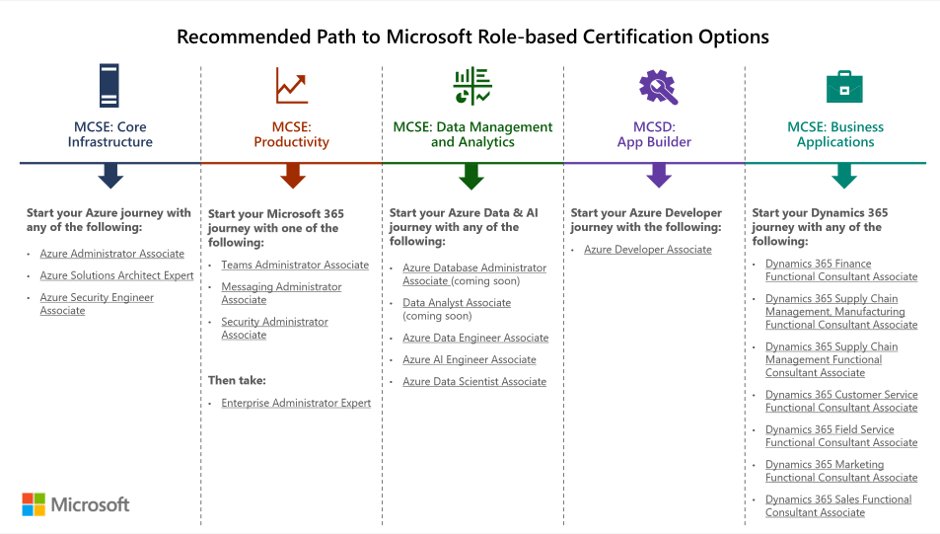
Microsoft have made various changes to partner incentives, changed a few Software Assurance benefits related to training resources, and changed the Home Use Program – all aimed to drive cloud awareness in different ways. Their latest move is to retire all their on-premises server certification paths and exams related to the MCSA, MCSD, and MCSE qualifications that have been a staple of the Microsoft server world for years. The retirement date is June 30, 2020.

As you can see in this image from Microsoft, the recommended paths are now all cloud focused:

Microsoft alternative certifications
Taken from https://www.microsoft.com/en-us/learning/community-blog-post.aspx?BlogId=8&Id=375282

You can see a full list of what’s being retired, along with some FAQs, here – https://www.microsoft.com/en-us/learning/community-blog-post.aspx?BlogId=8&Id=375282

While not surprising given the focus on cloud, not just from Microsoft but across the industry, I do wonder if this is a little short sighted? There are still a LOT of on-premises servers in use and, with hybrid cloud being the de-facto way forward for most organisations, they will remain for a long time to come. Rightly or wrongly, this feels like Microsoft saying that they don’t care about on-premises anymore. I’ve seen MS people saying they’re still hiring lots of on-premises server engineers etc. and that may be the case, but this announcement will definitely be taken as a sign of their overall focus.

I’m often asked if Microsoft will continue to make on-premises versions of their software and, following this announcement, I can’t help but wonder if I need to rethink my answer…

Snow Software acquire Embotics


Photo by Savvas Stavrinos on Pexels.com

Snow Software announced, on December 3rd, their acquisition of the hybrid cloud management company, Embotics. This follows on the heels of Flexera buying RightScale, VMware buying CloudHealth and, a little further back, Microsoft buying Cloudyn.

Infrastructure as a Service (IaaS) is a big focus for me (and a lot of people) and Embotics were one of the big cloud tool providers, along with this mentioned above.. Snow have been very successful on-premises and clear they want to extend that success to the cloud, so making an acquisition is a logical move – you get capabilities, knowledge, and people much faster than building it up yourself. The big next step is ensuring they can integrate those capabilities, knowledge, and people into the existing platform and company – Snow say:

“The process of integrating Embotics into the Snow platform will begin immediately, and the companies will have a single go-to-market strategy starting in 2020.”

If they can do that, I’ll be very interested to see the progression over the next 12, 24, and 36 months. Most organisations are going to be working in the “hybrid cloud” – part on-premises and part public cloud – a tool that can manage assets wherever they are and help make cost and value based decisions around asset type/location etc. will be very useful.

Further Reading

Snow announcement – https://www.snowsoftware.com/int/company/news/snow-software-acquires-embotics#.XgdMS252vic

Microsoft Project gets a refresh


Photo by Pixabay on Pexels.com

Microsoft are making changes to the “Project experience” to make it easier to use. They say this new Project is “designed to be both simple and powerful, so anyone can get started quickly and take control of any project right away”, with a more intuitive user interface – certainly something Project could do with in my opinion! Not surprisingly, there’s a fair amount of integration with Teams and Power BI.

As part of this, there are new/changed product names too. Project Online Professional is now Project Plan 3, while Project Online Premium is Project Plan 5. Added to the lineup is Project Plan 1 – an entry level SKU which doesn’t include many of the features nor a desktop client. It’ll be interesting to see what, if anything, Plan 1 means for the future of Planner.

Project Plan 1 features – https://products.office.com/en-gb/project/compare-microsoft-project-management-software

You can see Microsoft’s announcement here, and check out the features and pricing for the Project Plans here.

Microsoft Arc – Azure on other clouds


Photo by Max Avans on Pexels.com

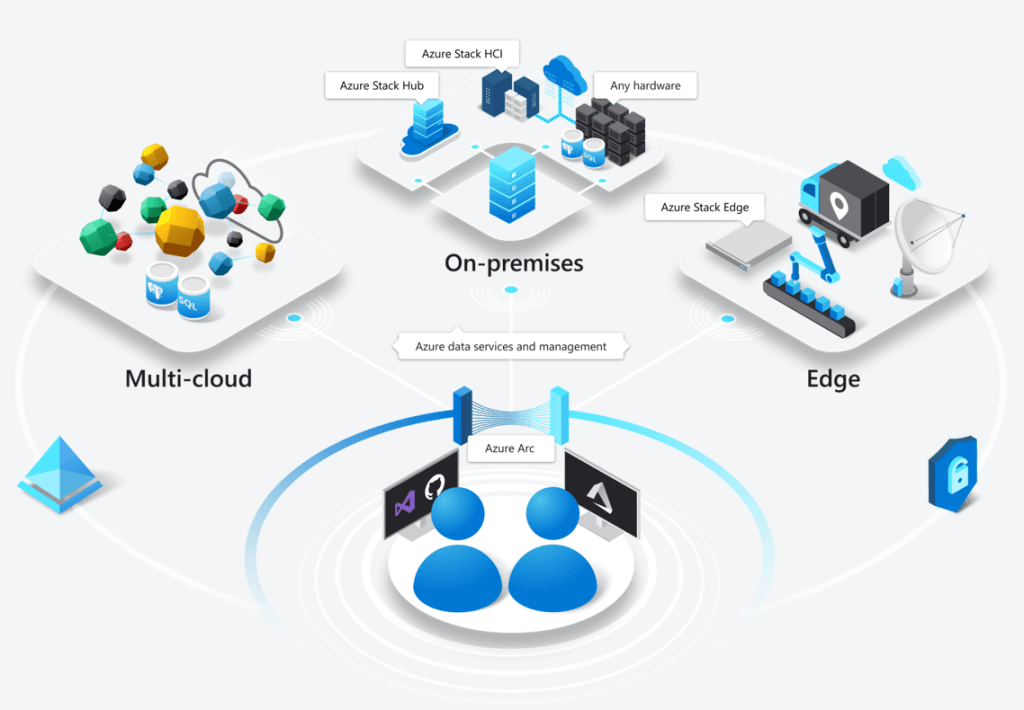
Microsoft Arc has been announced at Microsoft Ignite and it looks like it could be quite the game changer. Microsoft say that it “enables deployment of Azure services anywhere and extends Azure management to any infrastructure” across “across on-premises, edge and multicloud”.

The concept is pretty clever – it will allow certain Azure services to run in a variety of places, including on-premises hardware – both Azure Stack and seemingly regular customer hardware – but also other clouds like Amazon AWS and Google Cloud Platform!

Taken from https://azure.microsoft.com/en-us/services/azure-arc/

Multi-cloud is the concept of an organisation having multiple public clouds (Azure, AWS, GCP etc.) in use at the same time and, while many say it isn’t necessary – and even more say it isn’t a good idea – it’s already reality for many companies around the world. That being the case, anything to help make it easier and more secure to manage is a positive for customers…but I’m really intrigued to see what Amazon and Google make of this! What measures will they put in place to prevent or discourage customers from using Azure Arc within their datacentres?

Microsoft are talking about “Azure data services anywhere”, which looks to be based on a Kubernetes container platform. Some of the benefits Microsoft tout include:

  • Unified Management
  • Consistent cloud billing model
  • Consistent governance
  • Unique security tools like Azure Threat Protection

Currently Azure SQL Database and Azure Database for PostgreSQL Hyperscale are available for private preview on Azure Arc – although this Microsoft site:

https://azure.microsoft.com/en-us/services/azure-arc/hybrid-data-services/

only talks about them being available on-premises. It does however mention that SQL Server customers will be able to “leverage their existing licensing investments” to use SQL on Azure Arc, which suggests a future widening of the Azure Hybrid Benefits available through Software Assurance.

This is definitely one to keep an eye on over the next few months as it goes through private preview, then public preview, and finally out into general availability.

Microsoft Product Terms: November 2019


Photo by Markus Winkler on Pexels.com

I’ve taken a look at some of the highlights of this month’s Microsoft Product Terms document.

Big news is SQL Server 2019 is here – with a new SKU type and expanded fail-over rights.

We now have “SQL Server Big Data Node (BDN)” – available in 2-core packs via EA & EES. Requires a “master node” of SQL Std/Ent core with SA and includes certain SA rights.

Each SQL Server Ent Core license with SA gives 8 BDN licenses and each SQL Server Std Core license with SA gives 1 BDN license, when assigned to a “master node”.

The updated fail-over info is there too, but I’ll look at that properly in a separate article.

New language that M365 & O365 F1 licenses can only be assigned to users without a dedicated device.

“A Dedicated Device is a computing device used for work with a 10.1” screen or larger, used by the user more than 60% of the user’s total work time during any 90-day period”

F1 licenses are aimed at users who tend not have a device – drivers, nurses, warehouse staff etc. but I know some organisations are looking at them as a way to license traditional office workers and reduce costs. This new language looks to prevent that.

The new Project Plan 1, 3, and 5 licenses are added – only available via CSP. Plan 1 not available in France or South Korea for some reason. 🤔

Terms have been added to cover Azure Spot offers. <– Interestingly, I haven’t seen Microsoft use this term themselves until now. They have referred to them as “low-priority VMs” in Azure, with Spot being a term used by Amazon AWS.

Microsoft & SAP Embrace


Photo by cottonbro on Pexels.com

Project Embrace is a new initiative from SAP to help their customers move to the cloud, and digitally transform, quickly and easily. Microsoft are a key part of this, particularly around SAP S4/HANA running in the Azure cloud. The 2 vendors have created a joint roadmap with guidance to help organisations move from on-premises to the cloud. This new phase takes things further whereby Microsoft & SAP will align their partner ecosystems and collaborate around customer support.

This seems similar in many way to the partnership Microsoft announced with Oracle earlier this year, continuing the trend of “co-ompetition” between some of the largest players in the new cloud world. It can also be seen as a revival of the SAP/Microsoft “Duet” partnership – a joint product they launched many years ago to facilitate collaboration for companies using SAP and Microsoft SharePoint.

It’s interesting that Microsoft talk about being the first global cloud provider to support Project Embrace, although the SAP statement includes Amazon AWS and Google Cloud alongside them.

You can see more from SAP, and the others involved, here.

Microsoft give more info about VMware on Azure


Intro

Microsoft recently announced their plans to start running VMware software natively within the Azure cloud. This caused much interest in the tech world as well as some angry words from VMware!

You can read more about the initial announcement here

After the initial blog post, Microsoft went very quiet and had no more to say on the subject. I attended a webinar about VMware & Azure but this just covered the Azure Migrate tool – Microsoft’s new way of converting on-premises VMware VMs to Azure VMs running in the cloud…a great offering but not the super interesting part really!

Some news!

Today (December 19, 2017) Microsoft have given us a bit of an update, in a new blog post.

They tell us that they’re working with multiple VMware partners and will run the solution on existing VMware certified hardware:

preview hardware will use a flexpod bare metal configuration with NetApp storage

This will allow organisations to continue running the VMware software they have invested in – both in terms of money and time – and that they trust to run their business, but also allow them to have L3 network connectivity with Azure services such as:

  • Azure Active Directory
  • Azure Cosmos DB
  • Azure Functions

Microsoft are in discussions with these VMware partners – and also VMware themselves – and aim to:

make this offering generally available next year

VMware’s Angry Words

Interestingly, VMware angry words have become less angry.

There initial blog post was quite confrontational but has since been updated and now ahs a more reconciliatory tone. For example:

Original Post:

Recently, Microsoft announced preview of VMware virtualization on Azure, a bare-metal solution that is stated to run a VMware stack on Azure hardware, co-located with other Azure services in partnership with VMware-certified partners. No VMware-certified partner names have been mentioned nor have any partners collaborated with VMware in engineering this offering. This offering has been developed independent of VMware, and is neither certified nor supported by VMware.

Revised post:

Recently, Microsoft announced a preview of VMware virtualization on Azure, a bare-metal solution that is stated to run a VMware stack on Azure hardware, co-located with other Azure services in partnership with VMware-certified partners. This offering is being developed independent of VMware, however it is being offered as a dedicated, server-hosted solution similar in approach to other VMware Cloud Provider Partners (VCPP). The deployment is on VMware certified hardware consisting of FlexPod. VMware is in the process of engaging with the partner to ensure compliance and that the appropriate support model is in place.

The original post also said:

Microsoft recognizing the leadership position of VMware’s offering and exploring support for VMware on Azure as a superior and necessary solution for customers over Hyper-V or native Azure Stack environments is understandable but, we do not believe this approach will offer customers a good solution to their hybrid or multi-cloud future.

This is now nowhere to be found in the updated blog post!

A better relationship between the two vendors will surely make for a better experience for customers who take up this new offering as closer ties should mean better support.

Next steps

They say they’ll share more info on plans for General Availability and partners “in the coming months” and if you’d like to take part in the preview – contact your Microsoft account manager.

Further reading:

https://azure.microsoft.com/en-gb/blog/vmware-virtualization-on-azure/

https://blog.cloud.vmware.com/s/content/a1y6A000000aFlgQAE/vmware-the-platform-of-choice-in-the-cloud https://www.itassetmanagement.net/2017/11/28/vmware-azure/