Microsoft had, as expected, a great Q4 with revenue up 13% to $38 billion, which closed out an equally good fiscal year. Overall revenue of $143 billion, and operating income of $44.3 billion, was driven by revenue increases in all Microsoft’s key areas:
Office 365 was up 19%
Dynamics 365 was up 38%
LinkedIn increased by 10%
Azure was up 47%
Although the Azure growth was lower than previous quarters, it still seems healthy enough for now.
Microsoft called out some interesting points during their earnings call, some of which give a good indication of future direction including:
Slowdown in transactional licensing and flat on-premises server revenue: While this may be down, at least in part, to the impact of COVID-19 – it is also where Microsoft are heading. This is also shown by the fact that Office Commercial (on-premises Office) was down 34% -which Microsoft attributed to a combination of COVID-19 and the move to annuity licensing.
As long as those transactional licenses and on-premises server software are being replaced by CSP, Microsoft 365, and Azure – Redmond will be happy. I’ll be keen to see if this numbers start to rise again as the economic situation stabilises.
Bigger, longer Azure contracts: They stated “material growth” in Azure contracts over $10 million which is good news for Microsoft. For everyone in this new subscription based world, locking customers in to longer term deals is a key aim as it makes it easier for the vendor to forecast and budget.
Increased ARPU for Office 365: Average Revenue Per User (ARPU) is a key metric for many of today’s organisations and an increase means Microsoft are making more money per user. This could be as they upgrade to higher level plans (E3 to E5 for example) or purchase add-ons to their existing licenses. The Office 365 seat count increased and the ARPU increased, which are both positive for Microsoft.
All in all, a very positive performance from Microsoft that clearly shows their focus on cloud continues to pay off. Looking ahead to this financial year, FY 21, I think we’ll see more focus on E5 – particularly for security and voice workloads, Power Platform continuing to appear in new places, and increased pressure on those organisations looking to remain on-premises.
There was no English document available on the 1st when I did this (I guess the end of FY took it out of them 🤣), so I used the French version…my now 909 day Duolingo streak is coming in handy!
Nothing major changed or announced which is to be expected; being the start of their new financial year (and when everyone goes on holiday), July & August are often pretty quiet. What we’ve got is:
“System Center Configuration Manager” is renamed to “Microsoft Endpoint Configuration Manager”. The first real sign of anything happening with this new product name since it was announced a few months back.
“Azure Monetary Commitment” is now “Azure prepayment”.
If you have 1 or more licenses of Project Plan 1/3/5, all O365 users on that tenant get limited access to “Project for the web” customer data. No access to Power Platform apps and doesn’t apply to public sector.
June is the last month of Microsoft’s financial year but they’re still made a few changes worth noting in this month’s Product Terms:
5 year reservations for Azure VMs are added – with a 35% early termination fee
Azure Hybrid Rights for SQL have been expanded so now:
on-premises SQL Server Standard licenses can be used to run SQL Server Enterprise VMs in Azure
on-premises SQL Server Enterprise licenses can be used to run SQL Server Standard VMs in Azure
Changes to the eligibility for Office 365 and Microsoft 365 F1 & F3 licenses
SQL Server
The core conversion ratio is different for the two new scenarios:
4 x SQL Server Std on-prem cores w/SA = 1 x SQL Server Ent Azure core
1 x SQL Server Ent on-prem core w/SA = 4 x SQL Server Std Azure core
You can see the above table, and the info, on pages 54-54 of the June 2020 Product Terms.
F1/F3 changes
Microsoft have again changed the rules around who is eligible for a “Firstline” SKU. The new requirements are that to qualify for an F1/F3 license a worker must satisfy at least one of these conditions:
Uses a primary work device with a single screen smaller than 10.1”
Shares their primary work device with other qualifying Microsoft 365 or Office 365 Firstline Worker licensed users, during or across shifts
Other licensed Microsoft Firstline Worker users must also use the device as their primary work device
Any software or services accessed from the shared device requires the device or users to be assigned a license that includes use of those software or services
The previous guidance, updated in November 2019, was:
“A Dedicated Device is a computing device used for work with a 10.1” screen or larger, used by the user more than 60% of the user’s total work time during any 90-day period.”
These new rules should make it a bit easier for everyone to police but, for organisations already licensed for F1/F3 prior to June 1, 2020, you can continue to license based on the previous rules until your next renewal.
Microsoft have introduced their first vertical specific cloud offering – Cloud for Healthcare. Currently in public preview, the stated aims of this are to:
Enhance patient engagement
Empower health team collaboration
Improve insights
and, considering the current Coronavirus situation, focusing first on healthcare makes sense. They highlight that over 1,600 “COVID-19 bots” have gone live since March across 23 countries and we’ve already seen a huge rise in Azure usage during the last couple of months. The offering will span Azure, Microsoft 365, Dynamics 365 and more.
What’s next?
I look forward to seeing which other verticals are next to receive their own cloud and also, over the long term, if we start to see features and licensing differences between them. As cloud goes from being presented as one monolithic thing that everyone uses to separate, discrete offerings tailored to different industries, it will be much easier to introduce commercial differences. I imagine we’ll see some more about these at Microsoft Inspire in July.
There have been reports recently that some users in certain regions were hitting capacity limits in Microsoft Azure when trying to create new resources. Microsoft have shared some information around the impact the coronavirus epidemic is having on their cloud infrastructure:
775% increase in cloud services (in regions performing lockdown)
Teams up to 44 million daily users, running over 900 million minutes of meetings and calls each day
Windows Virtual Desktop (WVD) usage increased 3x
42% increase in government use of Power BI for sharing COVID-19 dashboards
Some of these numbers are pretty mind-blowing and one can see how they might catch a cloud vendor by surprise.
Cloud Datacentre provisioning
Microsoft say they will be adding “significant new capacity” over the coming weeks to help support this increased use.
Something I’m sure Microsoft have considered is how much of this extra usage will continue?. What happens as things start to return to normal and some of this usage starts to drop off? They’ll be left with more unused capacity than their models anticipated – might this lead to them raising prices on certain Azure services in the future?
Prioritising certain services
Microsoft have detailed that they’re focusing the “highest level of monitoring” on services related to emergency services, medical supply management, healthbots, and more.
They have also introduced some temporary restrictions to help ease the load – free offers are being limited, to keep capacity available for “existing customers”, and certain resources are being “soft” limited for new subscriptions. Customers can raise support tickets to raise these soft limits, but Microsoft do say that other geographical regions may need to be used to help manage demand.
Teams changes
Microsoft have made a number of small changes to Teams in an effort to reduce bandwidth. They scaled back how often it checks for people’s “presence” (whether they’re online or not), reduced the video resolution, limited how quickly it shows if the other user is typing, and made OneNote within Teams read-only for non-education tenants. All small changes that won’t really impact users but, collectively, must make quite a difference to the bandwidth being used.
Microsoft have been on a cloud push for 12 years now, since the launch of BPOS in 2008. They’ve been slowly “turning the ship” in various ways over the last decade, with the ultimate aim that as much of Microsoft is pointing at the cloud as possible. This is also a case of “trickle down (cloud) economics” – Microsoft are making their new direction reflect as much as possible within their partner base…and that change will then happen within Microsoft’s customers too.
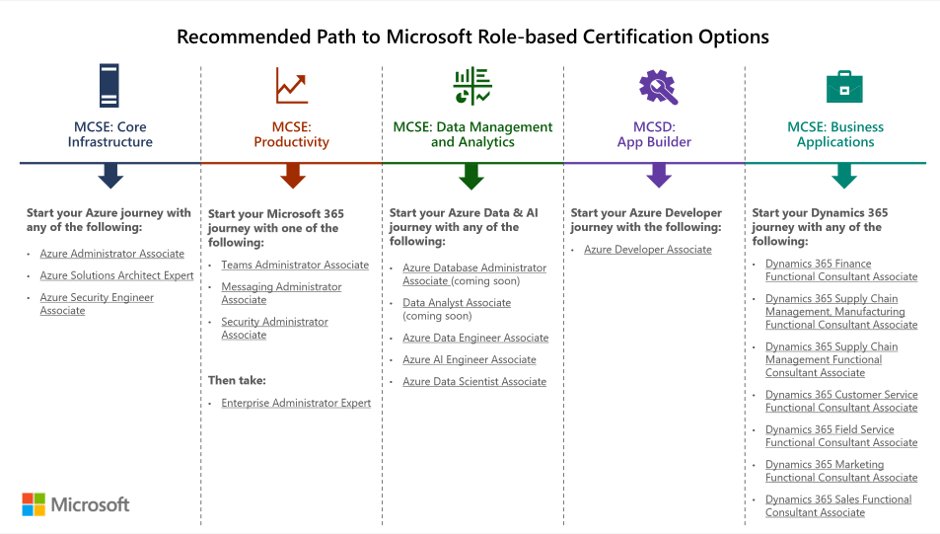
Microsoft have made various changes to partner incentives, changed a few Software Assurance benefits related to training resources, and changed the Home Use Program – all aimed to drive cloud awareness in different ways. Their latest move is to retire all their on-premises server certification paths and exams related to the MCSA, MCSD, and MCSE qualifications that have been a staple of the Microsoft server world for years. The retirement date is June 30, 2020.
As you can see in this image from Microsoft, the recommended paths are now all cloud focused:
While not surprising given the focus on cloud, not just from Microsoft but across the industry, I do wonder if this is a little short sighted? There are still a LOT of on-premises servers in use and, with hybrid cloud being the de-facto way forward for most organisations, they will remain for a long time to come. Rightly or wrongly, this feels like Microsoft saying that they don’t care about on-premises anymore. I’ve seen MS people saying they’re still hiring lots of on-premises server engineers etc. and that may be the case, but this announcement will definitely be taken as a sign of their overall focus.
I’m often asked if Microsoft will continue to make on-premises versions of their software and, following this announcement, I can’t help but wonder if I need to rethink my answer…
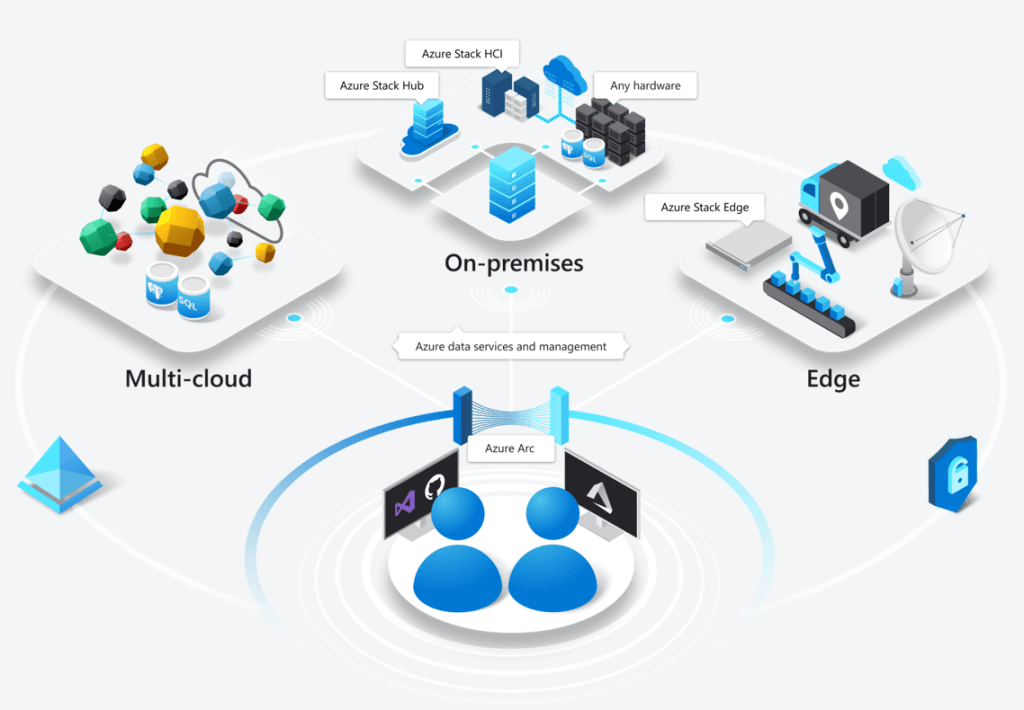
Microsoft Arc has been announced at Microsoft Ignite and it looks like it could be quite the game changer. Microsoft say that it “enables deployment of Azure services anywhere and extends Azure management to any infrastructure” across “across on-premises, edge and multicloud”.
The concept is pretty clever – it will allow certain Azure services to run in a variety of places, including on-premises hardware – both Azure Stack and seemingly regular customer hardware – but also other clouds like Amazon AWS and Google Cloud Platform!
Multi-cloud is the concept of an organisation having multiple public clouds (Azure, AWS, GCP etc.) in use at the same time and, while many say it isn’t necessary – and even more say it isn’t a good idea – it’s already reality for many companies around the world. That being the case, anything to help make it easier and more secure to manage is a positive for customers…but I’m really intrigued to see what Amazon and Google make of this! What measures will they put in place to prevent or discourage customers from using Azure Arc within their datacentres?
Microsoft are talking about “Azure data services anywhere”, which looks to be based on a Kubernetes container platform. Some of the benefits Microsoft tout include:
Unified Management
Consistent cloud billing model
Consistent governance
Unique security tools like Azure Threat Protection
Currently Azure SQL Database and Azure Database for PostgreSQL Hyperscale are available for private preview on Azure Arc – although this Microsoft site:
only talks about them being available on-premises. It does however mention that SQL Server customers will be able to “leverage their existing licensing investments” to use SQL on Azure Arc, which suggests a future widening of the Azure Hybrid Benefits available through Software Assurance.
This is definitely one to keep an eye on over the next few months as it goes through private preview, then public preview, and finally out into general availability.
Photo by George Dolgikh @ Giftpundits.com on Pexels.com
Microsoft recently announced their acquisition of Movere, a cloud discovery and assessment tool, to bolster their “Azure Migrate” offering.
Movere has been around since 2008 and has, over the last few years, become the tool of choice for Microsoft funded customer SAM/Cloud Readiness engagements – so the acquisition is perhaps no surprise. Microsoft’s main focus these days is getting more customers to move more workloads into their Azure cloud, and this is their next step in that journey; with the aim “to streamline our customers’ journey to the cloud, enabling them to bring innovation and transformation with the power of Azure”.
I wonder what this means for the other ISV partners involved in the Azure Migrate program, will they see a lack of focus on their elements of the scheme? Posting on LinkedIn brought a few interesting comments/questions: one person suggested that Movere is a “one trick pony” while another asked if this new acquisition could become the “ILMT* for Azure”.
*ILMT is the IBM License Metric Tool, which (most) IBM customers must use in order to prove compliance with certain license metrics.
Whenever a big vendor like Microsoft make an acquisition, it’s always interesting to see what happens to the technology, what it’s used for, how it’s licensed etc. I’ll definitely be watching for Movere to be added to the Product Terms!
Azure Archive Storage is used for less important data, where an organisation is happy to wait – perhaps hours – for access to their data. This means it is significantly cheaper than regular Azure storage.
Microsoft have announced that prices have dropped “by up to 50 percent in some regions” – although they haven’t given more precise info as to what reductions have taken place in what areas. That said, if you’re using this – you should see a reduction in your next cloud bill…or at least that section of it!