Podcast Episode: Microsoft Cloud Pricing Shifts


Pip: Welcome to Cloudy with a Chance of Licensing โ€” where the forecast is partly cloudy with a strong chance of your Azure bill going up.

Mara: rich_gibbons has been tracking some significant changes across Azure pricing, reservation policy, and Copilot Studio this episode, alongside Microsoft's latest financial results. There's a lot that touches FinOps and ITAM teams directly.

Pip: Let's start with what February 2027 is quietly turning into: a deadline with teeth.

Azure Prices and Reservation Policy: February 2027

Mara: Two separate but converging changes land on the same date โ€” February 1st, 2027 โ€” and together they reshape how organizations should be thinking about their Azure commitments right now.

Pip: The price increases hit seven regions, and the spread is meaningful. Dublin leads at 17%, Singapore sits at the low end with 8%, and France, Amsterdam, and Norway fall in between.

Mara: The post is direct about the action item: "If you're heavily in these datacentres, particularly Dublin, modelling your bills next year โ€” and potential mitigations โ€” should be on the list for FinOps and ITAM teams."

Pip: Seventeen percent is not a rounding error. That's a real budget conversation waiting to happen, and the exclusion lists don't make it simpler โ€” there are long lists of VM series and storage services carved out, so teams need to check their specific footprint carefully.

Mara: And the reservation exchange policy post explains exactly why that footprint review matters even more now. From February 1st, 2027, Azure Reservations for Virtual Machines, App Service, SQL Database, and similar services will no longer be exchangeable if a Savings Plan exists for that service.

Pip: This change has been announced, postponed, and re-announced since October 2022 โ€” it's had more false starts than a budget approval cycle.

Mara: That history is worth noting. It was pushed from January 2024 to July 2024, then deferred indefinitely, with Microsoft promising six months' notice before re-implementing. That notice has now been given, and the post suggests another postponement seems unlikely.

Pip: So the flexibility organizations relied on โ€” swapping reservations when workloads shifted โ€” is going away for most compute services.

Mara: The post frames the strategic choice clearly: Savings Plans offer lower maximum discounts but much less administrative overhead and no need to manage exchanges. Reserved Instances still deliver higher discounts for stable, predictable workloads, but the safety valve of exchangeability is closing. Strategies need to be reviewed before that door shuts.

Pip: Two changes, one date โ€” the financial modeling homework is overdue.

Microsoft's Q1 FY27 Numbers

Mara: Microsoft's first quarter FY27 results are out, and the headline figures are substantial โ€” revenue of $92.3 billion, up 19%, with net income up 32% and Microsoft Cloud revenue reaching $63.9 billion.

Pip: Azure grew 48% year over year, which does make the price increases feel a little less like necessity and a little more like confidence.

Mara: Satya Nadella described Copilot's direction plainly: "We think of Copilot as the new OS for work." The results show consumption billing โ€” particularly through GitHub Copilot and M365 Copilot โ€” as a primary growth driver, with usage-based billing customers up over 75% in the quarter.

Pip: Speaking of usage-based billing โ€” that's exactly where the next story lives.

Copilot Studio's New Harness and Its Billing Catch

Mara: Copilot Studio now has a third option for building agents โ€” the GitHub Copilot harness โ€” which brings the same coding and reasoning capabilities as GitHub Copilot and Copilot Cowork to your in-house agents.

Pip: The capability sounds useful. The billing model is the part that deserves a careful read before anyone starts building.

Mara: The post quotes Microsoft directly: "Agents running on the GitHub Copilot harness use usage-based billing for all work, regardless of Microsoft 365 Copilot licensing." Unlike the existing harnesses, where Copilot Credits are covered by an M365 Copilot license, this one draws on pre-purchased credits or incurs pay-as-you-go costs.

Pip: No one is being forced onto this model โ€” it's an optional, additional capability. But "optional" and "inadvertent spend" have a way of meeting each other quietly.

Mara: The Copilot Studio Licensing Guide for August 2026 is worth reviewing alongside this, and the post is clear that strong internal governance and awareness programs are the practical response here.


Mara: February 2027 keeps appearing as the date when several assumptions about Azure cost management stop holding โ€” pricing, reservations, and consumption billing are all moving at once.

Pip: Next time, hopefully the forecast includes at least one change that makes the bill smaller. We'll be watching.

Microsoft Financial Results: FY27 Q1


Microsoft’s results for FY27 Q1 are out and, once again, the numbers are bigger than last time. It’s always difficult to reconcile such huge results with layoff announcements and that has happened again with news that Microsoft have made a voluntary exit offer to approx. 60,000 staff – almost a quarter of the workforce.

Talking about the recent Copilot “super app” that combines Chat, Cowork, Autopilot, and Code, Satya Nadella said “We think of Copilot as the new OS for work” – make of that what you will!

It’s clear that AI, Copilot, and consumption billing are the big drivers of Microsoft’s revenue and future direction.

  • Revenue = $92.3 billion, up 19%
  • Net Income = $36.6 billion, up 32%
  • Microsoft Cloud revenue = $63.9 billion, up 30%

For several years, revenue has been split into different categories:

  • Productivity and Business Processes
  • Intelligent Cloud
  • More Personal Computing

but it now seems to be:

  • Agents and Infra
  • Devices and Consumer

so the Agents & Infra segment includes Azure and M365. I assume it will include Dynamics 365 too but, for the first time in a long time, that isn’t mentioned specifically…does that mean D365 hasn’t grown in Q1 FY27?

Nadella did say that they’re “bringing the business logic and capabilities of Dynamics 365 directly into Copilot and helping every organization stand up their own infinite SaaS Factory” – perhaps there’s a shift in focus happening?

Amy Hood, CFO, stated that:

“Capital expenditures were $45.2 billion,. Roughly three quarters of…capex was for short-lived assets, primarily CPUs and GPUs, including higher memory and storage costs.”

That’s over $33 billion on CPUs and GPUs in a single quarter!

Agents & Infra numbers

  • Revenue increased 25% to $76.8 billion
  • Azure revenue grew 48%
  • M365 Commercial increased 17%

M365 Copilot, E5, and E7 helped drive higher average revenue per user as well as more consumption billing, particularly of GitHub Copilot.

Earnings Call highlights

  • The number of Copilot customers actively consuming credits through usage-based billing grew over 75 percent over the quarter.
  • Credit consumption from agentic features on GitHub has more than doubled since usage-based billing went into effect.
  • Over 44,000 paid Fabric customers, up more than 50 percent year over year.
  • Microsoft added 24 new data centers across five continents this quarter.

See the Microsoft page here – FY27 Q1 – Press Releases – Investor Relations – Microsoft

Microsoft Copilot Cowork Pricing Explained: What Your Organisation Will Actually Pay


Microsoft has officially announced that Copilot Cowork is generally available. If you caught my LinkedIn post on this just after launch, you’ll know I flagged the headline numbers – and promised a deeper look. Here it is.

This isn’t just another Copilot feature release, Cowork represents a different, additional way of working…and brings with it an additional billing mechanism.

What Is Copilot Cowork?

Copilot Cowork is Microsoft’s agentic AI layer sitting on top of Microsoft 365 Copilot. Where standard Copilot handles in-the-moment assistance (drafting emails, summarising meetings, generating content), Cowork is designed for longer-running, multi-step tasks that span multiple apps and require sustained reasoning in the background.

How the Billing Works

This is where things get interesting and where CFOs – and everyone else – will want to pay close attention.

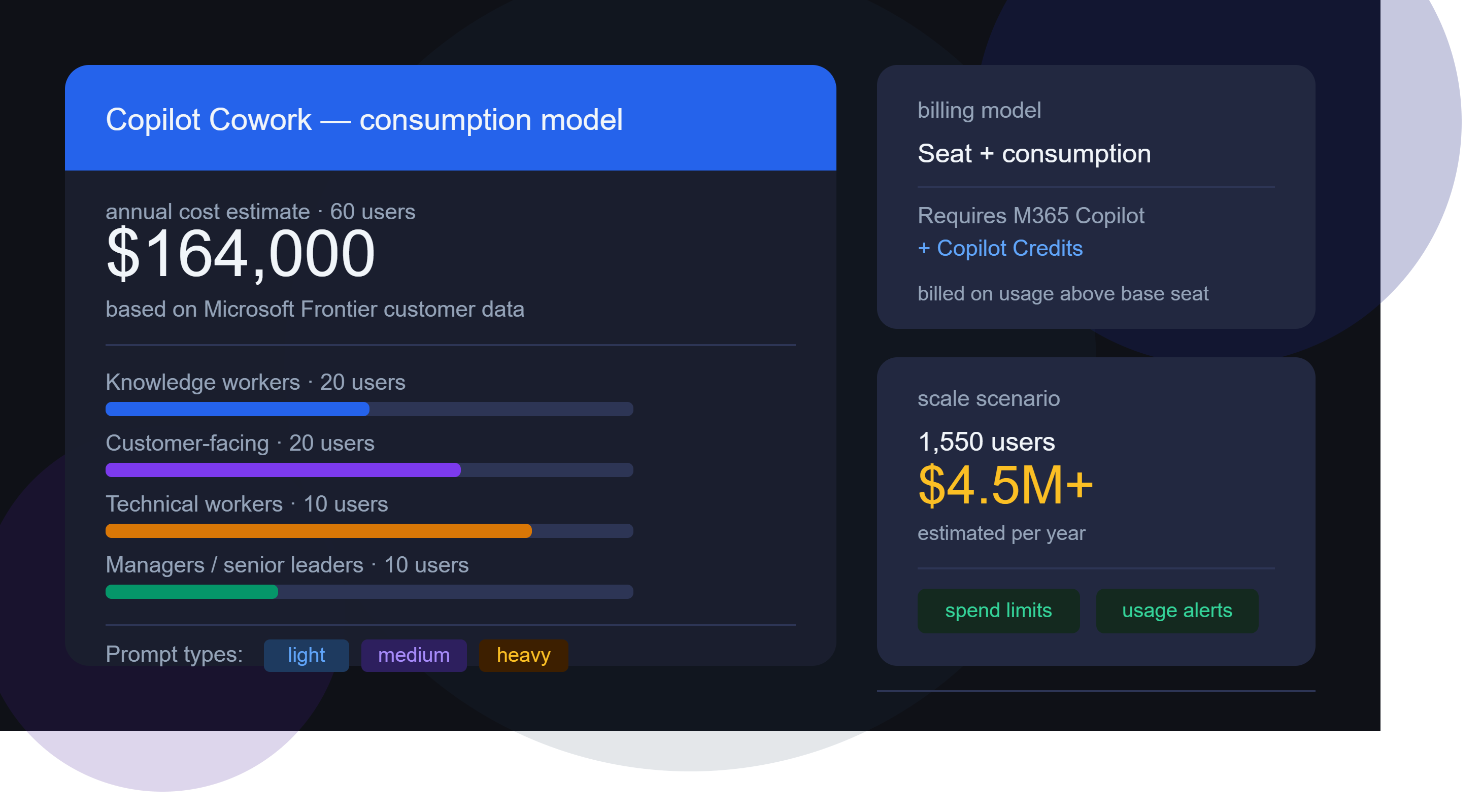
Copilot Cowork uses a seat + consumption model:

Seat requirement: Users must already hold a Microsoft 365 Copilot licence
Consumption billing: Cowork usage is billed on top of that, via Copilot Credits

In other words, you’re not paying a flat per-user fee for Cowork. You’re paying based on what people actually do with it. That might sound fair – but as we’ll see, it creates significant cost unpredictability at scale.

The Three Prompt Types

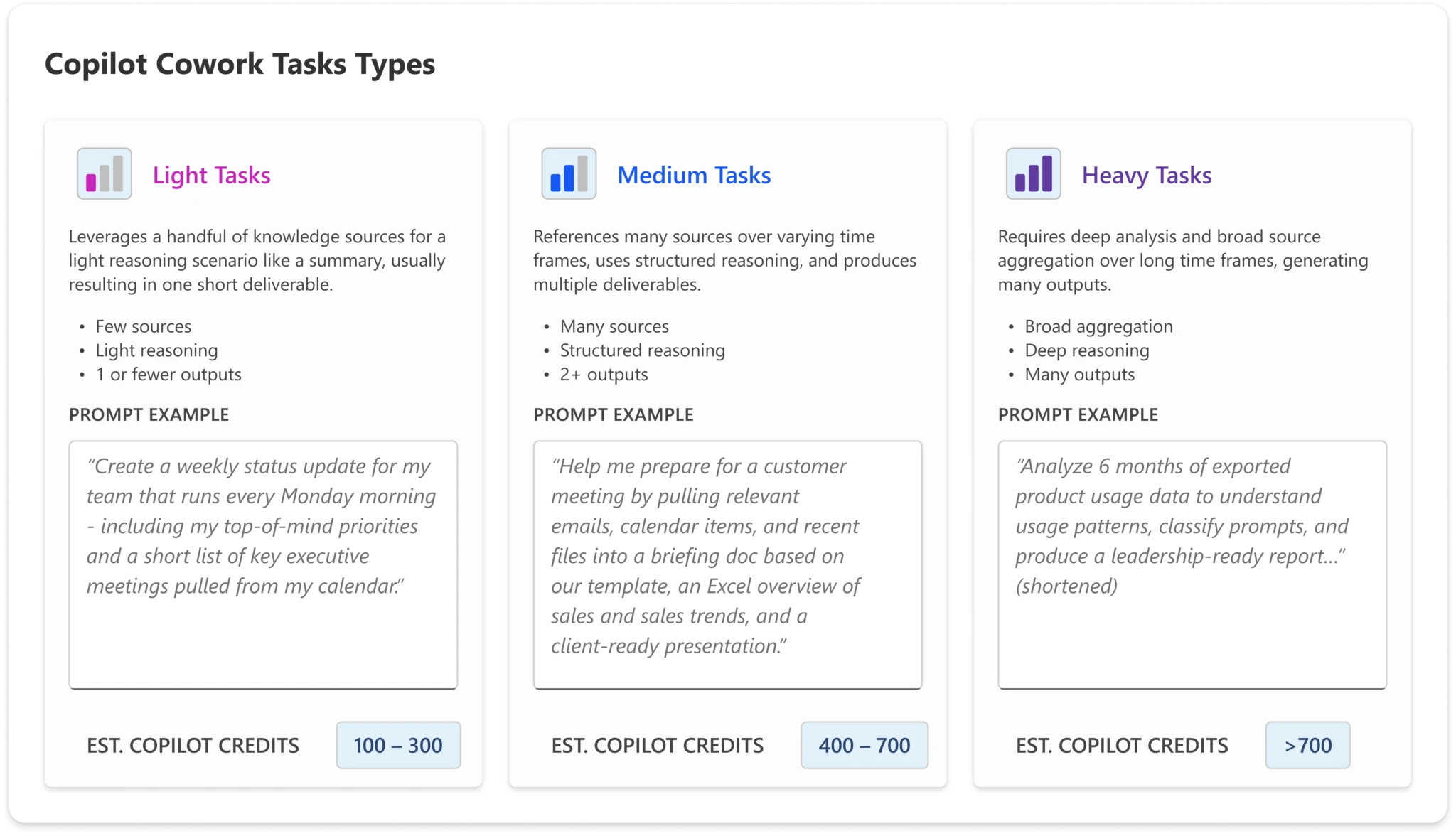
To help organisations estimate their likely spend, Microsoft has defined three categories of prompt complexity:

  • Light Simple, quick tasks – lookups, short summaries, straightforward Q&A
  • Medium Multi-step tasks with moderate reasoning or tool use
  • Heavy Complex, long-running agentic tasks – deep research, multi-app orchestration, extended workflows
Copilot Cowork is now generally available | Microsoft 365 Blog

The credit cost per interaction scales accordingly. A user who primarily sends light prompts will consume far fewer credits than one regularly triggering heavy agentic workflows.

The Four Microsoft-Defined Personas

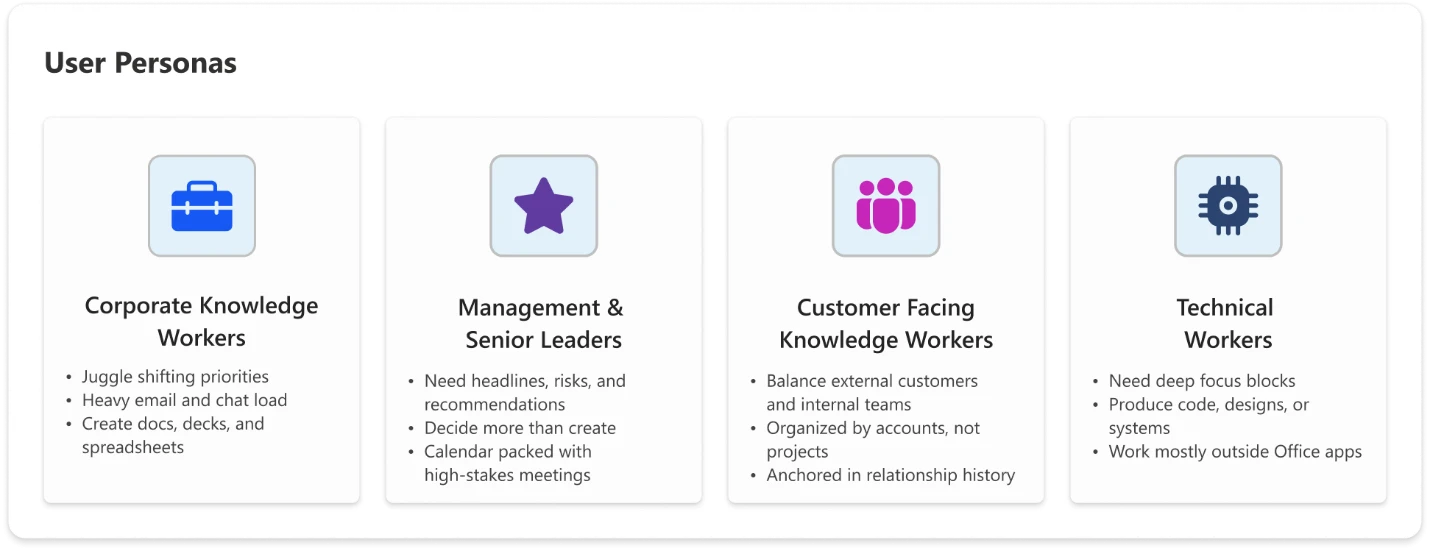
Microsoft has also defined four user personas to help organisations model expected usage – and therefore expected cost:

  1. Knowledge Worker

Your standard office employee: using Copilot for day-to-day tasks like drafting documents, summarising emails, and pulling information. Predominantly light-to-medium prompt usage.

  1. Customer-Facing Knowledge Worker

Staff in sales, customer success, support, or account management. Higher interaction volume and a greater likelihood of medium-to-heavy prompts – researching customer history, generating proposals, triaging complex queries.

  1. Technical Worker

Developers, analysts, engineers, and data professionals. Usage tends towards heavier, more complex prompts – code generation, data analysis, technical documentation, multi-step problem solving.

  1. Manager / Senior Leader

Executives and team leads. Usage is often more strategic – executive briefings, synthesising reports across sources, preparing for key meetings. Likely lower volume but higher complexity per interaction.

Copilot Cowork is now generally available | Microsoft 365 Blog

What Does This Actually Cost?

Microsoft has shared estimated annual Cowork costs based on data from early Frontier customers. Modelling the costs is where things start to get really surprising…the below uses list pricing and doesn’t factor in any type of discount.

*Update 18-06-26*

The calculator I’ve been using is here – GitHub – mfg-365/cowork-cost-estimator: Live usage-based cost estimator for Microsoft Copilot Cowork โ€” print & PDF export ยท GitHub

However, in their announcement post, Microsoft link to this spreadsheet – https://aka.ms/CustomerCoworkEstimator.

As was pointed out in a comment, there is a small but important difference between the two. The Github hosted calculator estimates “Heavy” prompts at 2,500 credits while the spreadsheet version uses a value of 1,200. This means the latter version produces lower prices for those heavy prompt users.

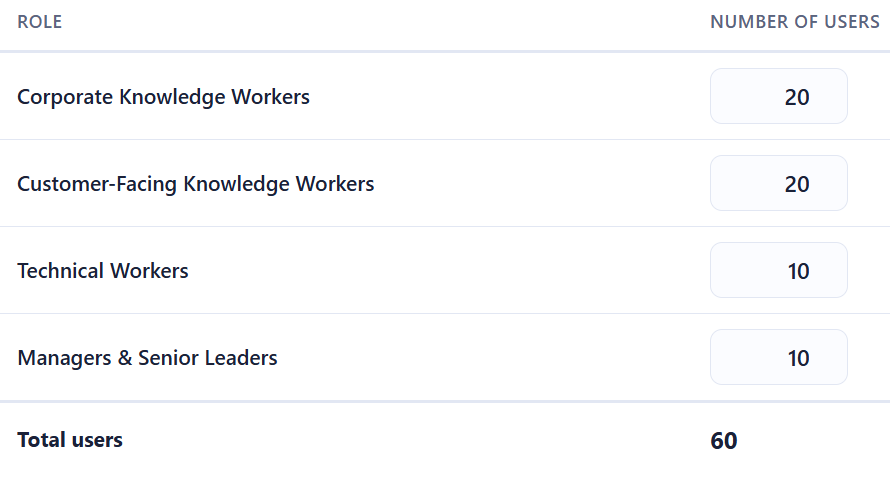
Let’s look first at a small org of 60 users:

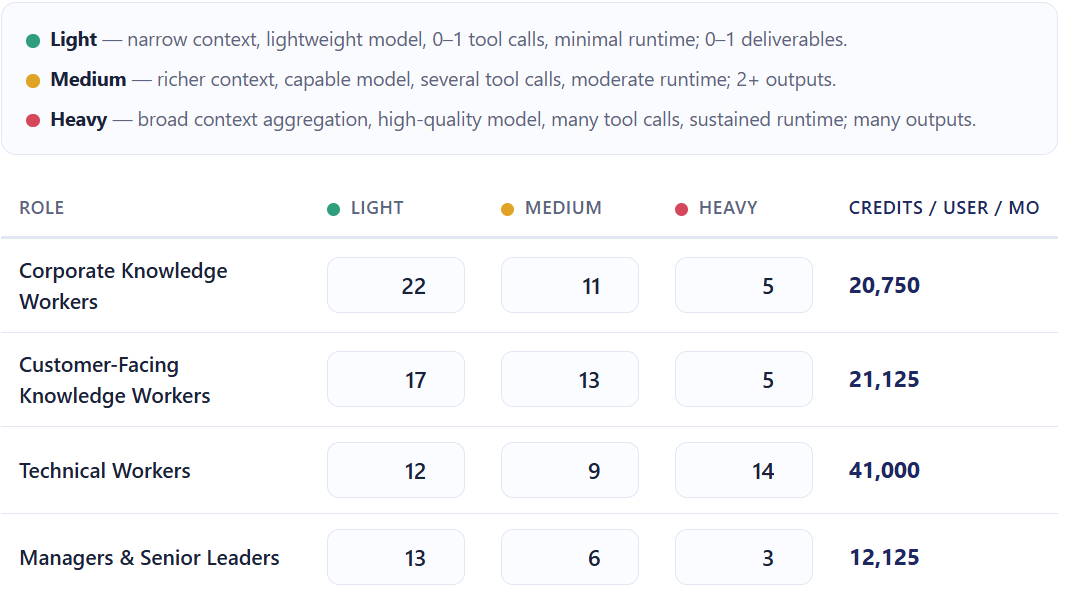
The Microsoft calculator uses the following estimates for the number and type of prompts each persona will use:

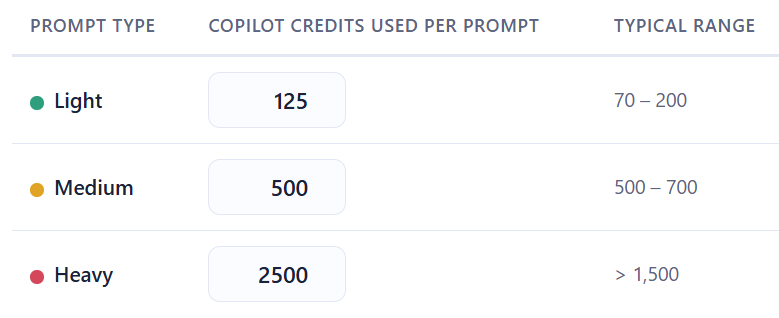
and these for the number of credits used per prompt:

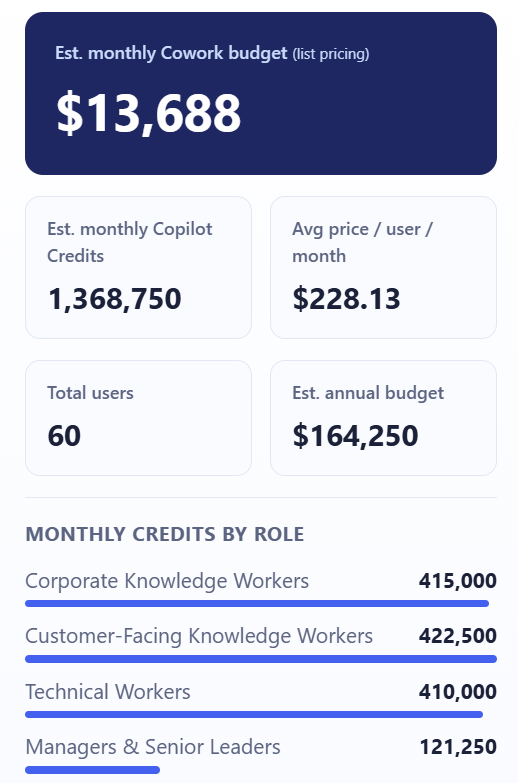
That gives a final estimate of:

That’s right – over $164,000 per year for 60 people to use Copilot Cowork.

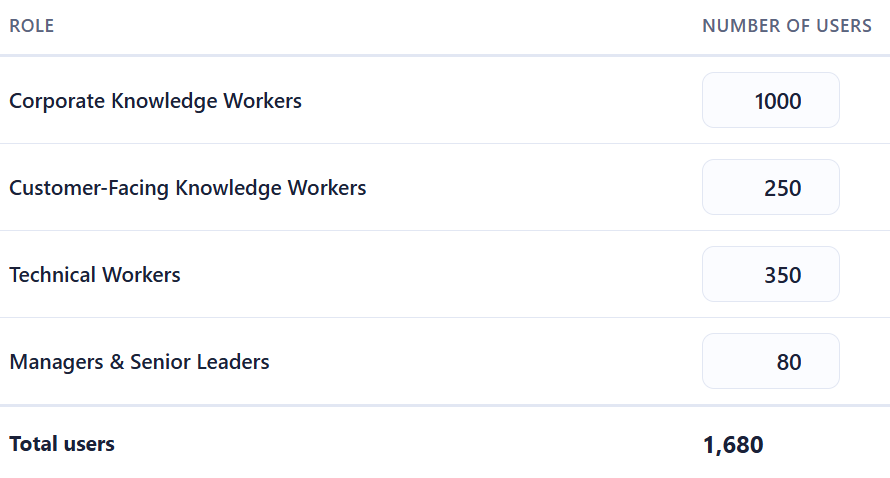
For a company of 1,680 staff:

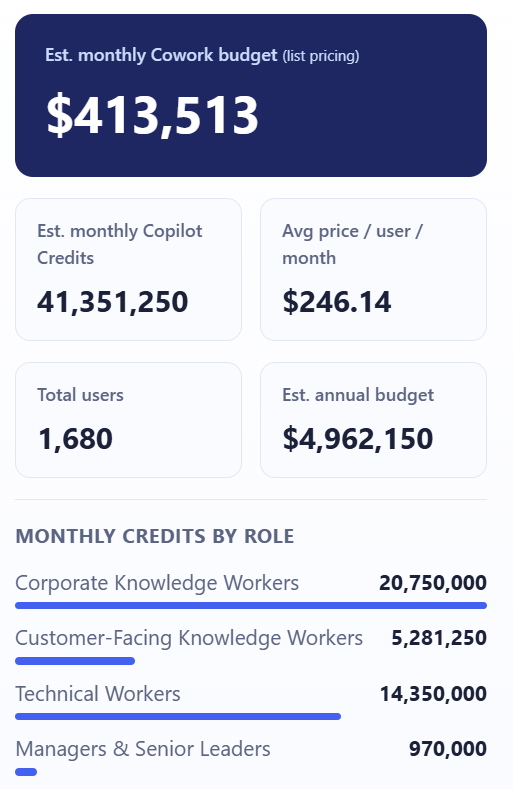
You end up with an estimated annual bill of almost $5,000,000!

It seems impossible that companies are going to pay these amounts – surely? If these costs are real, it shows that customers are going to have to be much more realistic as to who gets access to Copilot Cowork.

The Guardrails Microsoft Provides

To be fair to them, Microsoft have built in some controls:

  • Spending limits – administrators can cap Cowork credit consumption at tenant, group, and user levels
    Usage alerts – notifications when consumption approaches defined thresholds
  • Usage reporting – Admins see usage broken down by user, group, and feature
  • User-level pricing – Users see what each task costs as they run it (coming soon)

These are sensible features, and their inclusion suggests Microsoft is aware of the sticker shock potential and are trying to get out in front of it.

As well as PAYG pricing, the Copilot P3 advance purchase option – which can give discounts of up to 20% – is available for Cowork – see more here Microsoft Copilot Credit Pre-Purchase Plan โ€“ Cloudy with a chance of Licensing

Why This Changes the AI Governance Conversation

This is what I really want to focus on, because the billing model isn’t just a procurement question โ€” it’s an organisational design question.

  1. Not all usage is equal value

A heavy prompt from a technical worker building an internal tool could save dozens of engineering hours. A heavy prompt from someone using Cowork to draft a quick internal update is a poor use of credits. The credit model treats both the same. Your organisation needs a way to distinguish between them.

  1. You need a usage policy, not just a spending cap

A spending cap is a ceiling. What you actually need is a framework that answers questions like:

  • Which personas should have access to Cowork at all?
  • What types of tasks are appropriate for Cowork vs. standard Copilot?
  • Who approves high-complexity agentic workflows?
  • How do we measure whether Cowork usage is delivering value?

Without answers to these, you’re handing out a consumption-based service with no purchasing guidelines.

  1. The ROI question is now urgent

With flat-fee AI tools, ROI questions are important but not time-sensitive – you’re paying regardless of use. With consumption billing, poor adoption and excessive adoption are both problems. You need a framework for measuring the value of AI usage – not just the cost.

  1. Consumption models reward the vocal, not the strategic

In many organisations, power users will naturally gravitate toward the most capable features. That’s not always aligned with where the highest-value use cases are. Without intentional governance, Cowork credit consumption may cluster around enthusiastic individuals rather than high-value workflows.

What Organisations Should Do Now

If you’re already running Microsoft 365 Copilot – or planning to – here’s where to focus:

  • Map your personas
    • Use Microsoft’s four categories as a starting point, but refine them for your organisation. Who are your heaviest potential users? Where are the highest-value use cases?
  • Model your costs before you deploy
  • Use the per-persona estimates to build a realistic cost projection. Stress-test it against both optimistic and conservative adoption scenarios.
  • Define your governance framework
  • Decide who gets access to Cowork, for what purposes, and with what approval process for high-complexity tasks. Document this as policy, not just an IT configuration.
  • Set up monitoring from day one
  • Don’t wait for the first bill to understand usage patterns. Use Microsoft’s alerting tools, and complement them with your own reporting.
  • Establish a value measurement approach
  • Credits spent should be traceable to outcomes. What did that agentic workflow actually deliver? This doesn’t need to be complex – even a lightweight system for use case categories can help you build the picture.

See the Microsoft announcement here – Copilot Cowork is now generally available | Microsoft 365 Blog

Grab the calculator from Github here – Live usage-based cost estimator for Microsoft Copilot Cowork

Join the conversation on my LinkedIn post here – Copilot Cowork Post

GitHub Copilot moving to consumption billing


Software developers collaborating with multiple monitors and AI interface holograms in an open office
A group of software developers collaborate around computers with AI interfaces in a modern office

From June 1st, GitHub Copilot usage will start to consume GitHub AI Credits. Microsoft say that, as Copilot use has changed and become more complex, inference costs have increased and they can no longer sustain the current premium request unit (PRU) model.

Copilot features that consume AI credits include Copilot Chat, Copilot CLI, Copilot cloud agent, Copilot Spaces, Spark, and third-party coding agents.

Every Copilot plan will include an amount of GitHub AI Credits, and paid plan users will be able to purchase additional credits if needed. Microsoft say that “usage will be calculated based on token consumption, including input, output, and cached tokens“.

  • Copilot Business: $19/user/month, including $19 in monthly AI Credits
  • Copilot Enterprise: $39/user/month, including $39 in monthly AI Credits

There will be higher credits included for June, July, and August:

  • Copilot Business: $30 in monthly AI Credits
  • Copilot Enterprise: $70 in monthly AI Credits

1 AI credit = $0.01 USD so the standard inclusions are:

PlanTotal AI credits per user per month
Copilot Business1,900
Copilot Enterprise3,900

As is becoming common in FinOps for AI, the choice of models used for tasks will become much more important with this change. For example:

  • GPT 4.1 is $2 per input token and $8 per output token
  • GPT 5.5 is $5 per input token and $30 per output token
  • Claude Haiku 4.5 is $1 per input token and $5 per output token
  • Claude Opus 4.7 is $5 per input token and $25 per output token

Significant price differences for sure! See more here.

Usage will be pooled across an organisation which may help reduce the impact of this, depending how uniformly your teams use these features. A “Preview Bill Experience” has been introduced earlier in May to give users a view of what your consumption bill will look like. (That’s quite a good idea but more than a 1 month run up would have been better).

A few key things to note:

  • Base plan pricing isn’t changing.
  • Code completions and Next Edit suggestions will not consume AI credits.
  • Credits do not roll over from month to month.
  • Fallback experiences will no longer be available.
  • Copilot code review will consume GitHub Actions minutes AND GitHub AI Credits.

See the Microsoft announcement here – GitHub Copilot is moving to usage-based billing – The GitHub Blog

Microsoft Financial Results FY26 Q2


Microsoft Financial Results for Q2 FY26

Revenue = $81.3 billion (up 17%)

Net Income =ย $38.5 billion (up 60%)

Microsoft Cloud = $51.5 billion

As it has been every quarter for many years now, more big increases across the board as Microsoft continues to grow. They have RPO (Remaining Performance Obligation) of $625 billion, an increase of 110%, which indicates a lot of multi-year agreements have been signed. This huge backlog of guaranteed revenue likely means that Microsoft aren’t as bothered about your order/renewal as you might like them to be…making discounts harder to come by for many customers.

Is AI still a hot topic?

Yes!

Satya Nadella, Microsoft CEO said:

โ€œWe are only at the beginning phases of AI diffusion and already Microsoft has built an AI business that is larger than some of our biggest franchises”

โ€œWe are pushing the frontier across our entire AI stack to drive new value for our customers and partners.โ€

And devoted the majority of his time on the earnings call to discussing AI, both software and hardware.

Additionally, Q2 saw commercial booking increase 230%, โ€œdriven by Azure commitments from OpenAI and Anthropicโ€. Further more, Perplexity have also signed a $750 million deal with Azure – https://www.msn.com/en-us/money/other/perplexity-inks-microsoft-ai-cloud-deal-amid-dispute-with-amazon/

Productivity & Business Processes

Revenue = $51.5 billion, an increase of 26%

Dynamics 365 revenue increased 19%

Microsoft 365 Commercial cloud revenue increased 17% with ARPU (Average Revenue Per User) driven by E5 and M365 Copilot.

Microsoft 365 Copilot seats added increased 160% year on year in FY26 Q2 (Oct โ€“ Dec 2025) taking them to 15 million paid seats. Of course, how many of those are being used โ€“ and being used well โ€“ is a different question entirely. 

Tracking and understanding ROI of AI investments isnโ€™t as high a priority for most organisations as it should be. This really is an areas where ITAM & FinOps professionals can help organisations take a deeper, more data driven approach to AI procurement and value. I wrote this over 2.5 years ago – https://cloudywithachanceoflicensing.com/2023/07/21/microsoft-365-copilot-pricing-and-licensing-strategy/ – and I don’t think much has changed tbh.

Intelligent Cloud

Revenue = $32.9 billion, an increase of 29%

Azure increased by 39% (down from 40% in the previous quarter) but gross margin on cloud declined slightly. Market analysts were hoping for higher Azure growth so this perceived miss was partially responsible for a drop in Microsoft’s stock after the announcement.

They are also concerned that the huge amount of money Microsoft are spending on CAPEX related to AI datacentres etc. isn’t generating ROI fast enough.

Conclusion

Microsoftโ€™s results underscore that licence management, cloud cost control, and financial governance are now inseparable, particularly as AI accelerates both consumption and complexity. 

For ITAM and FinOps leaders, Q2 FY26 is less about Microsoftโ€™s growth and more about the operational response it demands: proactive review of AI and cloud commitments, tighter contract scrutiny, and implementation of usage intelligence. 

Organisations that align ITAM and FinOps processes to anticipate consumption variability and optimise spend can mitigate financial risk while maximising value from licences, cloud services, and emerging AI capabilities. Success will increasingly depend on granular monitoring, AI-informed analytics, and governance tools that bridge licensing, cloud, and financial metrics.

See more here – FY26 Q2 – Press Releases – Investor Relations – Microsoft

Microsoft announce 2026 price increases


Following Microsoftโ€™s Ignite 2025 conference, they have announced some feature additions to Microsoft 365โ€ฆand some price increases to go along with it.

Copilot Chat

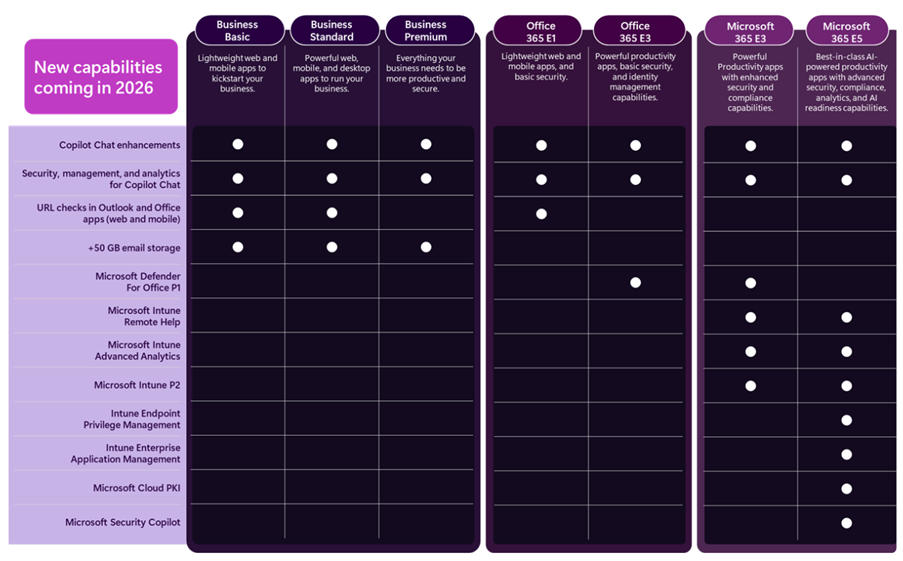
This free entry point to Copilot, included with various Microsoft products, will have new features to work with Outlook inboxes and calendars and standard access to Agent Mode. There will also be additional management and security capabilities around Copilot Chat.

Enhancing Copilot Chat makes sense as an entry point into M365 Copilot…effectively a “freemium” model albeit in a product you’re already paying for.

Addition Security Features

Microsoft Defender for Office 365 Plan 1, currently only available with Microsoft 365 E5, is being added to:

  • Microsoft 365 E3
  • Office 365 E3

It appears that all features are being added but that is to be confirmed.

Furthermore, URL checking features are being added to Office 365 E1, Business Basic, and Business Standard. The Business SKUs (including Premium) are all getting 50GB email inboxes too.

Boosting the security capabilities of lower SKUs is a welcome move, given the importance of security in today’s tech world.

Endpoint Management

A range of Microsoft Intune products are being added to both Microsoft 365 E3 and E5, these are:

  • Intune Plan 2
  • Intune Advanced Analytics
  • Intune Remote Help

While M365 E5 will also receive:

  • Intune Endpoint Privilege Management
  • Enterprise Application Management
  • Microsoft Cloud PKI
https://www.microsoft.com/en-us/microsoft-365/blog/2025/12/04/advancing-microsoft-365-new-capabilities-and-pricing-update/

Security Copilot and Microsoft 365 E5

The Microsoft announcement also talks about the adding of Security Copilot SCUs to Microsoft 365 E5. I covered that a few weeks ago here – https://cloudywithachanceoflicensing.com/2025/11/20/microsoft-security-copilot-scu-included-with-microsoft-365-e5/

2026 Pricing

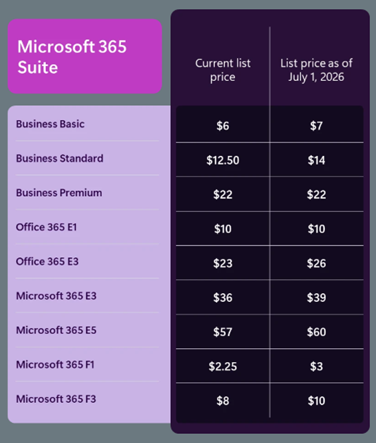
Of course, these new features come at a cost. Pricing for the included suites will be increasing as of July 1, 2026 (aka Microsoftโ€™s new financial year)โ€ฆeven Microsoft 365 E5.

https://www.microsoft.com/en-us/microsoft-365/blog/2025/12/04/advancing-microsoft-365-new-capabilities-and-pricing-update/

M365 E3 increases by 8% and M365 E5 by 5%. An organisation with 15,000 E5 SKUs will see an increase of $1.6 million over a 3-year contract – so understanding how the additional features may work for you will help you decide what steps to take at renewal.

Something that I did notice is that, while there is no mention of new features being added to the Frontline Worker F SKUs, they too are increasing in price – with M365 F1 rising by 33% and M365 F3 by 25%.

8,000 F3 users will lead to an increase of almost $600,000 over 3 years…seemingly with no new features to show for it.

Note as well that these increases will also apply to non-profit pricing.

See the Microsoft post here – Advancing Microsoft 365: New capabilities and pricing update | Microsoft 365 Blog

What’s it all about?

ARPU (Average Revenue Per User) is a key metric for Microsoft (and all SaaS publishers) and this will help keep that growing for several more quarters through their next financial year and beyond. Increasing the amount they earn from each user is key to driving shareholder value…especially as the amount of new users to buy M365 licenses is decreasing. Higher pricing also increase the Customer Lifetime Value (CLV), another important metric that helps businesses plan future campaigns and initiatives.

There is the risk that customers will become angry and disillusioned and look for alternatives. However it’s likely that Microsoft are confident in their view that there are very few real alternatives to many of their products and, even when they are available, the time and effort involved in swapping will discourage most organisations. While some may leave, the increased revenue from those who stay will more than offset the losses.

For some organisations, the additional products in E3 and E5 may mean that they can reshape their licensing slightly โ€“ dropping additional SKUs or possibly even dropping from E5 to E3. However, it is yet another price increase from Microsoftโ€ฆparticularly galling if you donโ€™t need or want those additional features. Review your Microsoft budget projections and work to lock in the lower pricing for as long as possible.

Microsoft SQL Server 2025 Failover Rights – staying or going?


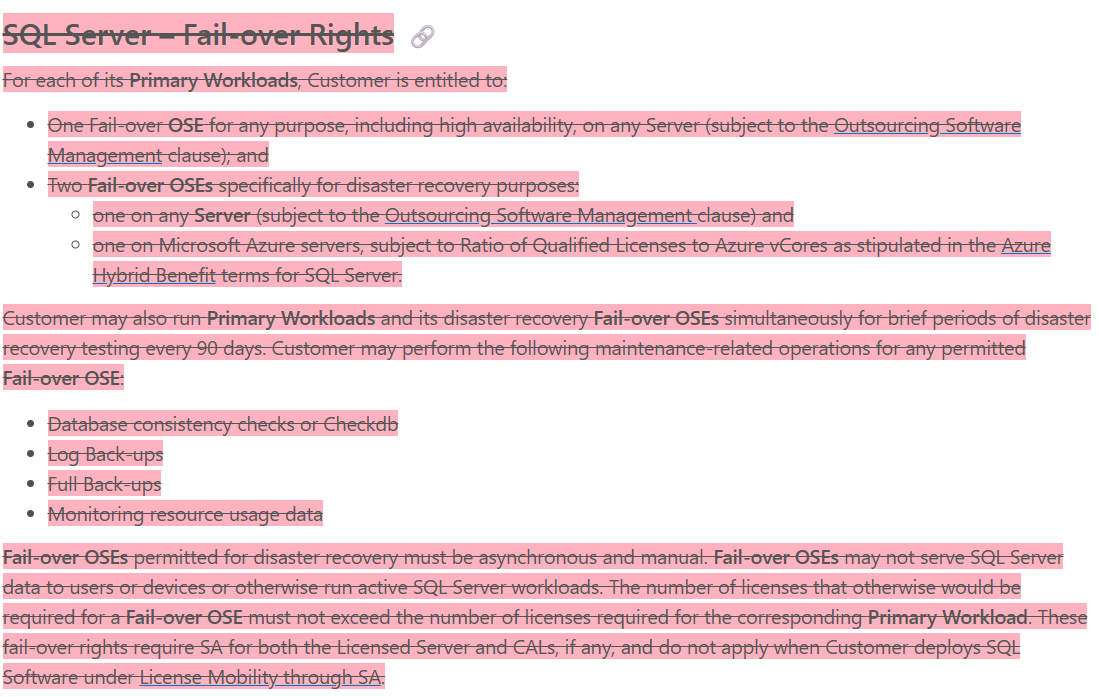
Microsoft released SQL Server 2025 on November 18th 2025 and updated the Product Terms. However, the update has caused confusion and consternation amongst the Microsoft community – as it seems to suggest that failover rights as a Software Assurance benefit have been removed!!! ๐Ÿ˜ฑ (Spoiler alert – it’s almost certain they haven’t).

If you’re not familiar with this right it means, in a nutshell, that organisations who purchase SQL Server licenses with Software Assurance (SA) may license additional servers at no extra cost, as long as those servers are used only for disaster recovery/failover purposes. This is a long standing and widely used benefit – removing this right will mean one of 2 things:

  • Organisations’ SQL Server licensing will double/triple by millions of ยฃ/$/โ‚ฌ more per year
  • Organisations will be forced to have less resilient SQL Server systems, potentially leading to more downtime and lost revenue

Ultimately, if either of those were the case, I believe it would lead to a mass exodus of SQL Server customers. Microsoft may hope they would move to SQL Azure/SQL Server enabled by Azure Arc but I’d expect many to explore other options – Oracle, Postgres, Amazon RDS etc.

Largely because of that, and the fact that we have seen an increase in Product Terms errors over the last couple of years, I’m of the opinion that it is an error and will – eventually – be corrected…but it is worth looking at anyway.

As I was about to press publish, Peter Van Uden has commented on LinkedIn that he’s had confirmation that it is an error and will be corrected in the coming days.

Fellow Microsoft watcher Alex Golev noticed that the whole section had been deleted without replacement:

Other parts of the Product Terms still refer to this section which suggests this is an erroneous deletion…but it could also mean that they just didn’t edit those sections correctly.

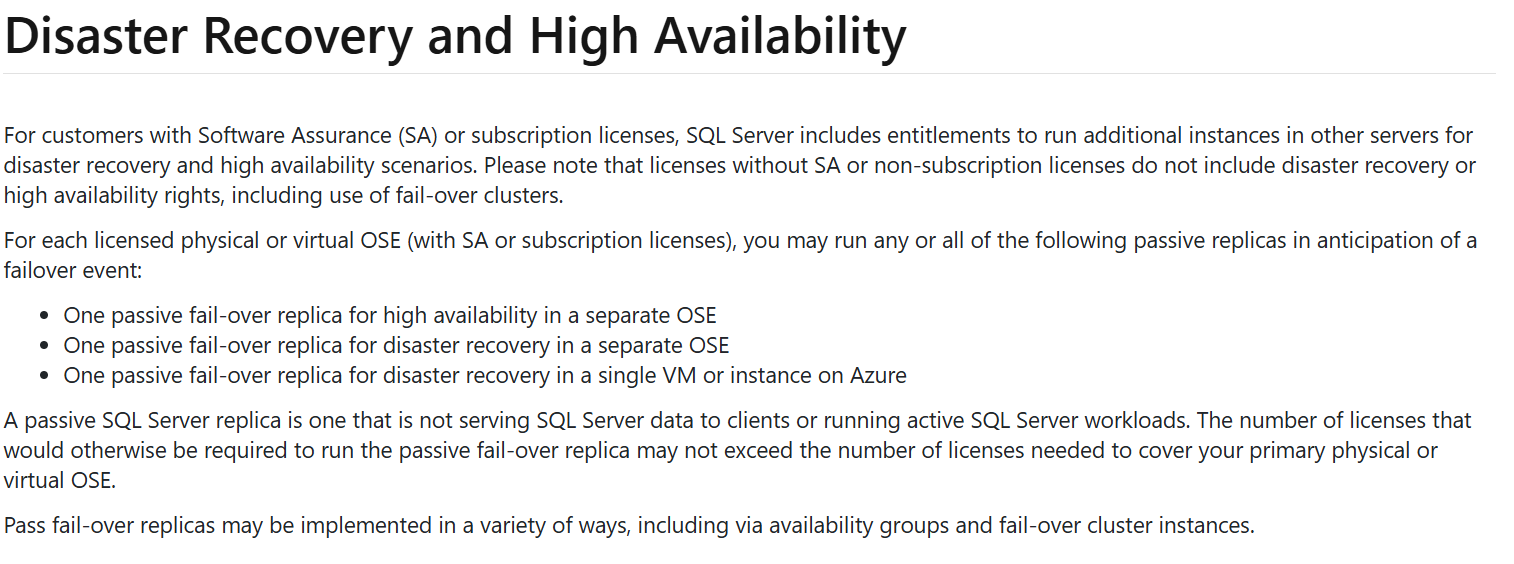
This Microsoft page – https://www.microsoft.com/licensing/guidance/SQL?msockid=144db73d53b469e721fda347528468b6 which is licensing guidance for SQL Server 2025 still contains the failover rights information:

I genuinely believe this is an error. It is a huge change that would have significant consequences for most Microsoft customers, including their largest and most significant customers. Making this change would be an enormous risk and to do so without any official announcement or warning is unbelievable. I’m sure we’ll see a reversal in the coming days and that’s why I haven’t posted about this already.

However, I feel it does highlight the increasingly slapdash approach that has been taken to the Microsoft Product Terms since it became an online site, rather than document downloads. It seems likely to me that updates are being made by people with little understanding of software licensing and so they don’t see the consequence of their actions.

The fact that it’s 4 days since this change was made and there has been no word from Microsoft is disappointing – but hopefully that correction will appear soon.

So, don’t panic but do remember that these things happen and that Microsoft experts like me, Alex, Peter and more can be very useful in these scenarios. ๐Ÿ˜

Update: The missing text has been reinstated so the panic is over. It does highlight the need for us all to be vigilant in the future though.

Microsoft announce new European Cloud options


Microsoft announce new cloud options for Europe. There is an increasing push back from European organisations, particularly Government, against so many critical services and so much data all being run out of the US…this has been accelerated by the current geo-political situation too.

These announcements are Microsoft’s attempt to pre-emptively stem the flow of European customers away from their cloud services.

Altogether we’ve got:

  • Sovereign Public Cloud
  • Sovereign Private Cloud
  • National Partner Clouds
  • Microsoft 365 Local
  • Data Guardian
  • External Key Management
  • Regulated Environment Management

Microsoft 365 Local is interesting but the MS announcement only talks about productivity workloads like Exchange Server & SharePoint Server. Does M365 Local include Teams, Stream, ClipChamp, Planner etc.? ๐Ÿคทโ€โ™‚๏ธ

Sovereign Public Cloud

Will be offered across all existing European datacentre regions, for all European customers, across enterprise services such as Microsoft Azure, Microsoft 365, Microsoft Security and Power Platform.

Customer data stays in Europe, under European Law, with operations and access controlled by European personnel, and encryption is under full control of customers.

Sovereign Private Cloud

Will support critical collaboration, communication and virtualization services workloads on Azure Local. This solution now integrates Microsoft 365 Local and the security platform with Azure Local, providing consistent capabilities for hybrid or air-gapped environments to meet resiliency and business continuity requirements

National Partner Clouds

Available in France (Bleu) & Germany (Delos Cloud), these will offer comprehensive capabilities of Microsoft 365 and Microsoft Azure in an independently owned and operated environment.

Microsoft 365 Local

Microsoft 365 Local provides customers with additional choice by bringing together Microsoftโ€™s productivity server software into an Azure Local environment that can run entirely in a customerโ€™s own datacentre.

This provides a simplified deployment and management framework for organizations to run Microsoftโ€™s trusted productivity servers in environments they fully control. It remains to be seen exactly what is included and how the licensing works…

Data Guardian

Data Guardian will add an additional level of assurance by ensuring that only Microsoft personnel residing in Europe control remote access to these systems and adds additional human and technical oversight whenever engineers outside of Europe need access.

All remote access by Microsoft engineers to the systems that store and process your data in Europe is approved and monitored by European resident personnel in real time and will be logged in a tamper-evident ledger.

External Key Management

With external key management, customers can connect Azure to keys stored on their own Hardware Security Module (HSM) on-premises or hosted by a trusted third party.

Regulated Environment Management

The Regulated Environment Management service will allow customers to easily manage all these features in one place (for instance, configuring Data Guardian policies or reviewing access log entries).

The Microsoft announcement is here.

Microsoft Product Terms: March 2025


Photo by Markus Winkler on Pexels.com

Removed “without Microsoftโ€™s prior written approval” from the clause preventing using MS service to mine crypto…I guess they realised they were never going to give anyone permission for this!

Changed the Use Rights for Azure Local software from:

“Customer may use the Azure Local software only (i) onย serversย dedicated to Customerโ€™s internal use“

to

“Customer may use the Azure Local software only (i) onย devices dedicated to Customerโ€™s internal use“

Microsoft say this represents a move to “include smaller, more affordable devices than traditional servers“

They also removed the following clause “Any customer support for Azure Local that may be available from Microsoft requires that Azure Local runs on server hardware that is pre-validated and listed in the Azure Local catalog or any successor.”

Added Microsoft 365 Copilot Chat to the list of EU Data Boundary Services

March 5th

You can now add the Microsoft 365 E5 Security add-on to the Business Premium SKU.

March 12th

Added a section on Data Handling of Query Data with M365 Copilot & M365 Copilot Chat:

  • Microsoft has no rights in Query Data other than as needed to provide the services,
  • Query Data is not used to improve Bing,
  • Query Data is not used to create advertising profiles or track user behavior,
  • Query Data is not shared with advertisers or otherwise beyond Microsoft and its contracted suppliers who are subject to terms no less protective than these provisions,
  • Query Data is not used to train generative AI foundation models, and
  • Query Data is treated as Customer confidential information and protected by appropriate technical and organizational measures.

Clarification that certain concurrent use rights for Defender on up to 5 devices does not include Server OSEs:

  • Eligible Licensed Users may use Microsoft Defender for Business on up to five concurrent devices. Customer may not use a Microsoft Defender for Business User SL with server OSEs.
  • Eligible Licensed Users may use Microsoft Defender Vulnerability Management or Microsoft Defender Vulnerability Management Add-on on up to five concurrent devices. Customer may not use Microsoft Defender Vulnerability Management or Microsoft Defender Vulnerability Management Add-On User SLs with server OSEs.

Microsoft 365 Copilot Chat


Microsoft have launched a new addition to the Copilot family, confusingly called Microsoft 365 Copilot Chat.

Copilot Chat was already a thing (that is different to Copilot Biz Chat) and this seems to be a re-positioning as they add some new capabilities too. It is a basic, entry point tool that sits below Microsoft 365 Copilot.

Microsoft 365 Copilot Chat is free and has access to internet info to give “web-grounded” responses. Additionally it can interact with Agents (more on that later) and also has elements of the “Copilot Control System” to help with corporate data privacy.

The table below shows how it stacks up against the “full” Microsoft 365 Copilot product:

https://www.microsoft.com/en-us/microsoft-365/blog/2025/01/15/copilot-for-all-introducing-microsoft-365-copilot-chat/?msockid=1c5969e97aa36c313d327b0f7b586d33

One of the new additions is that users of this free product can use 2 types of agents on a Pay As You Go (PAYG) basis, they are:

  • “Tenant Graph” grounded agents
  • Autonomous action agents

“Tenant Graph” grounded means agents that can access internal company data as well as internet information, giving answers with additional, organisation specific info and context. This is an additional PAYG per-message cost for M365 Copilot Chat users but is included within the M365 Copilot license – adding a new variable to consider when pricing up licensing options.

Autonomous actions are where the agent uses “generatively orchestrated triggers, topics, data connectors, and workflows” to act on behalf of a user. This is an additional PAYG per-message cost for all users – it is an additional cost even for users licensed with M365 Copilot.

For more info and details on the PAYG per-message pricing model – see my post here.

You can see Microsoft’s announcement here.