Microsoft have announced that Viva Goals, their OKR tool, will be retired on December 31st, 2025 and that all new feature development ceased on December 4th, 2024.
The reason for this is that “overall adoption and usage of Viva Goals across the Viva Suite customer base hasn’t grown. Microsoft has been unable to reach the scale and impact needed to continue further investment“. This also means that Microsoft aren’t replacing Goals with another OKR tool so customers need to look at 3rd-party solution. If you email GoalsDecom@microsoft.com, Microsoft will offer help in that regard. The full FAQ page is here.
Continued access: Viva Goals will continue to be available to our existing customers until December 31, 2025, to provide you with an opportunity to plan for its end-of-life transition to other OKR solutions if desired. We will continue to maintain Viva Goals’ availability, accessibility, and security of the product, and provide product support until its retirement.
No new functionality Viva Goals will no longer add any new features or functionality to the product. All current design change requests (DCRs) will be closed and no new DCRs will be accepted.
Data migration options: Viva Goals offers data export features via API, Excel, and PowerPoint, allowing users to move their data to a solution of their choice. we recommend that users export their data before December 31, 2025.
They are keen to point out that they are still committed to the rest of the Viva Suite and further development and investment will continue.
I was quite excited about the launch of Viva Goals as I think the OKR model makes a lot of sense for businesses and being able to integrate it into Teams etc. seemed powerful. I wonder whether the failure of Viva Goals is due to Microsoft’s technology or perhaps simply that the OKR methodology isn’t widespread enough for a dedicated tool to reach critical mass?
Microsoft’s Get Licensing Ready (GLR) training platform is being shut down as of December 31st, 2024.
A mainstay of the Microsoft channel and pretty much every reseller salesperson’s introduction to the wonderful world of Microsoft licensing, GLR has been a trusty companion to many for decades. It has been around as long as I can remember (so at least 20 years) but it is now a casualty of Microsoft’s apparent lack of interest in licensing these days.
My post on LinkedIn has been one of the most liked, commented, and reposted for some time -showing the depth of affection for the platform…and also the concern that it’s going to get even more difficult for partners and customers to understand Microsoft licensing.
I haven’t done GLR for a few years but I plan to take them all again and get one last set of certificates for posterity’s sake.
Microsoft have announced changes to the Enterprise Agreement but, not unusually, it’s still all a bit unclear.
“Beginning January 1, 2025, a small percentage of cloud Enterprise Agreements (EA) in direct markets will no longer be eligible for renewal under the existing EA framework”
What exactly is a “cloud EA”? Is it where there is only Azure? Only Azure and M365?
Why not all cloud EAs?
How is that defined?
What will be the alternative?
“For enterprise customers, the Microsoft Customer Agreement for enterprise (MCA-E, the digital evolution of the traditional EA), will provide the optimal, streamlined solution.”
This is direct from Microsoft but is, in many ways, a “bigger” version of CSP rather than a slightly different EA.
So, “evolution” is an interesting choice. That implies a continuation whereas I’d probably us the word “replacement”…
Microsoft will begin notifying impacted customers in Jan 2025 that they cannot renew into the EA.
The post also says:
“Partners will continue to earn incentives when transacting EA renewals”
So they’re not all disappearing…at least not yet!
This marks yet another shift and yet another step towards more licensing business going direct to Microsoft.
To balance this out, they have also announced thst Copilot for M365/Sales/Service will be available on a monthly billing basis from December 1st…but will be 5% more expensive.
As well, all current monthly SKUs will have a 5% price increase from April 2025 and Power BI is increasing. I’ll do a separate post on that shortly.
It is interesting that the final section of the Microsoft post is titled “Microsoft is a partner-led company”…
If you have any questions, feel free to get in touch 😊
After a delay of several hours where the website wasn’t working (one of the perils of this current format), we can now see the changes this month are:
Windows Server 2025 added
Windows Server PAYG via Azure Arc is added
System Center 2025 added
Windows 10 ESU added
Various additional/refined terms for Azure Services
Let’s take a look at the Win Svr PAYG option in more detail based on the Product Terms:
Customer must have a valid Windows Server Standard or Windows Server Datacenter License to use the PAYG option. <– Just one license or all cores in the server?
For Licensed Servers running PAYG virtual machines, there are no restrictions on the number of PAYG virtual machines that can be deployed.
Additional virtualization rights are not granted. A separate License is required for each guest. <– So you don’t get 2 OSEs for Std and Unlimited for Datacenter…each PAYG VM needs to be paid for.
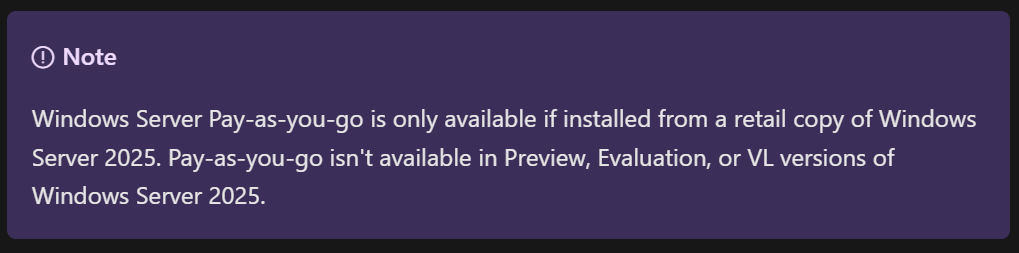
This, taken from the Microsoft Learn page, is very odd:
Apparently, you can only use Windows Server PAYG if you install a retail copy of Windows Server 2025?!
We have also seen that there will be a 10% price increase for Windows Server 2025 & System Center 2025 from December 1st 2024 and then also for SPLA from January 1st, 2025.