
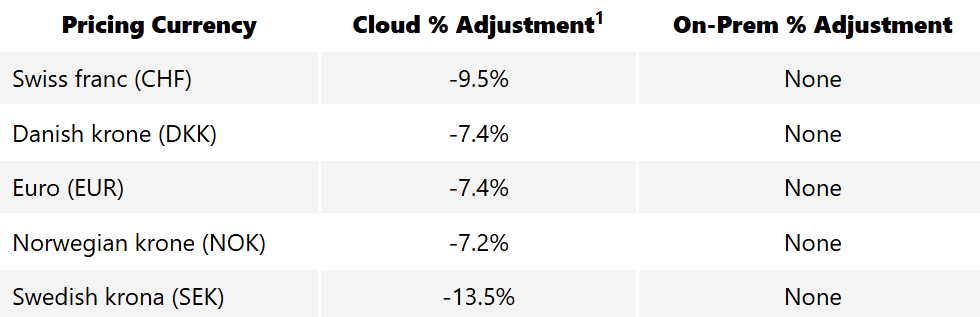
As part of their twice early price harmonisation efforts, Microsoft have announced price decreases for “Commercial Cloud” products in certain European currencies from February 1st, 2026:

Cloudy with a chance of Licensing
Latest news on Microsoft licensing, Cloud, and AI
As part of their twice early price harmonisation efforts, Microsoft have announced price decreases for “Commercial Cloud” products in certain European currencies from February 1st, 2026:

Following Microsoft’s Ignite 2025 conference, they have announced some feature additions to Microsoft 365…and some price increases to go along with it.
This free entry point to Copilot, included with various Microsoft products, will have new features to work with Outlook inboxes and calendars and standard access to Agent Mode. There will also be additional management and security capabilities around Copilot Chat.
Enhancing Copilot Chat makes sense as an entry point into M365 Copilot…effectively a “freemium” model albeit in a product you’re already paying for.
Microsoft Defender for Office 365 Plan 1, currently only available with Microsoft 365 E5, is being added to:
It appears that all features are being added but that is to be confirmed.
Furthermore, URL checking features are being added to Office 365 E1, Business Basic, and Business Standard. The Business SKUs (including Premium) are all getting 50GB email inboxes too.
Boosting the security capabilities of lower SKUs is a welcome move, given the importance of security in today’s tech world.
A range of Microsoft Intune products are being added to both Microsoft 365 E3 and E5, these are:
While M365 E5 will also receive:
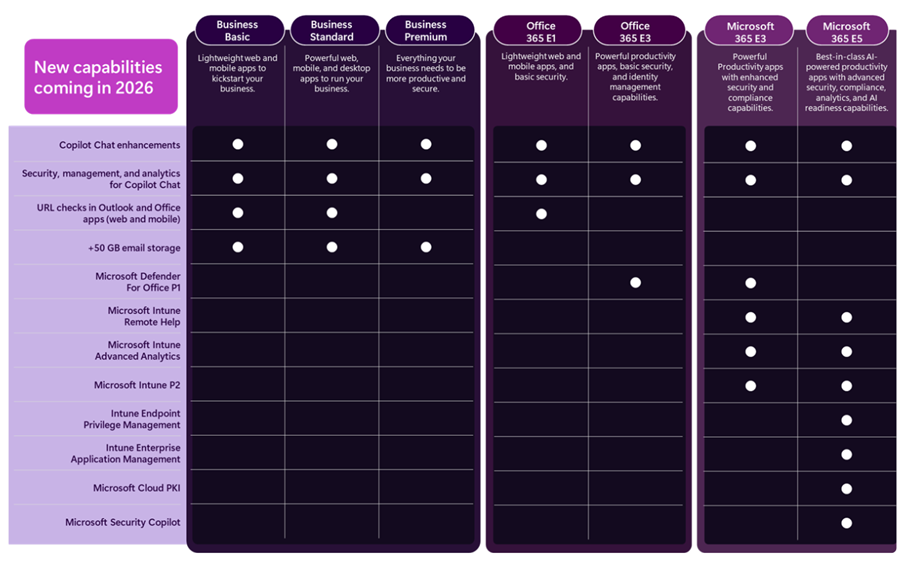
The Microsoft announcement also talks about the adding of Security Copilot SCUs to Microsoft 365 E5. I covered that a few weeks ago here – https://cloudywithachanceoflicensing.com/2025/11/20/microsoft-security-copilot-scu-included-with-microsoft-365-e5/
Of course, these new features come at a cost. Pricing for the included suites will be increasing as of July 1, 2026 (aka Microsoft’s new financial year)…even Microsoft 365 E5.
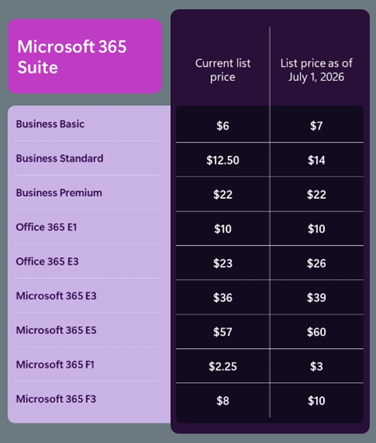
M365 E3 increases by 8% and M365 E5 by 5%. An organisation with 15,000 E5 SKUs will see an increase of $1.6 million over a 3-year contract – so understanding how the additional features may work for you will help you decide what steps to take at renewal.
Something that I did notice is that, while there is no mention of new features being added to the Frontline Worker F SKUs, they too are increasing in price – with M365 F1 rising by 33% and M365 F3 by 25%.
8,000 F3 users will lead to an increase of almost $600,000 over 3 years…seemingly with no new features to show for it.
Note as well that these increases will also apply to non-profit pricing.
See the Microsoft post here – Advancing Microsoft 365: New capabilities and pricing update | Microsoft 365 Blog
ARPU (Average Revenue Per User) is a key metric for Microsoft (and all SaaS publishers) and this will help keep that growing for several more quarters through their next financial year and beyond. Increasing the amount they earn from each user is key to driving shareholder value…especially as the amount of new users to buy M365 licenses is decreasing. Higher pricing also increase the Customer Lifetime Value (CLV), another important metric that helps businesses plan future campaigns and initiatives.
There is the risk that customers will become angry and disillusioned and look for alternatives. However it’s likely that Microsoft are confident in their view that there are very few real alternatives to many of their products and, even when they are available, the time and effort involved in swapping will discourage most organisations. While some may leave, the increased revenue from those who stay will more than offset the losses.
For some organisations, the additional products in E3 and E5 may mean that they can reshape their licensing slightly – dropping additional SKUs or possibly even dropping from E5 to E3. However, it is yet another price increase from Microsoft…particularly galling if you don’t need or want those additional features. Review your Microsoft budget projections and work to lock in the lower pricing for as long as possible.

BIG Microsoft news!
Are you a Microsoft EA customer with Online Services at Level B, C, or D pricing?
From November 1st, 2025:
“Microsoft will expand the set of products that have a single consistent price across Price Levels A-D to include all online services” on EA and MPSA agreements.”
The new pricing will be the same as on the Microsoft site once the waterfall discounts are removed.
This will take effect from your next renewal, or when you buy Online Services not on your CPS, post November 1st.
On-premises software pricing isn’t changing.
This is going to cause a lot of Microsoft bills to increase significantly – be prepared!
See the announcement here – https://www.microsoft.com/en-us/licensing/news/online-services-pricing-consistency-update

Microsoft have announced more price increases!
From July 1st, 2025 there will be a 10% increase for the on-premises versions of:
SharePoint Server
Exchange Server
Skype for Business Server
The Subscription Editions of Exchange and Skype will also be available from July 2025.
But wait – there’s more!
From the same date, Core CAL Suite will increase by 15% and Enterprise CAL Suite will increase by 20%.
*Update* The price increase for the CAL Suites has been pushed back to August 1st, 2025
See the announcement here: https://techcommunity.microsoft.com/blog/microsoft_365blog/licensing-and-pricing-updates-for-on-premises-server-products-coming-july-2025/4400174
Microsoft price increases are coming – again. They have announced they will be performing “price harmonisation” in 2023 – where they will be bringing local currency pricing in line with US Dollar (USD) pricing. They say this is to give customers “more consistent pricing”, but I’d say it mainly to stop organisations purchasing in regions other than their primary location.
They state that some products in some regions are up to 40% cheaper than the US pricing and I believe the Euro is around 15% cheaper. Once the initial adjustment is made, Microsoft will continue the process on a 6-monthly cadence going forward to keep ensuring local pricing doesn’t drift too far from USD again. They do say that prices will be “aligned up or down” so it will be interesting to see what happens to pricing in regions such as Australia that typically pay more than USD for more products.
While the focus of the announcement is cloud pricing, on-premises software pricing will also be affected although Microsoft will consider “local and regional market dynamics including competition, business models, local currency rates and local inflation” – which includes rising energy costs.
More changes for Japan & Korea
Alongside the above, Microsoft have also revealed they will be revising pricing across all products (on-premises and cloud) in Japan & Korea from April 1, 2023. The increases are as follows:
Japan
See Japanese announcement here.
Korea
Those of you with long-term contracts such as Enterprise Agreements won’t be affected until your renewal (or if you add new products) but now is the time to start planning how this will alter budgets over the next few years. Also, don’t forget the O365/M365 price increases in March 2022 that will also kick in on certain products you may have on your contract.
Update
An announcement on Jan 5th, 2023 for price increases across GBP, EUR, DKK, NOK, SEK currencies.
Sign up to my monthly Microsoft newsletter here.

For those that haven’t seen, Microsoft have announced increases to the list pricing of Office/Microsoft 365 that will take effect from March 2022. The new per user per month pricing will be:
Note, there are no prices increases for Microsoft 365 E5 or the “F” SKU products. Microsoft have stated that they “want to make it more economically transparent that E5 represents the best value” and that this increase reduces the gap between M365 E3 and E5.
While price increases are never anyone’s favourite thing, and a 25% increase for E1 is certainly pretty sizeable – my main feeling is that, actually, this isn’t the end of the world or VENDOR LOCK-IN writ large. These are the first such price increases in about a decade and I don’t think that they are unreasonable or an example of Microsoft abusing their position or their customers.
In a nutshell, Microsoft have added a LOT of stuff to O/M365 over the years and it is better than it used to be. Microsoft say they have added 24 new apps and over 1,400 new features since Microsoft 365 was introduced. These include:
Microsoft also include the Power Platform apps but, as they’re relatively new and pretty limited without extra licensing, I’m not sure how much value they’re adding right now tbh.
Taking Teams as an example, it is miles ahead today of Teams on Day 1 as so many new features and capabilities have been added. I’d say that most customers have probably found an extra $2-$4 (pupm) value from the additions over the years…if you’ve started using OneDrive or Teams for example.
Often, people will say something like “no-one is using every feature in their subscription” as a “gotcha” in these cases – that’s absolutely true and will always be the case. No person or organisation will ever use every feature in everything – and they don’t have to. An organisation simply needs to use enough of a product that it adds value to their business by helping them do something new/faster/better etc.
I haven’t watched everything on Netflix and I never will, but as long as I keep watching enough each month, and they keep adding new content, that I’m getting value – that’s fine. It’s well known that product adoption can be more difficult that expected for organisations, and it often becomes more difficult the larger the user base. That said, if an organisation truly hasn’t seen an increase in value that far outstrips this price increase, a review of what they’re buying and how they introduce new software to their users is urgently required.
All this said – if these price increases become a regular thing from Microsoft – every 1 – 3 years for example – then my tune will surely change! However, if they continue to add new apps and features and keep price increases few and far between (and at a reasonable level) – it seems fair enough to me if I’m honest.
However, doing it a month after announcing almost $70 billion annual operating income isn’t the greatest timing! While I think the principle is sound, if you can make that much money…do you really need to increase the price? Just because you can doesn’t mean you should…
For end user organisations, this is absolutely a great opportunity to review your Microsoft spend and strategy though.

Now that Windows 365 has hit General Availability, Microsoft have also listed the public pricing online.
Pricing is per user per month and ranges from $20 to $162, the entry level giving you:
and the most expensive providing:
You are able to upgrade to a more powerful machine by “resizing” however, the ability to downgrade the machine is not currently available.
Microsoft also make it clear that Azure Bandwidth charges (see them here) will apply on top of any Windows 365 Enterprise charges. For the Business version, there is a monthly per user outbound data cap that ranges from 12GB to 70GB, depending on your plan.
Furthermore, Windows 365 Enterprise requires license pre-requisites including:
but Windows 365 Business has no such requirements – it is a standalone offering.
Windows 365 also introduces a new term “Windows Hybrid Benefit” (not to be confused with “Azure Hybrid Benefit”).
Applicable to Windows 365 Business (the sub-300 license offering), this gives a discount of up to 16% for users who are the primary user of a Windows 10 Pro device – that is also their primary work device. Said device must be accessed at least once during the license subscription term.
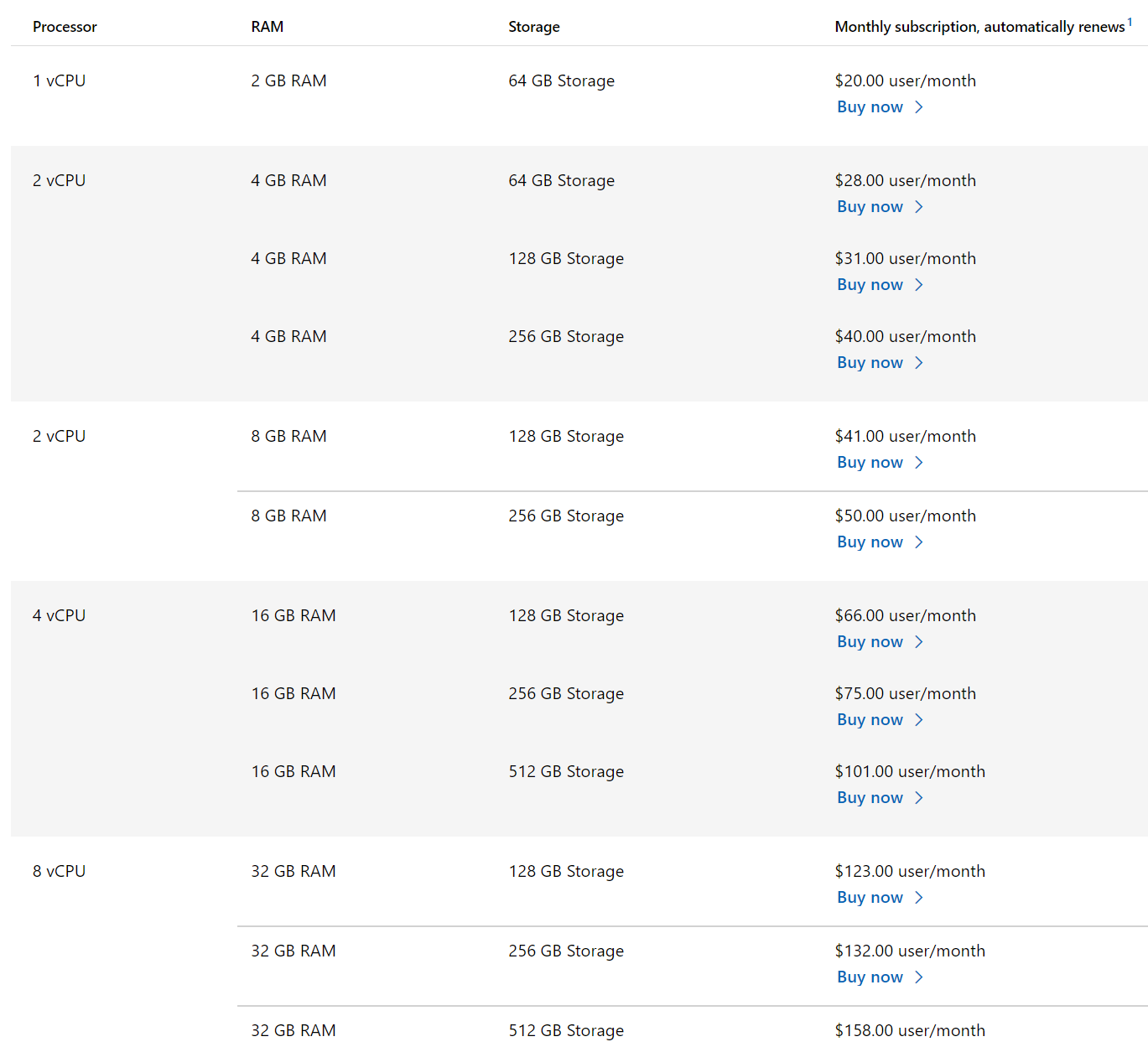
Here’s a screenshot of the full range of pricing for Windows 365 Business. Although WHB says it can save up to 16%, you can see below that all the WHB prices are simply $4 per user per month cheaper.

The pricing for Windows 365 Enterprise is:
The upcoming 2013 release of Microsoft’s Office suite & the related products brings with it not just great new features but also price increases.
The affected products and the expected increases are:
An increase in price when a new version is released is quite common, with most manufacturers, but coupled with the December 1st 15% increase on user CALs and just 6 months after the up to 30% price rise relating to the Euro/GBP levelling – I do not anticipate this being well received by customers!
The big takeaway from this is *If you’re looking at purchasing these products, look at the cost of buying now with SA (as well as the extra benefits) compared to the projected costs from December onwards*.
There are also a number of licensing changes about to take effect:
Lync
Lync Server Std & Enterprise are merging into 1 SKU, with a price of around £2000+ – a significant increase over the current Lync Std price. This does bring the failover & load balancing features to all Lync 2013 organizations.
Sharepoint
Microsoft have, in many areas, moved to simplify licensing and SharePoint is another area.
FAST Search Server & Search Server are no longer separate entities, they’re now simply part of SharePoint Server 2013.
A big one here, SharePoint for Internet Sites is no more. Microsoft have done away with the (up to) £30,000+ license, which was required for external user access to SharePoint content, and rolled those licensing rights into the standard server license. From the October Product Use Rights (PUR) document:
“CAL WAIVER FOR USERS ACCESSING PUBLICLY AVAILABLE CONTENT
CALs are not required to access content, information, and applications that you make publicly available to users over the Internet (i.e., not restricted to Intranet or Extranet scenarios).”
I imagine that this will partially contribute to the increase in price we’re seeing with 2013.
Exchange
Basic Anti-Malware protection will be baked into Exchange Server 2013
External Connectors
External connector licenses have been removed for both Exchange 2013 & Lync 2013. Again from the October 2012 PUR:
“External User Access: Licensed with Server”
Visio
Again in a move to simplify the SKU line up and make it easier for customers to make the right selection, Visio Premium is being discontinued and all it’s extra features will be moved into Visio Pro 2013.
Software Assurance
Organizations who purchased any products that are due to be discontinued along with Software Assurance need not worry, your benefits will continue and you will receive access to the relevant 2013 version.
Office 365
Something that Microsoft have not mentioned much at all and have in fact been reluctant to discuss, is that Visio & Project are being made available online via Office 365. This will be of big benefit to many customers, enabling easier collaboration among staff no matter their location.
Another benefit of this may well be around Software Asset Management (SAM). It’s common to see organizations over licensed for Project & Visio, Office 365 may make it easier for them to track how many licenses they have and who they are assigned to.
 Cloudy with a chance of Licensing