The European Commission (EC) announced on July 27th, 2023 that they have opened a formal investigation into Microsoft. The focus is whether they have breached EU anti-competition rules through the bundling of Teams with Office/Microsoft 365.
Slack filed a complaint back in July 2020 that alleged Microsoft had:
“created a weak, copycat product and tied it to their dominant Office product, force installing it and blocking its removal, a carbon copy of their illegal behavior during the ‘browser wars.”
and now the European Commission have taken it up. I take it that at least part of the 3 year gap has been used by the EC to look into the situation and decide that there is merit to it being investigated formally.
“concerned that Microsoft may grant Teams a distribution advantage by not giving customers the choice on whether or not to include access to that product when they subscribe to their productivity suites and may have limited the interoperability between its productivity suites and competing offerings.
These practices may constitute anti-competitive tying or bundling and prevent suppliers of other communication and collaboration tools from competing, to the detriment of customers in the European Economic Area (‘EEA’)”
This isn’t the first time Microsoft have been here with the EU so I thought a little look back would be in order 😊
Media Player and the N SKU
As well as the “browser wars”, this is also reminiscent of the ruling in 2004 that Microsoft were guilty of breaching these rules by including Media Player with Windows, which led to the creation of the Windows “N” SKU…and a €497 million fine which was, at the time, the largest ever dished out by the EU.
In the 2004 ruling, the initial fine was €165 million which was then doubled to €331 million due to “Microsoft’s significant economic capacity” and finally an additional 50% was added due to the length of time the issue had been happening (5.5 years).
In FY 2003, Microsoft had revenue of $32.1 billion with operating income of $13.2 billion. In FY 2023, Microsoft had revenue of $211.9 billion and operating income of $88.5 billion…that’s a roughly 6.5x increase over the last 20 years. Should the EC decide to fine Microsoft in this latest case, simply multiplying the previous amount x 6.5 would come to a little over $3 billion!
It must be noted that the 2004 ruling was not just about Media Player, it also covered interoperability between Operating Systems.
The European Commission’s decision found that:
“Microsoft infringes Article 82 of the Treaty by tying WMP with the Windows PC operating system (Windows). The Commission bases its finding of a tying abuse on four elements:
(i) Microsoft holds a dominant position in the PC operating system market
(ii) the Windows PC operating system and WMP are two separate products
(iii) Microsoft does not give customers a choice to obtain Windows without WMP
(iv) this tying forecloses competition.”
What is Article 82?
“Article 82 of the Treaty” refers to the “Treaty establishing the European Community (TEC)” which is now Article 102 “Treaty of the Functioning of the European Union” (TFEU). This states:
“Any abuse by one or more undertakings of a dominant position within the internal market or in a substantial part of it shall be prohibited as incompatible with the internal market in so far as it may affect trade between Member States.
Such abuse may, in particular, consist in:
(a) directly or indirectly imposing unfair purchase or selling prices or other unfair trading conditions;
(b) limiting production, markets or technical development to the prejudice of consumers;
(c) applying dissimilar conditions to equivalent transactions with other trading parties, thereby placing them at a competitive disadvantage;
(d) making the conclusion of contracts subject to acceptance by the other parties of supplementary obligations which, by their nature or according to commercial usage, have no connection with the subject of such contracts.”
and is primarily focused on abuses by companies with a dominant position.
My thoughts
It’s true that you don’t get a choice as to whether Teams is included in your Office package when you purchase it. It is possible to prevent Teams from installing with M365 Apps, it isn’t the default option but the guidance is available here from Microsoft.
I can see it being quite likely that an organisation would stop paying for Slack once they purchased Office 365 and got Teams included with that, effectively for free. Now, with all the features and functionality it contains, I imagine that Teams would be successful as a standalone, paid for product but I suppose something the EC will consider is whether it would have reached that point without being bundled for the last few years? Also, what is the impact on consumers if Microsoft make O/M365 more expensive to include a paid-version of Teams?
Finally, I want to state that I Am Not A Lawyer and these are my own thoughts and musings on the subject based on the publicly available information.
Following recent security breaches where important information was only available to those customers paying for Office 365 E5, Microsoft have announced they are moving certain Microsoft Purview Audit features from the Premium tier into the Standard tier. Following urging from the ‘Cybersecurity and Infrastructure Security Agency’ (CISA), updates will start from September 2023.
Purview audit availability
Purview Audit Premium is only available with E5 licenses while Purview Audit Standard is part of:
Microsoft Business Basic/Standard subscriptions
Microsoft 365 Apps for Business subscription
Microsoft 365 Enterprise E3 subscription
Microsoft 365 Business Premium
Microsoft 365 Education A3 subscription
Microsoft 365 Government G1/G3 subscriptions
Microsoft 365 Frontline F1 or F3 subscription, or F5 Security add-on
Office 365 Enterprise E1/E3 subscription
Office 365 Education A1/A3 subscriptions
which covers a significantly wider portion of Microsoft’s customer base.
Customer with these licenses “will receive deeper visibility into security data, including detailed logs of email access and more than 30 other types of log data” and Microsoft are also doubling the default retention length from 90 to 180 days.
Microsoft Inspire saw a range of announcements about Power Automate licensing and a little bit of Power Apps too.
Power Automate Premium
From August 1st, 2023, the “Power Automate Attended RPA per user” license will become “Power Automate Premium” and will include:
“both unlimited cloud flows, known as digital process automation (DPA), and unlimited desktop flows, known as robotic process automation (RPA) in attended mode as well as entitlements to Power Automate Process Mining“
This new license is going to be $15 per user per month while the current price for Power Automate Attended RPA per user is $40 per user per month…a 62.5% reduction!
Available as an add-on to the Power Automate Premium license, this will cost $5,000 per tenant per month for 100GB of additional Process Mining data storage.
Power Automate Process
A new license that gives access to an automation bot “which can be used for unattended desktop automation (RPA), or to run an organization-wide cloud-flow based process that needs to be accessed by unlimited users in an organization“.
Power Apps Premium
The “Power Apps per User” license is being renamed to “Power Apps Premium“.
June 31st saw the end of another financial year for Microsoft and, despite there being many 1000’s of layoffs, the final numbers were very positive indeed for Redmond – yet again.
Full year FY23 results
Overall revenue = $211.9 billion, up 7%
Operating Income = $88.5 billion, up 6%
For specific product areas:
Dynamics 365 surpassed $5 billion
Microsoft Cloud hit $111 billion
Azure Virtual Desktop & Windows 365 combined for $1 billion
Q4 FY23 results
Revenue = $56.2 billion, up 8%
Operating Income = $24.3 billion, up 18%
Then looking at the individual business units we see:
Productivity & Business Processes
Revenue was up 10% to $18.3 billion and within that:
Office 365 Commercial up 15%
Dynamics 365 up 26%
LinkedIn up 5%
Intelligent Cloud
Revenue was up 15% to $24 billion and this included Azure (and other cloud services) growth of 26%. Nadella mentioned that optimisation is continuing within Azure and there were a record number of contracts over $10 million as well as the highest annualized value for long-term Azure contracts.
Microsoft Cloud
This isn’t a Business Unit but rather a grouping of various cloud products including:
Azure
O365 Commerical
Dynamics 365
Parts of LinkedIn
“Other cloud properties”
and this hit $30.3 billion for the quarter (up 21%) and $111 billion for the year. Satya Nadella mentioned that Azure was over 50% of this for the first time…which puts a number of just over $55 billion on annual sales for Azure. That means (according to this list) if Azure became its own company, it would be approx. the 64th biggest company in the US, surpassing Novartis, Cisco, Nike, Oracle, and Coca-Cola among others.
Earnings call comments
recognition from Copilot will be weighted towards the 2nd half of this financial year, which suggests M365 Copilot won’t be generally available until later in 2023 – perhaps October?
Azure Arc now has 18,000 customers, a 150% Year on Year (YoY) increase
Microsoft Fabric has over 8,000 trial customers
Viva has over 35 million Monthly Active Users (MAU)
EMS has over 256 million users (up 11%)
Teams Premium has over 600,000 seats
Teams Phone PSTN users increased 45% YoY to 17 million
Making it the “market leader in cloud calling” according to Nadella
Teams Revenue more than doubled YoY
Microsoft 365 saw a record number of $10 million+ contracts
They saw “particular strength” in Office 365 upsell at renewal
Things are all going in the right direction and there’s plenty of room for growth in areas like Azure Arc, Fabric, Windows 365, and Teams Premium.
Microsoft Inspire 2023 saw the announcement of two services that have been long awaited:
Microsoft 365 Backup
Microsoft 365 Archive
While 3rd-parties such as AvePoint, Veritas, Veeam, and SkyKick have offerings, many customers have wanted a native Microsoft product.
Microsoft 365 Backup
This provides protection and restore for:
OneDrive
SharePoint
Exchange
and keeps all data within the Microsoft 365 security boundary. You will be able to:
Backup all or select SharePoint sites, OneDrive accounts, and Exchange mailboxes in your tenant.
Restore files, sites, and mailbox items in your tenant in parallel to a prior point-in-time in a granular manner or at massive scale.
Search or filter content in your backups using key metadata such as item or site names, owners, or event types within specific restore point date ranges.
It will be accessed via the M365 Admin Center.
Microsoft 365 Archive
This will provide a cold storage tier within SharePoint for old/inactive data at a “cost effective price”. This will allow you to:
Select and archive or reactivate full sites in place without needing to migrate your data outside of Microsoft. File level archiving will be coming in the second half of 2024.
Maintain full admin-level search, eDiscovery, access policy, sensitivity label, DLP (Data Loss Prevention), retention policy, access control settings, and other security and compliance functionality.
Site-level archiving will be the only option at first until file-level archiving arrives mid-2024.
Overview
Sensibly, Microsoft have made APIs available for both services so partners (such as those mentioned above) can make use of this functionality too. Both of these new services are powered by Microsoft Syntex, a set of tools/products that is yet to truly find its place but is clearly becoming utilised more by Redmond.
You can see more info here and sign up for the previews of these products here.
Just 16 months since its first rebrand in years to become the “Microsoft Cloud Partner Program”, the Microsoft Partner program is now the “Microsoft AI Cloud Partner Program”.
As far as I can see, nothing is changing within the program itself – including the Solution designations. Just as adding the word “cloud” showed Microsoft’s focus in March 2023, this clearly demonstrates that AI is going to be a key part of Microsoft’s strategy for the future.
ISV Partners can benefit from the newly available “ISV Success” program and an expanded range of benefits. ISV Success is, according to Microsoft, “the pathway for ISV partners within the AI Cloud Partner Program to access product and cloud benefits, demo and sandbox environments, technical consults to build and publish applications, and once published, sales and marketing benefits to help accelerate deals through marketplace“. One of those expanded benefits is the addition of GitHub Copilot towards the end of 2023.
Microsoft’s latest AI product Copilot, which promises to be a real game changer when it comes to applying Generative AI to business, now has pricing available.
It will cost $30 per user per month and, as we saw recently, will be an add-on license to Microsoft 365 E3/E5/Business Std/Business Premium.
That’s higher than I was expecting; I thought they’d go lower to ensure as many people as possible got on-board. I know there stand to be some really great time savings and productivity increases but an additional $360,000 per year for an organisation licensing 1,000 users seems quite steep.
Of course, many organisations won’t pay that price in reality with volume discounts on EA, negotiated discounts etc. but it will still represent a large investment for many.
Bing Enterprise Chat
This has also been announced – a way to give employees a more powerful way of searching without risking data leakage. Microsoft state:
“Chat data is not saved, and Microsoft has no eyes-on access – which means no one can view your data. And, your data is not used to train the models.”
This is included in Microsoft 365 E3/E5/Business Std/Business Premium free of charge and you can access Bing Chat Enterprise using your work account wherever Bing Chat is supported — Bing.com/chat and the Microsoft Edge sidebar. It will eventually be available as a standalone offering for $5 per user per month.
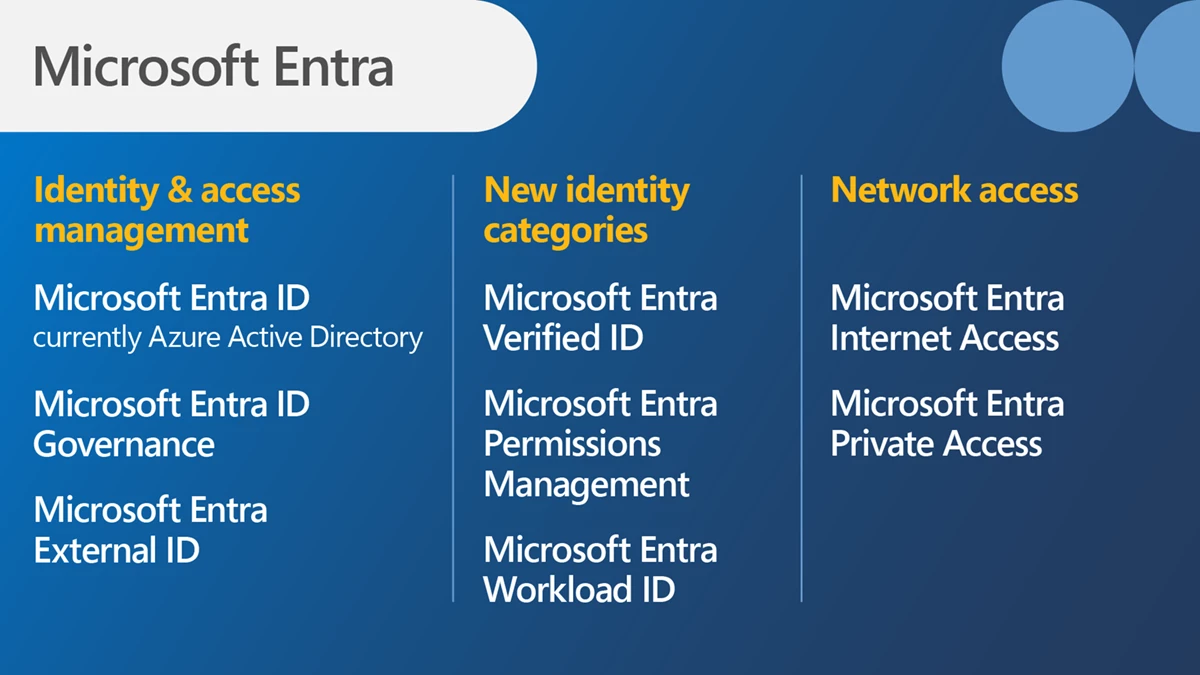
Microsoft have added 2 new products to their Entra family:
Microsoft Entra Internet Access
Microsoft Entra Private Access
Both are focused on security and protecting access to apps over the internet.
Microsoft Entra Internet Access
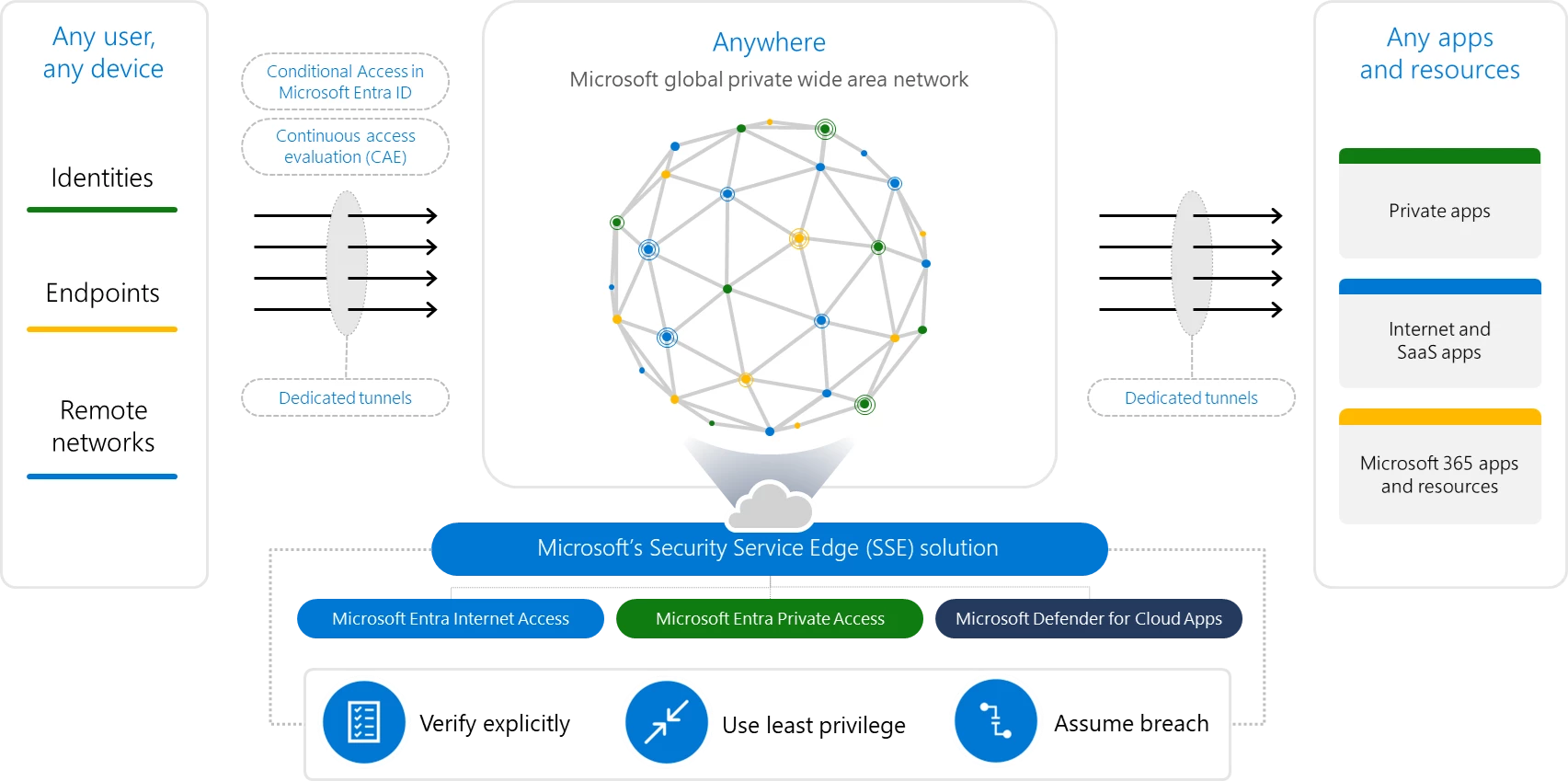
An identity-centric Secure Web Gateway that protects access to internet, SaaS, and Microsoft 365 apps and resources. It extends Conditional Access policies with network conditions to protect against malicious internet traffic and other threats from the open internet.
Microsoft Entra Private Access
An identity-centric Zero Trust Network Access that secures access to private apps and resources. It reduces operational complexity and cost by replacing legacy VPNs and offers more granular security. You can apply Conditional Access to individual applications, and enforce multifactor authentication, device compliance, and other controls to any legacy application without changing those applications
These 2 products, plus Defender for Cloud Apps, form what Microsoft call their Security Service Edge (SSE) solution:









 Cloudy with a chance of Licensing