Microsoft have announced changes to the Enterprise Agreement but, not unusually, it’s still all a bit unclear.
“Beginning January 1, 2025, a small percentage of cloud Enterprise Agreements (EA) in direct markets will no longer be eligible for renewal under the existing EA framework”
What exactly is a “cloud EA”? Is it where there is only Azure? Only Azure and M365?
Why not all cloud EAs?
How is that defined?
What will be the alternative?
“For enterprise customers, the Microsoft Customer Agreement for enterprise (MCA-E, the digital evolution of the traditional EA), will provide the optimal, streamlined solution.”
This is direct from Microsoft but is, in many ways, a “bigger” version of CSP rather than a slightly different EA.
So, “evolution” is an interesting choice. That implies a continuation whereas I’d probably us the word “replacement”…
Microsoft will begin notifying impacted customers in Jan 2025 that they cannot renew into the EA.
The post also says:
“Partners will continue to earn incentives when transacting EA renewals”
So they’re not all disappearing…at least not yet!
This marks yet another shift and yet another step towards more licensing business going direct to Microsoft.
To balance this out, they have also announced thst Copilot for M365/Sales/Service will be available on a monthly billing basis from December 1st…but will be 5% more expensive.
As well, all current monthly SKUs will have a 5% price increase from April 2025 and Power BI is increasing. I’ll do a separate post on that shortly.
It is interesting that the final section of the Microsoft post is titled “Microsoft is a partner-led company”…
If you have any questions, feel free to get in touch 😊
After a delay of several hours where the website wasn’t working (one of the perils of this current format), we can now see the changes this month are:
Windows Server 2025 added
Windows Server PAYG via Azure Arc is added
System Center 2025 added
Windows 10 ESU added
Various additional/refined terms for Azure Services
Let’s take a look at the Win Svr PAYG option in more detail based on the Product Terms:
Customer must have a valid Windows Server Standard or Windows Server Datacenter License to use the PAYG option. <– Just one license or all cores in the server?
For Licensed Servers running PAYG virtual machines, there are no restrictions on the number of PAYG virtual machines that can be deployed.
Additional virtualization rights are not granted. A separate License is required for each guest. <– So you don’t get 2 OSEs for Std and Unlimited for Datacenter…each PAYG VM needs to be paid for.
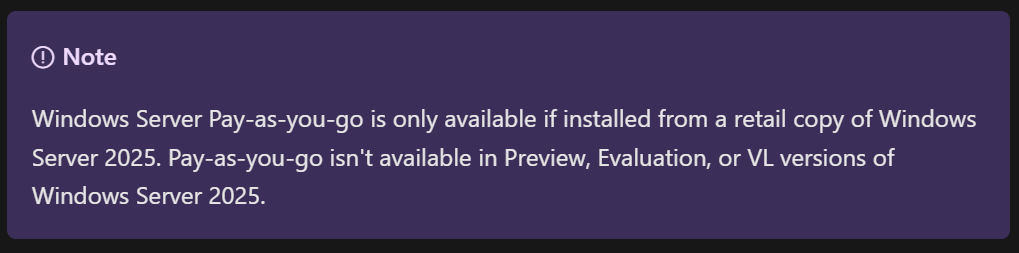
This, taken from the Microsoft Learn page, is very odd:
Apparently, you can only use Windows Server PAYG if you install a retail copy of Windows Server 2025?!
We have also seen that there will be a 10% price increase for Windows Server 2025 & System Center 2025 from December 1st 2024 and then also for SPLA from January 1st, 2025.
We’ve got some new M365 licenses added to EA, EAS, and MCA (CSP) – first up, a bunch more Frontline Worker SKUS:
10-Year Audit Log Retention
Defender Vulnerability Management
Entra Internet Access
Entra Private Access
Secure Access Essentials Frontline Worker
Also “Python in Excel” is now available as an add-on license for:
M365 Apps for Business/Enterprise M365 Business Standard/Premium O365 E3/E5
One would assume it can also be added to M365 E3/E5, as that includes Apps for Enterprise…but then why are Business Std/Prem listed separately?
It’s to be noted that “Python in Excel” has been in public preview since August 2023 with the features freely available for Excel within Microsoft 365 subscriptions. However, the intention has always been to move some of the features behind a paid license:
“While in Preview, Python in Excel will be included with your Microsoft 365 subscription. After the Preview, some functionality will be restricted without a paid license. More details will be available before General Availability.”
It’s the Microsoft Product Terms for August 2024 – the first of the new FY so not much going on but let’s take a look.
O365/M365 A1 added as a base license for Copilot for M365
The base licenses for Copilot for Sales & Services have been expanded, although not to the extent of Copilot for M365. You can now add these to: Microsoft 365 Business Basic/Standard/Premium/F1/F3/E3/A1/A3/E5/A5 Office 365 F3/E1/E3/A1/A3/E5/A5
Intune Frontline Worker SKUs added to MCA
Changes to (seemingly) tighten the wording around using Open AI content for training purposes.
It’s that time of year again – Microsoft have announced their Q4 and full financial year results…so let’s take a look.
Full Year FY24 Results
Revenue = $245.1 billion, a 16% increase
Net Income = $88.1 billion, a 22% increase
Microsoft Cloud = $135 billion +, a 23% increase.
Q4 FY 24 Results
Q4 Revenue = $64.7 billion, a 15% increase
Q4 Net Income = $22 billion, a 10% increase
Microsoft Cloud
This isn’t a Business Unit but rather a group of related products across the organisation including:
Azure
O365 Commercial
Dynamics 365
Parts of LinkedIn
“Other cloud properties”
Revenue was $36.8 billion, an increase of 21% Year on Year (YoY).
Microsoft note that gross margin decreased YoY to 69%. This is driven by “sales mix shift to Azure” but was partially offset by Microsoft making Azure improvements including scaling their AI Infrastructure.
Now let’s look at some of the individual Business Units and how they performed in Q4 FY24.
Productivity and Business Processes
Revenue = $20.3 billion, an 11% increase
Office 365 Commercial = 13% increase. Seat growth was again driven by SMB and Frontline Worker growth while Average Revenue Per User (ARPU) growth was driven by E5 and Copilot for M365.
LinkedIn = 10% increase
Dynamics 365 = 19% increase <– This is now almost 90% of all Dynamics revenue.
This gives a good overview of growth over the last 5 quarters:
Intelligent Cloud
Revenue = $28.5 billion, a 19% increase
Azure (and other cloud services) growth was 29% for this quarter, a little drop from the percentage point increase of the last 2 quarters but, as it’s Q4, likely increasing from a higher base. Microsoft highlight that 8 points of this growth was from AI services.
Amy Hood (CFO) states that AI demand is higher than Microsoft’s currently available capacity but they expect availability to increase in H2 FY25 aka Jan 2025 onwards.
Server Products grew by 2% this quarter, again driven by hybrid BYOL use with Azure Hybrid Benefit.
Overall growth over the last 5 quarters looks like this:
Overall business and FY25
In terms of how Microsoft are spending money, Amy Hood, CFO, stated that:
“Cloud and AI related spend represents nearly all of total capital expenditures [CAPEX]. Within that, roughly half is for infrastructure needs where we continue to build and lease datacenters that will support monetization over the next 15 years and beyond. The remaining cloud and AI related spend is primarily for servers, both CPUs and GPUs, to serve customers based on demand signals.”
Amy Hood gave her expectations for Q1 FY25 (and beyond) and they are:
Productivity and Business Processes
Expected revenue growth of between 10% and 11% in constant currency (or $20.3 to $20.6 billion), with O365 driven by E5 and Copilot for M365.
Intelligent Cloud
Expected revenue growth of 18 – 20% (or $28.6 to $28.9 billion) with Azure expected to be 28% – 29% up.
Earnings Call highlights
42 mentions of Copilot.
Number of customers with 10,000+ licenses of Copilot for Microsoft 365 doubled quarter over quarter,
Industry specific Copilots are here. DAX Copilot for Healthcare (over on the Nuance side of the portfolio) has over 400 customers currently.
Over 1,000 paying customers of Copilot for Security. Satya Nadella also states they have “1.2 million security customers” <– that indicates a lot of potential growth for Copilot there!
60,000+ Open AI customers – with average spend per customer increasing.
GitHub Copilot accounts for over 40% of GitHub’s revenue and is bigger than GitHub was when Microsoft acquired it.
36,000 Azure Arc customers, a 90% YoY increase.
14,000+ paying Microsoft Fabric customers.
48 million Monthly Active Users of Power Platform, a 40% YoY increase.
Over 40,000 organisations using Dynamics 365 Business Central.
Over 3 million users of Teams Premium.
More large-scale SAP workloads being migrated to Azure.
There was further growth in the “number of 10-million-dollar-plus and 100-million-dollar-plus contracts for both Azure and Microsoft 365“
Microsoft & CISPE have come to an agreement which takes some of the legal pressure off Microsoft and should lead to a more diverse cloud market…to a point.
Background
CISPE (the Cloud Infrastructure Service Providers in Europe) is, as its name suggests, a group comprised of, and working for, European Cloud hosting organisations including AWS, OVH, and Aruba.
In November 2022, CISPE filed a formal complaint with the European Commission about Microsoft’s “anti-competitive licensing practices” in the cloud. CISPE said:
“the new contractual terms imposed unilaterally by Microsoft on 1st October 2022 add new unfair practices to the list. Microsoft’s ongoing position and behaviours are irreparably damaging the European cloud ecosystem and depriving European customers of choice in their cloud deployments.”
The crux of the issue is that Microsoft’s licensing rules make it cheaper to run Microsoft workloads in Azure than any other cloud environment, thus giving them an unfair advantage against their competitors.
What’s happened now?
The two parties have signed a Memorandum of Understanding (MoU) where Microsoft have committed to make changes to address the claims and so CISPE have agreed to withdraw its complaint and also that they “will not initiate or support complaints on these issues in Europe or elsewhere”. Microsoft have also agreed to pay $22 million to CISPE to reimburse them for the last 3 years’ of “cost of litigation and campaigns for fair software licensing”.
Central to the agreement is Microsoft agreeing to release “Azure Stack HCI for Hosters”. This new Azure Stack HCI offering will include:
Multi-session virtual desktop infrastructure based on Windows 11
Free Extended Security Updates (ESU)
Pay-as-you-go licensing for SQL Server
Enabling 3rd-party cloud providers to close the gap between their services and those available in Microsoft Azure – a key part of the complaint.
There is a clock ticking for Microsoft now, as changes must be made within 9 months. They must release this new offering and/or solve the issues another way within that timeframe otherwise the complaint will be refiled with the European Commission.
It must be noted that CISPE state:
“Amazon Web Services, a CISPE member, was excluded from these negotiations and it, along with Google Cloud Platform and AliCloud, will neither benefit from nor be bound by these terms”
This means Microsoft’s “Listed Provider” exclusion still applies to this change.
European Cloud Observatory (ECO)
This new body, established by CISPE and including Microsoft, will monitor the development of “Azure Stack HCI for Hosters” and the fairness of Microsoft’s cloud licensing.
Reception
Not everyone is happy with this outcome. It has been reported that Google made an offer to CISPE worth almost $500 million, comprised of licenses and cash, for them to continue their compliant against Microsoft.
Additionally, Google’s Head of Platform, Amit Zavery, has said:
“Microsoft’s playbook of paying off complainants rather than addressing the substance of their complaint hurts businesses and shouldn’t fool anyone“
“Microsoft selectively making these changes for some CISPE members shows that there are no technical barriers that prevent Microsoft from making its software more easily available to rival cloud providers”
What’s next?
The Azure Stack for Hosters product will enable cloud providers to offer new features and capabilities that are attractive to customers, which is good. The main issue that many people may have is that this agreement excludes Amazon AWS and Google Cloud Platform, so their customers are no better off than before.
While that is true, I think it is also representative of what I believe is CISPE’s main aim – to help boost the non-hyperscaler cloud market in Europe. They want to help companies like OVH, Irideos, and UpCloud more so than Amazon and Google.
This is certainly not the end of this story. The cloud is going to be a battleground for many years to come and so licensing and competitive advantages will be a key issue for some time…








 Cloudy with a chance of Licensing