Microsoft have announced 3-year subscription terms on CSP for:
1) Microsoft 365 E3 (with and without Teams)
2) Microsoft 365 E5 (with and without Teams)
3) Microsoft Teams Enterprise
4) Microsoft 365 E5 Security
5) Microsoft 365 E5 Compliance
Numbers 1, 2, and 3 will be available from June 1, 2025 while 4 & 5 will come on July 1, 2025.
The price will be the same as 3 x 12-month subscriptions but of course, with the price protection against increases that a longer commit brings. It seems there will be a 100 SKU minimum for these 3-year SKUs.
This strengthens the push for smaller EA customers to move across to CSP and comes hot on the heels of the “channel transfers interface” to that launched in April to help partners renew Enterprise Agreements (EAs) into CSP and retain their existing rights to bundled Teams.
Microsoft have also announced enhanced investment in, and incentives for, CSP partners moving into FY26 from July 1st.
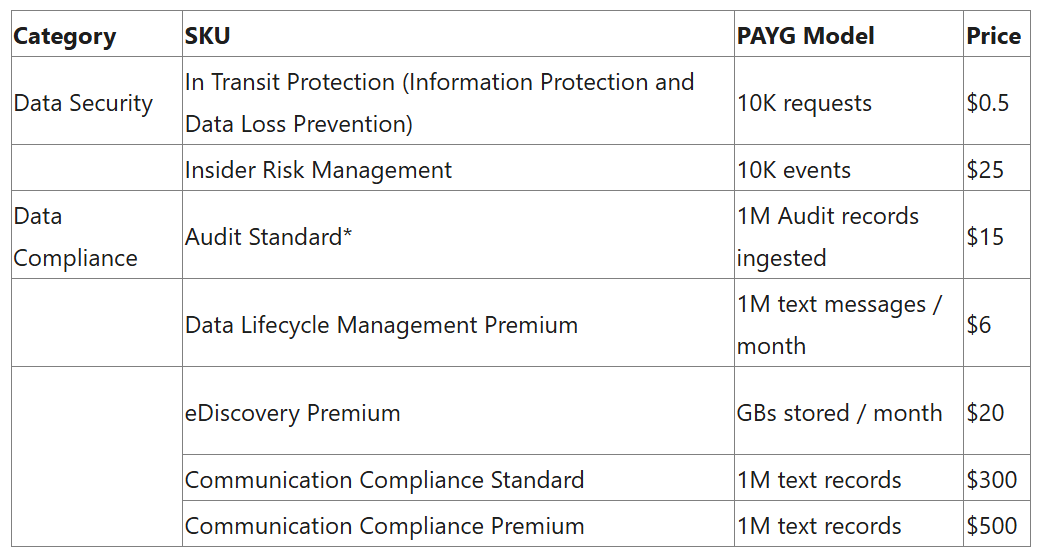
Microsoft Purview is a suite of products focused on data security, governance, and compliance across the Microsoft portfolio.
Microsoft first introduced Pay As You Go (PAYG) aka Consumption SKUs for Purview in January 2025 and now, from May 1, 2025 there are a new set. These new SKUs are aimed at protecting “your data as it moves across networks and through GenAI applications“.
The * is to note that Audit Standard is included within “Microsoft first party applications such as Microsoft 365 applications, Fabric, and Microsoft first party AI apps like Microsoft 365 Copilot, Security Copilot or AI applications custom-built using Copilot Studio“.
New metric/acronym alert! The 10,000 events for Insider Risk Management are known as a “Data Security Processing Unit (DPSU)”.
I notice that, for “Data Security Investigations”, Microsoft say:
“Data Security Investigations is billed through two meters: 1) the Data Security Investigations non-AI processing and storage meter and 2) Security Compute Units.
The Data Security Investigations non-AI processing and storage meter allows customers to store data related to an investigation. Security Compute Units are used to measure the computational capacity needed to run the AI analysis within DSI.”
Security Compute Units (SCUs) were introduced with Microsoft Security Copilot. It seems now that certain Purview PAYG usage may also consume your SCUs – needing further planning and budget insights.
Hotpatching – the ability to install patch updates without needing to restart the server – has been available in Microsoft Azure for a while. It is now coming to on-premises Windows Server 2025 machines…for a fee.
This new capability requires connection to Azure Arc and is currently free in preview but, from July 1 2025, it will cost $1.50 per core per month. That’s over $100,000 per year for 100 x 64 core servers…
If you’ve enrolled into the Preview, make sure you unenroll by June 30th to avoid being charged!
Interestingly, it doesn’t remove reboots completely but reduces the number from 12 per year to 4.
Frontline Worker Use Rights have moved to the Universal Terms for Online Services from product specific pages
A new definition for “Frontline Worker License” has been introduced in the Glossary
“Frontline Worker License means a license for a Microsoft Product designated with an “F”, “FLW”, or “Frontline” as identified in the Product Conditions table of product specific terms, which are subject to the Eligibility to Assign Frontline Worker Licenses terms in the Universal License Terms for all Online Services.”
Added Windows 10 ESU Cloud Managed SKUs
Removed Dynamics 365 Fraud Protection and Fraud Protection Additional Capacity from Availability tables
Updated Windows 365 Frontline terms and grant Windows 365 access rights for Windows Cloud PC OS
Added Windows 365 Disaster Recovery Plus Add-on to Availability Table
Removed “without Microsoft’s prior written approval” from the clause preventing using MS service to mine crypto…I guess they realised they were never going to give anyone permission for this!
Changed the Use Rights for Azure Local software from:
“Customer may use the Azure Local software only (i) on servers dedicated to Customer’s internal use“
to
“Customer may use the Azure Local software only (i) on devices dedicated to Customer’s internal use“
Microsoft say this represents a move to “include smaller, more affordable devices than traditional servers“
They also removed the following clause “Any customer support for Azure Local that may be available from Microsoft requires that Azure Local runs on server hardware that is pre-validated and listed in the Azure Local catalog or any successor.”
Added Microsoft 365 Copilot Chat to the list of EU Data Boundary Services
March 5th
You can now add the Microsoft 365 E5 Security add-on to the Business Premium SKU.
March 12th
Added a section on Data Handling of Query Data with M365 Copilot & M365 Copilot Chat:
Microsoft has no rights in Query Data other than as needed to provide the services,
Query Data is not used to improve Bing,
Query Data is not used to create advertising profiles or track user behavior,
Query Data is not shared with advertisers or otherwise beyond Microsoft and its contracted suppliers who are subject to terms no less protective than these provisions,
Query Data is not used to train generative AI foundation models, and
Query Data is treated as Customer confidential information and protected by appropriate technical and organizational measures.
Clarification that certain concurrent use rights for Defender on up to 5 devices does not include Server OSEs:
Eligible Licensed Users may use Microsoft Defender for Business on up to five concurrent devices. Customer may not use a Microsoft Defender for Business User SL with server OSEs.
Eligible Licensed Users may use Microsoft Defender Vulnerability Management or Microsoft Defender Vulnerability Management Add-on on up to five concurrent devices. Customer may not use Microsoft Defender Vulnerability Management or Microsoft Defender Vulnerability Management Add-On User SLs with server OSEs.
It’s the Microsoft Product Terms for February 2025:
Added Azure Managed Applications, Azure Resource Manager, and Cloud PC to the EU Data Boundary Services…which now also includes storage of Professional Services Data.
Added Microsoft Defender for Business customers can apply Defender for Business to five devices.
Removed Microsoft 365 Information Protection and DLP – Student Use Benefit Add-on from Availability and Prerequisite Tables.
Microsoft have announced their Q2 results for FY25 and, not surprisingly at all, they’ve earned a LOT of money and are talking a lot about AI!
Overall results
Revenue was up 125 to $69.6 billion and Net Income was up 10% to $24.1 billion. The over-arching “Microsoft Cloud” segment increased 21% to $40.9 billion while the AI business was approx. $3.25 billion as it had an annual run rate of $13 billion, which is 175% up year on year.
Satya Nadella sad:
“We are innovating across our tech stack and helping customers unlock the full ROI of AI to capture the massive opportunity ahead,”
Productivity & Business Processes
Revenue = $24.9 billion, up 14%
This was driven by a 16% increase in M365 Commercial cloud revenue and 19% revenue growth for Dynamics 365.
Microsoft saw “better-than-expected performance in E5 and M365 Copilot, both of which drove Average Revenue Per User (ARPU).
Intelligent Cloud
Revenue = $25.5 billion, up 19%
31% growth in Azure (and other cloud services)
Earnings Call
There were 54 mentions of AI throughout the call.
Over 19.000 paying customers for Microsoft Fabric.
30 million+ monthly active users (MAU) for Power BI, which is 40% up year on year.
200,000 MAU for Azure AI Foundry.
Over 400,000 custom agents created with Copilot Studio across 160,000 orgs in the last 3 months.
Continued growth in the number of $100 million+ contracts for Azure and M365.
More changes to the partner channel?
CFO Amy Hood stated:
“Growth in our non-AI services was slightly lower than expected due to go-to-market execution challenges, particularly with our customers that we primarily reach through our scale motions, as we balance driving near-term non-AI consumption with AI growth.”
She described the “scale motion” as “customers we reach through partners and through more indirect methods of selling” and alluded to changes around where investments, marketing spend, and internal resources would be positioned to help drive sales through the partner channel.
Nadella also said “How do you really tweak the incentives go to market? At a time of platform shifts, you want to make sure you lean into even the new design wins, and you just don’t keep doing the stuff that you did in the previous generation.“
This could be partly behind Microsoft’s increasing drive to take more customers direct, that it gives them more control over what’s happening to drive organisations towards new platforms and products.
Microsoft’s Get Licensing Ready (GLR) training platform is being shut down as of December 31st, 2024.
A mainstay of the Microsoft channel and pretty much every reseller salesperson’s introduction to the wonderful world of Microsoft licensing, GLR has been a trusty companion to many for decades. It has been around as long as I can remember (so at least 20 years) but it is now a casualty of Microsoft’s apparent lack of interest in licensing these days.
My post on LinkedIn has been one of the most liked, commented, and reposted for some time -showing the depth of affection for the platform…and also the concern that it’s going to get even more difficult for partners and customers to understand Microsoft licensing.
I haven’t done GLR for a few years but I plan to take them all again and get one last set of certificates for posterity’s sake.











 Cloudy with a chance of Licensing