SQL 2014 Release Date


Microsoft have announced that SQL Server 2014 has been RTM’d (Released To Manufacturing) and will be generally available from April 1st.

SQL 2014 brings a host of new and improved features, particularly around Business Intelligence and Cloud computing.

  • In-memory transaction processing (In-Memory OLTP), speeds up an already very fast experience by delivering speed improvement of up to 30x.
  • Customers do not have to rewrite their application or deploy new servers. We approached in-memory columnstore the same way – it is built into SQL Server.
  • Customers can easily and securely backup and recover on-premises SQL Server databases using Windows Azure
  • SQL Server 2014’s AlwaysOn technology was not just improved for this release, it was built to enroll Windows Azure virtual machines running SQL Server into a customers’ disaster recovery solution.

You can read more about this release here:

http://blogs.technet.com/b/microsoft_blog/archive/2014/03/18/sql-server-2014-released-to-manufacturers-will-be-generally-available-april-1.aspx?WT.mc_id=Blog_SQL_RTM_SQL14

Windows 8.1 Enterprise Upgrade


One of the fundamentals of MS licensing has been changed. It’s always been the case that:

“the only way to get Windows Enterprise is to buy Pro + SA”

Well not anymore!

As of March 2014, there is a standalone Windows 8.1 Enterprise SKU available via Volume Licensing.

Why?

This means organizations who can’t/won’t enter into an agreement with Software Assurance can now benefit from things such as:

  • Direct Access
  • AppLocker
  • Windows To Go

and more

Other SA benefits are not effected so things such as:

  • New Version Rights
  • MDOP
  • Virtualization

etc. are still only available with SA.

What else has changed?

It is now ONLY possible to attached SA to the Enterprise Upgrade SKU.

This takes away one relatively common practise. Organizations would often buy machines with Windows Pro OEM and then attach Windows SA within 90 days. This is no longer possible as SA can be attached only to Enterprise – and that won’t come pre-loaded on machines.

If you bought the OEM devices before July 1st 2014, you still have the 90 days to purchase SA. Once that date passes, it will no longer be possible.

Windows Intune & Power BI coming to Open Licensing


In a very encouraging move, Microsoft have announced that, from April 1st 2014, customers will be able to purchase both Windows Intune through the Open licensing program.

Currently Intune is available only via the MS portal but will now sit alongside Office 365 (and soon Power BI too) on the regular pricelists.

See more here:

http://www.digitalwpc.com/Community/Perspectives/Pages/Windows-Intune-and-Power-BI-coming-to-Open-Volume-Licensing.aspx?fbid=-jjTmFnB-aO&mtag=mbar-twitter&mtag=mbar-linkedin#fbid=PVSRpLQGbVC

Hat tip to Licensing School for finding this.

Cloud Platform Suite


This is a new licensing program that will be available on the January 2014 SPLA price list. It is aimed at Service Providers who run heterogenous environment – that is environments with a mix of Operating Systems such as Windows, Linux & Unix.

It is licensed in a “Host and Guest” model – the Host license covers the hardware and you will then purchase a Guest license for each Windows VM you wish to run.

Host SKU: Includes Windows Server 2012 R2, System Center 2012 R2, and Windows Azure Pack, host capabilities and rights to manage all guests

Guest SKU: Includes Windows Server 2012 R2 guest capabilities

For more info, check out my good friends over at Licensing School:

Permalink to Cloud Platform Suite

Adding Azure to an Enterprise Agreement


It’s now easier than ever for customers to add Windows Azure to their Enterprise Agreement (EA).

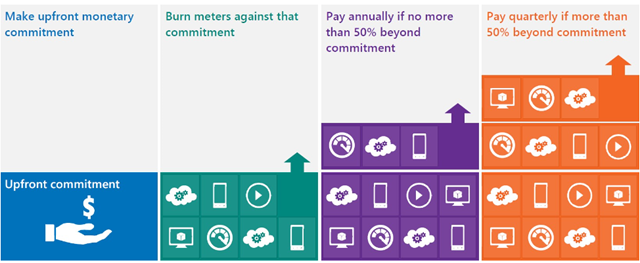
You commit upfront to a monthly amount that you feel will cover all your needs, and that monetary commitment can be utilised in any way within Azure.

image

Previously, you would receive great payment terms for your monetary commitment but – should you go over that amount (known as “overage”) – the extra usage would be charged at much higher rates. This effectively punished organizations who thought “wow, this Azure stuff is cool” – but no more, Overage is now charged at the same rates as the initial agreed amount. This makes increasing the usage of Azure a much more compelling proposition.

See Josh Waldo’s full post here:

http://www.digitalwpc.com/Community/Perspectives/Pages/Windows-Azure-added-to-Enterprise-Agreement-Use-it-to-power-your-solutions-.aspx?wt.mc_id=corp_mpn_tw_dwpc_joshwaldoazureagreement#fbid=7Lt8ur4Ygjd

Office 365 Cross Family Transitions


At the 2013 WorldWide Partner Conference (WPC), Microsoft announced plans to make it easier for customers to switch between Office 365 plans – this was greeted by smiles & cheers from many!

The initial introduction worked only for a few cases but the supported switching scenarios have now been expanded to include:

From To
Small Business MidSize Business
Enterprise E1
Enterprise E3
Enterprise E4
Small Business Premium MidSize Business
Enterprise E3
Enterprise E4
Exchange Online Plan 1 Enterprise E1
Enterprise E3
Enterprise E4
MidSize Business
Exchange Online Plan 2
Enterprise E3
Enterprise E4

Microsoft say:

“We continue to work on transition solutions for both additional scenarios (e.g., Exchange Online to Midsize Business) as well as for Open subscriptions and Government/Academic SKUs”

So there will continue to be additions and improvements around this – making Office 365 even more relevant for businesses everywhere.

Office 365 MidSize Business and Exchange Online Archiving


Exchange Online Archiving (EOA) is now available as an add-on for Office 365 MidSize Business; this gives MidSize users unlimited archiving as well as legal hold capabilities.

It’s great to see Microsoft continuing to improve and add to their Office 365 platforms, and this move really helps SMBs to attain Enterprise levels of service.

The Ordering Process

Currently, EOA can only be added to MidSize Business licenses purchased via the Advisor model, that is via the Microsoft Online Portal. If you purchased via Open Licensing (so from your reseller partner – and you pay them rather than MS), you need to add just 1 license of MidSize Business via the Advisor Model. That way, you’ll then be able to attach EOA to that license but fear not, the subscription can be applied to all mailboxes on that tenant – including those purchased via Open.

The process is nice and simple, which is good:

  1. Login to your Office 365 account as the Administrator.
  2. Go to the “Purchase Services” tab in the Admin Console.
  3. Click “Add” to purchase one additional seat of Office 365 Midsize Business.
  4. You can add Exchange Online Archiving at the same time as you add the direct bill seat of Midsize Business:
  5. Select the “Optional Add-ons” dropdown and enter the number of licenses of EOA you want to purchase.
  6. Add to the cart and proceed to payment by clicking “check out.”
  7. Follow the wizard to complete your payment with a purchase by credit card or other locally available payment method.

Microsoft Student Advantage


Microsoft have announced another great benefit available to education customers:

“Any academic institution that licenses Office for staff & faculty can provide Office 365 Office Pro Plus to students AT NO ADDITIONAL COST”

This, known as Student Advantage, starts from December 1st.

Its aim is to help give students the skills they’ll need to be successful out in the world of work, whilst helping schools manage costs – certainly a worthy aim!

You can read more here:

http://blogs.technet.com/b/microsoft_on_the_issues/archive/2013/10/14/microsoft-announces-new-student-advantage-program-to-prepare-students-for-tomorrow-s-jobs.aspx#!

Server & Cloud Enrollment


Microsoft make yet another change to their licensing programs, aimed at making it easier for organizations to license what they need.

The Server & Cloud Enrollment (SCE) is related to an EA (Enterprise Agreement) offers four components:

  • Core Infrastructure
  • Application Platform
  • Developer Platform
  • Windows Azure

Customers can choose any of these components individually or group them as needed. When choosing any of the first three components, customers will also have access to Windows Azure at the best pricing available.

How to get started

To enroll in an SCE, customers make an enterprise-wide commitment to one or more components.  This means committing to full Software Assurance coverage across the installed base of an SCE component and in the case of System Center, committing to full System Center coverage on their Windows Server installed base through Core Infrastructure Suites (CIS).

Benefits include:

  • 15% off L+SA products and 5% off SA products, as well as 5% off Azure when another component is included.
  • New subscription-based licensing options are available alongside perpetual licenses.  This gives customers access to more flexibility when they need to retire workloads, consolidate, or migrate to the cloud.
  • Core Infrastructure Suite (CIS) committed customers receive incremental rights to use System Center to manage Azure virtual machines and resources at no additional cost.
  • Microsoft Premier Service’s customers may also qualify for unlimited problem resolution support for SQL Server, Windows Server and System Center, BizTalk Server and SharePoint Server.
  • All the benefits of Software Assurance (SA).  This includes access to License Mobility for many of our applications, which enables even more seamless migrations to the cloud.

The SCE makes it easier for customers to standardise on MS technologies, easier for customers to migrate to the Cloud and simplifies the licensing involved.

More info is available in the datasheet here:

Server and Cloud Enrollment Datasheet and FAQ

BizTalk licensing changes in April


Some BizTalk changes coming next month:

Biztalk 2013 will be on the pricelists from April and is moving to a per-core licensing model. As with SQL 2012, 1 license will cover 2 cores.

BztlkSvrStd 2013 ALNG MVL 2Lic CoreLic

BztlkSvrEnt 2013 SNGL OLP 2Lic NL CoreLic

BztlkSvrBrnch 2013 ALNG MVL 2Lic CoreLic