Microsoft are adding a raft of new features to both EMS (Enterprise Mobility & Security) and Intune, these include:
Microsoft Tunnel VPN features for Android and iOS devices
Enhanced MacOS management capabilities
New endpoint analytics features
Various enhancements to Microsoft Endpoint Manager
These, and other, additions mean that Microsoft are putting the prices up. From July 1, 2021:
EMS E3 will increase from $9 pupm to $11
Intune will increase from $6 pupm to $8
However, the price for Microsoft 365 E3 won’t increase (and so one must assume that neither will E5) – making the bundle option that little bit more attractive.
In the recent earnings call for Oracle’s Q3 FY21 results, Oracle Chairman Larry Ellison once again went on the offensive against SAP when it comes to their ERP capabilities.
First, some background…
At the 27th Citi Technology Investors Conference in September 2020, SAP CFO, Luka Mucic, said that SAP hadn’t lost a single ERP customer to Oracle. This was in response to a question based on Larry Ellison’s claims during a previous Oracle earnings call that Oracle were making inroads into SAP’s top 10 customers and were moving into their top 50 accounts too. Mucic said:
We are not aware of any competitive replacement. We actually are aware of quite a few we have competitively replaced other ERP solutions from our traditional competition through S/4HANA recently
He then said:
“I think also the relative growth that we are able to post versus that traditional competitor…actually speaks the clear language…perhaps at some point there will be more transparency given to us [as to] which customer…exactly [the] competition is talking about.”
and finished off by clearly stating:
“I have checked and we have not lost a single customer.”
“In Q3 alone [Oracle] signed contracts, totalling hundreds of millions of dollars to migrate several very large SAP ERP customers, to Oracle Fusion ERP”
And then, clearly in response to Mucic’s request for more transparency as to which customers are involved, he went on to list over 100 customers that have, or are in the process of, switching from SAP to Oracle Fusion ERP! Customers listed included:
TPS Company
G4S
First Solar
CEMEX
New Zealand IRS
University of The Andes
Postcon (2nd largest mail carrier in Germany)
Birmingham City Council (in the UK)
Fedex
Grupo Bimbo
Natwest Group
The largest private company in Belgium
And there were plenty more too.
These are all customers that Ellison claims have replaced all their SAP with Oracle, or they’re in the process of doing so. He had another section of the list for organisations that are purchasing Oracle ERP but still running SAP ERP too and said it is Oracle’s expectation is that “the vast majority” of those organisations will ultimately move entirely across to Oracle ERP.
He finished off by saying:
“SAP, the once-dominant on-premise[s] ERP market leader is currently not competitive in the cloud ERP market. … SAP … never rewrote their ERP system for the cloud and it’s too late for them to start now”
When asked why this SAP to Oracle migration is happening now, Ellison had more to say about SAP’s strategy:
“SAP instead, embedded their own database called HANA and focused on this new database and never really rewrote their ERP code for the cloud. I mean, it’s just an unbelievable error. S/4HANA in the cloud is … not a cloud product at all. It is the 35-year-old … programming language called ABAP”
and finished with:
“SAP really is more responsible for our leadership position than we are”
Conclusion
It’s difficult to know what the facts are here. SAP clearly stated they haven’t lost any customers to Oracle…but Oracle have publicly listed dozens of customers they say they’ve taken. They can’t both be right…but surely neither would have made such false claims? I can only assume there’s a way that they ARE both right…perhaps different definitions of what “losing” a customer is?
These two companies have long been rivals but things really seem to be heating up now. Whether this is because Oracle truly believe they’re the stronger option or this is a case of “the best form of defence is attack” remains to be seen but either way, this escalating ERP battle us sure to have an impact on customers.
If you’re an SAP ERP customer, can you use this to your advantage? Will the mere mention of looking at Oracle ERP prompt SAP to offer discounts and favourable terms in your next negotiation?
Maybe there’s no smoke without fire and Oracle really ARE miles ahead of SAP now (disclaimer – I have no idea!). If so, should you seriously evaluate them before moving to SAP S/4 HANA?
I’m intrigued to see the next steps in this conflict for sure!
Back in May 2020, Microsoft announced Cloud for Healthcare – their first vertical specific cloud offering and it launched in October that year. Microsoft Cloud for Retail was announced in January 2021 and now, following Ignite 2021, they have announced three more:
Microsoft Cloud for Financial Services
Microsoft Cloud for Manufacturing
Microsoft Cloud for Non-profit
Why ?
One of the great benefits of public cloud – the ability to pick and choose from an almost endless array of options and combine them in a seemingly infinite number of combinations – can also be a huge weakness. For some industries, it’s more important to have an “Out of the Box” offering that does what they need and, most importantly these days, be super secure while it’s doing it.
Plugging various different cloud services together is often where security gaps start to appear – a slight misconfiguration here, a forgotten port there – and that can means certain industries are less enamoured with the cloud. Equally, from a portfolio perspective, knowing which different products do exactly what you need and which ones can be combined to help you achieve your goals can be perplexing and overwhelming.
These pre-built cloud packages for different verticals aim to address both of those issues as well as introducing brand new features aimed at vertical specific issues.
Microsoft Cloud for Retail
A combination of Microsoft products including Azure, Dynamics 365, Power Platform, Teams, Bing, Advertising among others, this is largely driven by changes brought about by COVID-19 and the (even greater) shift to online shopping. It focuses on areas of importance to Retail such as:
This combines products including Microsoft 365, Dynamics 365, Azure, and Power Platform in a solution designed to comply with regulatory and compliance frameworks in what is a highly regulated industry. It offers functionality in key areas including:
This vertical offering combines Azure, Dynamics 365, Microsoft 365, Power Platform, AI, HoloLens and more to address manufacturing specific needs such as:
This combines Microsoft 365, Dynamics 365, Azure, Power Platform, and LinkedIn to help charities better connect with their supporters and volunteers, make better decisions, and reach their goals faster.
There’s not as much info available for this offering yet but you can see more here and register for a webinar to learn more about this offering on March 30th here.
Microsoft have announced that Windows Server 2022 is in preview and will be available “later” in 2021.
According to this Microsoft page, new security features include “Secured-core server” and Credential Guard while it also brings interoperability with Azure Arc – the service that allows Azure policies to manage on-premises and multi-cloud resources – and Storage Migration Service, which helps connect on-prem file servers to those in Azure.
There are also several updates relating to Containers – all of which show Microsoft’s focus. Although this is a new on-premises server OS, it’s all about connecting to the cloud and enabling a smooth, hybrid infrastructure.
You’ll be pleased to know that there’s no sign of any changes to the licensing model at this stage 😁
Microsoft revealed more details about Power BI Premium at their recent Ignite conference. I covered the initial announcement here but it’s now in General Availability so we now have details on the pricing and licensing.
Availability
April 2, 2021
Pricing
A full license will be $20 per user per month
For customers with Power BI Pro (standalone or as part of E5), it will be $10 per user per month
This Microsoft page has more information on this plus the new features coming to Power BI Premium in general – including vCore auto-scaling charged via Azure PAYG.
Microsoft have announced that their Power Automate Desktop product is going to be free for Windows 10 users. Power Automate is Microsoft’s Robotic Process Automation (RPA) offering and, as the name suggests, the product in question here is the desktop variant.
RPA is a rapidly growing hot topic within businesses as people look to do “more with less” and to use their time to drive and deliver real business value – rather than “busy work”. Typically these will be things like compiling information and creating reports – it needs doing but it’s repetitive (read boring) and doesn’t really need human input…certain things need putting in certain places at certain times. The repetitive nature makes it perfect for RPA – thing of an Excel macro on steroids – replicating actions across a variety of desktop applications and websites…while you do more important things 😊
This is an example of what you can do from Microsoft:
Power Automate Desktop will eventually be built into Windows 10 – it will start to appear in Insider Builds shortly – but for those of you as impatient as me, you can download it here.
I wonder if this will cause any other RPA vendors (such as UIpath) to launch a case against Microsoft for unfair bundling – like Slack recently did re: Teams?
Within that, the landscape for specific product areas is:
Cloud services & license support up 5% to $7.3 billion
Cloud license and on-premises licenses up 4% to $1.3 billion
Oracle Cloud Infrastructure (OCI) consumption up 123%
Oracle also touted double digit growth in both their Fusion (30%) and NetSuite (24%) Cloud ERP offerings.
Safra Catz, Oracle CEO, said they have some “very large users” coming to OCI soon that will need “significant amounts of capacity” and so Oracle are investing heavily to ensure they can handle all the new consumption.
She also called out that Java on-premises is doing “very well” as companies “continue to invest” in Java – it looks like the licensing changes of recent years are starting to pay off for Oracle.
Oracle predicts its own future
Ellison states that future success for Oracle lies in two areas:
ERP
Autonomous products
ERP
It’s clear that Larry Ellison is bullish on Oracle’s ERP offering – “our product is so much better than anyone else’s product in the cloud” – and he said that he expects Oracle will take over 50% of SAP’s customers plus those from other ERP companies too.
Autonomous Database
For me, pretty much the only person I’ve seen mention Oracle’s Autonomous Database is Larry Ellison, but he sure does like to mention it! Just as he’s been talking up ERP, he’s been doing the same for Autonomous Database:
“we expect it really to explode next year…I really do mean very, very rapid growth. I’m not really ready to disclose … why I think it’s going to suddenly spike but we expect very, very rapid database growth next year”
He sees autonomous products as a driver for Oracle Cloud Infrastructure too – both autonomous database and they also have an autonomous Linux offering too. He sees that removing human error and access as much as possible makes their cloud offering more cost effective and more secure than the other public cloud offerings.
Oracle are really pushing their OCI offering and, if they’re to be believed, are making a strong push for that #3 spot in public cloud providers, behind Amazon & Microsoft.
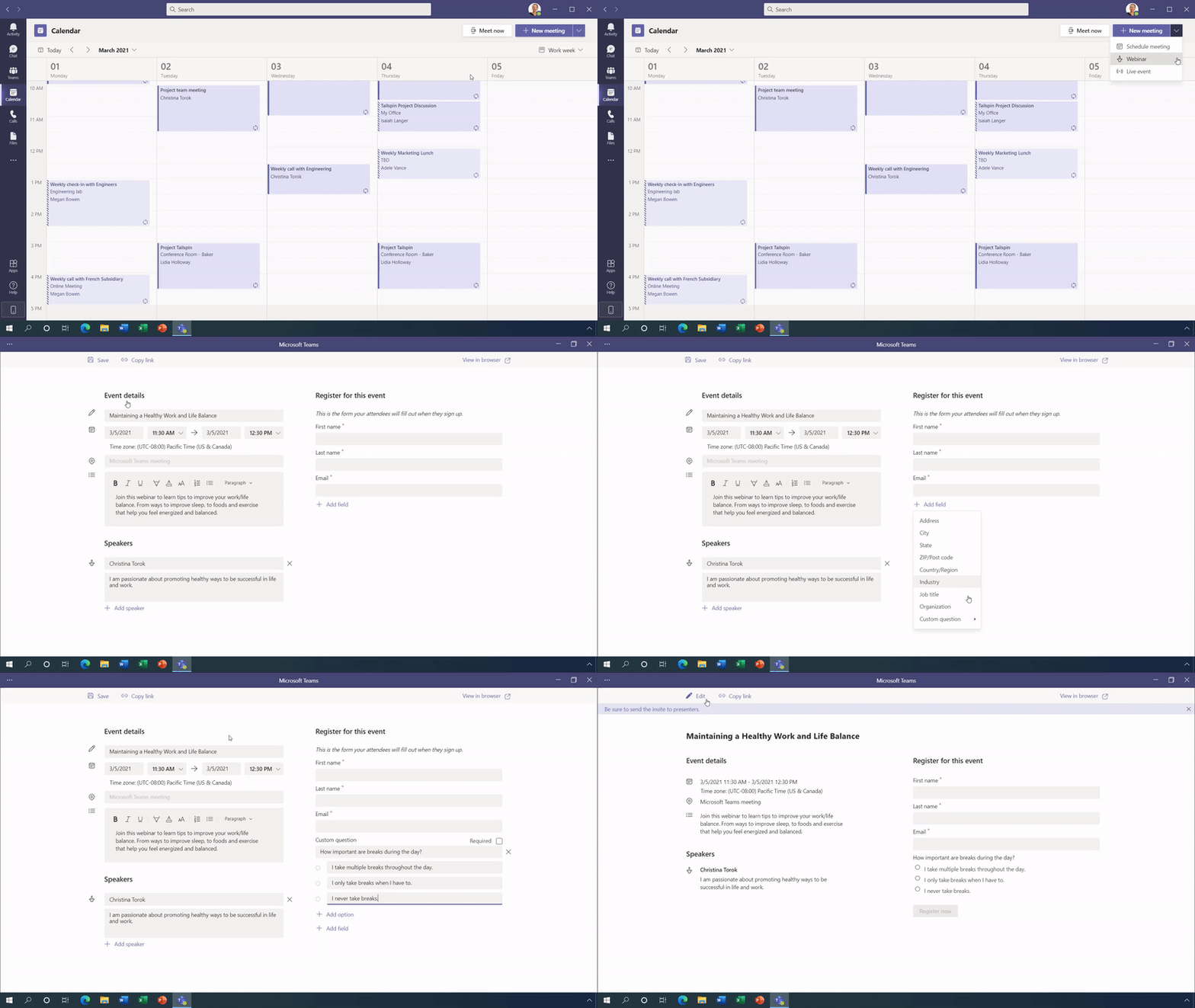
It was announced a while back that webinar functionality would be coming to Microsoft Teams and details have been released at this week’s Microsoft Ignite conference – including the required licenses.
Features
Organisations will be able to add a customisable registration page to webinars – an example of which you can see below:
Fully interactive webinars will be able to handle up to 1,000 (one thousand) participants with moderation available to control audio/video etc. and, should you need it, Teams can scale up to 10,000 participant “view-only” sessions. Microsoft are, for now, increasing that limit to 20,000.
You will also be able to download an attendee report showing attendance, participation etc. which is key for follow up. More reporting features are being rolled out over the coming months.
How is it licensed?
These new capabilities will be fully available as part of:
Microsoft 365 E3/A3/G3
Microsoft 365 E5/A5/G5
and will also be available in:
Microsoft 365 Business
Microsoft 365 Business Premium
for up to 300 users.
I’m pleasantly surprised that this doesn’t require an add-on license – it’s quite possibly been done as in-built functionality to give them the best chance of fighting off the threat from Zoom et. al. If you have to pay extra to Microsoft, you might as well just stick with your existing provider but if it’s “free”…that likely changes matters for a lot of organisations.
Further Reading
You can see more info on these, and dozens of other new features coming to Teams, here.







 Cloudy with a chance of Licensing