Microsoft reduce cloud prices in Europe


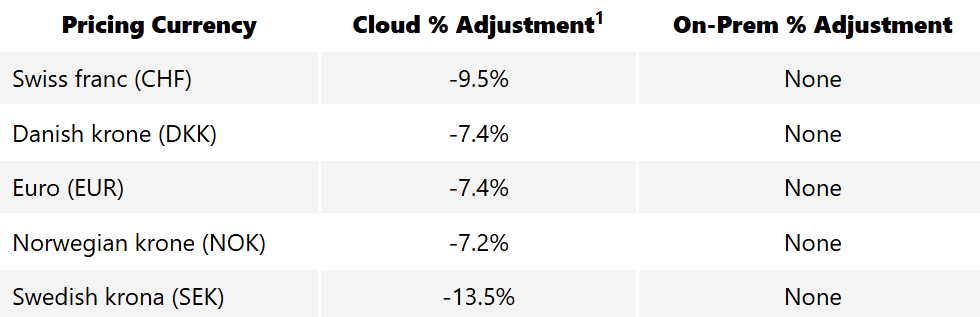
As part of their twice early price harmonisation efforts, Microsoft have announced price decreases for “Commercial Cloud” products in certain European currencies from February 1st, 2026:

https://news.microsoft.com/source/2025/12/11/local-currency-price-adjustments-for-microsofts-commercial-cloud-2/

Microsoft announce 2026 price increases


Following Microsoft’s Ignite 2025 conference, they have announced some feature additions to Microsoft 365…and some price increases to go along with it.

Copilot Chat

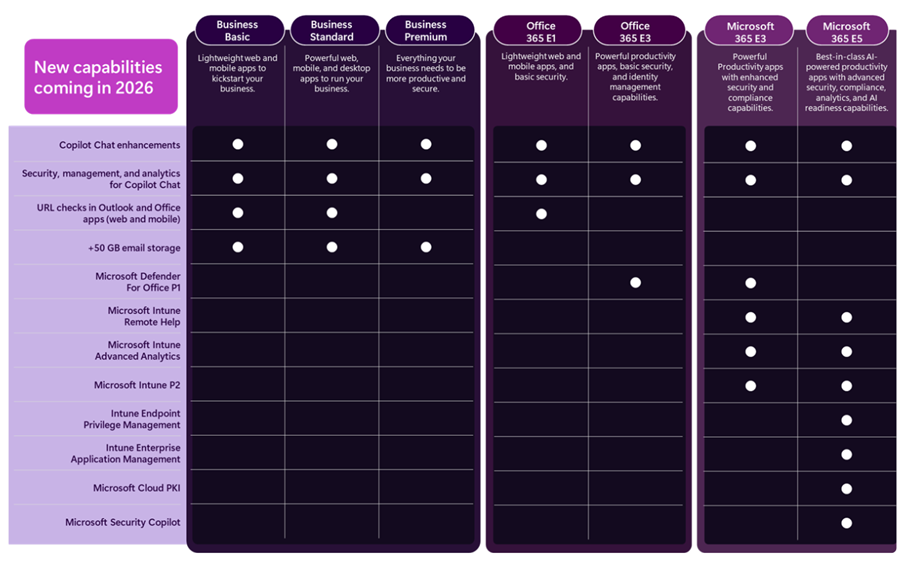
This free entry point to Copilot, included with various Microsoft products, will have new features to work with Outlook inboxes and calendars and standard access to Agent Mode. There will also be additional management and security capabilities around Copilot Chat.

Enhancing Copilot Chat makes sense as an entry point into M365 Copilot…effectively a “freemium” model albeit in a product you’re already paying for.

Addition Security Features

Microsoft Defender for Office 365 Plan 1, currently only available with Microsoft 365 E5, is being added to:

  • Microsoft 365 E3
  • Office 365 E3

It appears that all features are being added but that is to be confirmed.

Furthermore, URL checking features are being added to Office 365 E1, Business Basic, and Business Standard. The Business SKUs (including Premium) are all getting 50GB email inboxes too.

Boosting the security capabilities of lower SKUs is a welcome move, given the importance of security in today’s tech world.

Endpoint Management

A range of Microsoft Intune products are being added to both Microsoft 365 E3 and E5, these are:

  • Intune Plan 2
  • Intune Advanced Analytics
  • Intune Remote Help

While M365 E5 will also receive:

  • Intune Endpoint Privilege Management
  • Enterprise Application Management
  • Microsoft Cloud PKI
https://www.microsoft.com/en-us/microsoft-365/blog/2025/12/04/advancing-microsoft-365-new-capabilities-and-pricing-update/

Security Copilot and Microsoft 365 E5

The Microsoft announcement also talks about the adding of Security Copilot SCUs to Microsoft 365 E5. I covered that a few weeks ago here – https://cloudywithachanceoflicensing.com/2025/11/20/microsoft-security-copilot-scu-included-with-microsoft-365-e5/

2026 Pricing

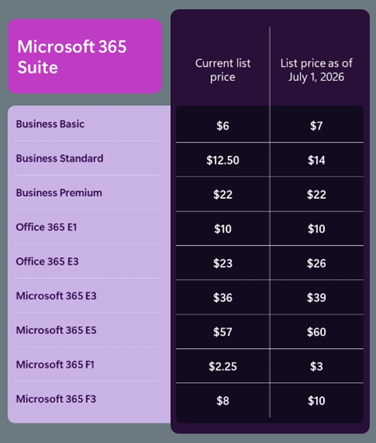
Of course, these new features come at a cost. Pricing for the included suites will be increasing as of July 1, 2026 (aka Microsoft’s new financial year)…even Microsoft 365 E5.

https://www.microsoft.com/en-us/microsoft-365/blog/2025/12/04/advancing-microsoft-365-new-capabilities-and-pricing-update/

M365 E3 increases by 8% and M365 E5 by 5%. An organisation with 15,000 E5 SKUs will see an increase of $1.6 million over a 3-year contract – so understanding how the additional features may work for you will help you decide what steps to take at renewal.

Something that I did notice is that, while there is no mention of new features being added to the Frontline Worker F SKUs, they too are increasing in price – with M365 F1 rising by 33% and M365 F3 by 25%.

8,000 F3 users will lead to an increase of almost $600,000 over 3 years…seemingly with no new features to show for it.

Note as well that these increases will also apply to non-profit pricing.

See the Microsoft post here – Advancing Microsoft 365: New capabilities and pricing update | Microsoft 365 Blog

What’s it all about?

ARPU (Average Revenue Per User) is a key metric for Microsoft (and all SaaS publishers) and this will help keep that growing for several more quarters through their next financial year and beyond. Increasing the amount they earn from each user is key to driving shareholder value…especially as the amount of new users to buy M365 licenses is decreasing. Higher pricing also increase the Customer Lifetime Value (CLV), another important metric that helps businesses plan future campaigns and initiatives.

There is the risk that customers will become angry and disillusioned and look for alternatives. However it’s likely that Microsoft are confident in their view that there are very few real alternatives to many of their products and, even when they are available, the time and effort involved in swapping will discourage most organisations. While some may leave, the increased revenue from those who stay will more than offset the losses.

For some organisations, the additional products in E3 and E5 may mean that they can reshape their licensing slightly – dropping additional SKUs or possibly even dropping from E5 to E3. However, it is yet another price increase from Microsoft…particularly galling if you don’t need or want those additional features. Review your Microsoft budget projections and work to lock in the lower pricing for as long as possible.

Microsoft SQL Server 2025 – what’s new


SQL Server 2025 has been released and, while the licensing model remains the same, there are few changes worthy of note:

  • Developer now comes in “Standard” and “Enterprise” versions.
  • SQL Server Standard max compute capacity per instance increased from 24 to 32 cores
  • SQL Server Standard max buffer memory increased from 128GB to 256GB
  • SQL Server Express now supports a 50GB database size

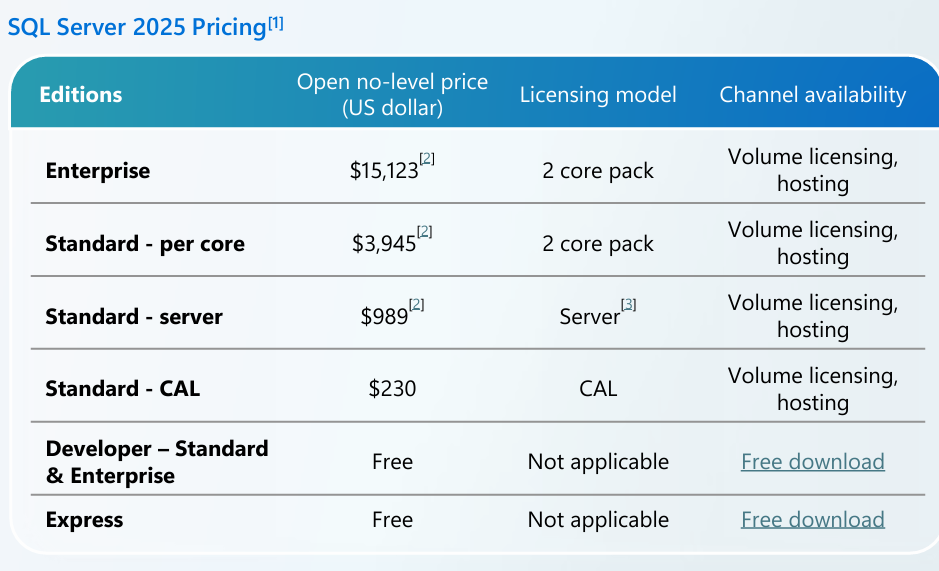
The first will help with a common problem. With just a single Developer product, it contained all the features of both SQL Server Standard and Enterprise; often I see scenarios where a product/system was inadvertently created with a dependency on an Enterprise feature…hugely increasing the required licensing costs. As you can see, the price difference between Standard and Enterprise is significant:

https://cdn-dynmedia-1.microsoft.com/is/content/microsoftcorp/microsoft/bade/documents/products-and-services/en-us/cloud/SQL-Server-2025-Pricing.pdf

That price difference is also why the changes to maximums for compute capacity and memory are important. The increased allowances may mean that some SQL Server Enterprise scenarios within your environment could be migrate to Standard edition with a 2025 upgrade. If it’s a 32 core setup, that’s a $176,000 reduction.

Finally, the increased database size for SQL Server 2025 Express may increase its viability for production scenarios – although it retains the single CPU limit.

See a comprehensive list of features here – Editions and Supported Features of SQL Server 2025 – SQL Server | Microsoft Learn

Another change is that SSRS (SQL Server Reporting Services) is now replaced with PBIRS (Power BI Reporting Services). 

PBIRS is available to customers with SQL Server 2025 Standard and Enterprise but for prior versions, PBIRS is SQL Enterprise only and only with active SA.

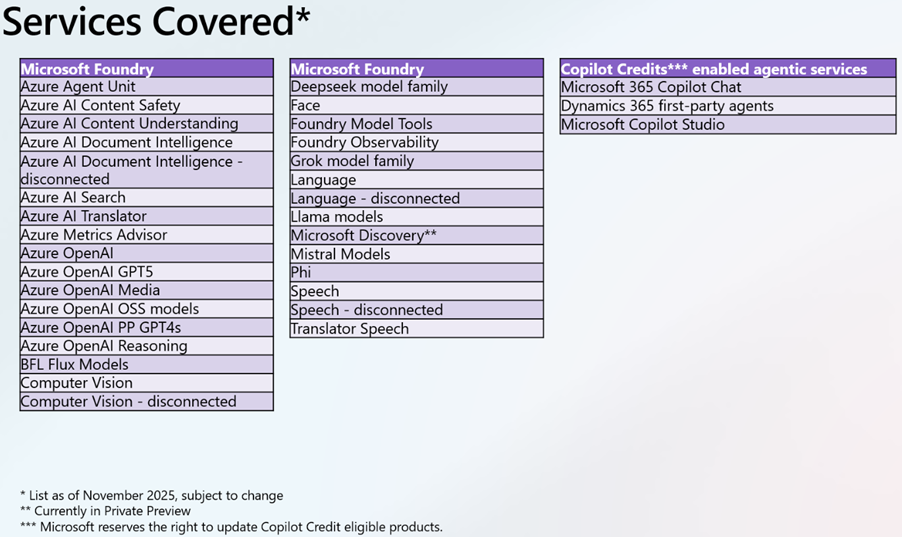
Microsoft Agent Pre-Purchase Plan (P3)


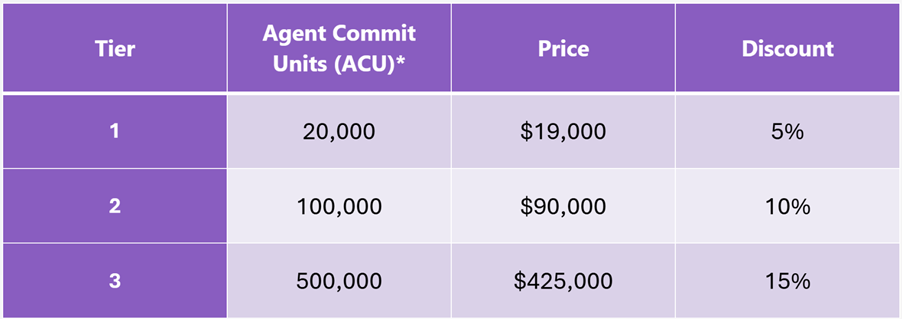
Microsoft have announced the Agent Pre-Purchase Plan (P3) – a new unified offer that covers both Copilot Studio and Microsoft Foundry services with one pool of credits.

How is the Agent Pre-Purchase Plan priced?

This annual commitment has 3 pricing tiers:

And covers a range of services:

Note the asterisks as always – some things are in preview and all are subject to change.

My big question is whether this offer sits alongside the recently announced “Copilot Credit Pre-Purchase Plan (P3)” or if it replaces it after just 3 weeks?! They seem slightly different but also very similar…

Microsoft Agent P3 – https://techcommunity.microsoft.com/blog/azure-ai-foundry-blog/introducing-microsoft-agent-factory/4470732

Microsoft Security Copilot SCU included with Microsoft 365 E5


Microsoft Security Copilot uses Security Compute Units (SCU) to measure the compute power used to run various workloads. A quantity of these is now available with Microsoft 365 E5 licenses, rollout starting from November 18th 2025..

What SCU capacity is included with Microsoft 365 E5 licenses?

Each Microsoft 365 E5 license includes 0.4 SCU so, for example, an organisation with 1,000 M365 E5 licenses will have 400 SCU per month. The allocation resets monthly and unused SCU cannot be rolled over to the next month.

There is a maximum limit of 10,000 included SCU per month – this is equivalent to 25,000 M365 E5 licenses.

Pricing considerations

Should organisations exceed their M365 E5 included SCU quantity, overage SCU will be available for $6 per SCU on a Pay As You Go (PAYG) basis. That is 50% higher than the “Provisioned” SCU pricing of $4.

However, an interesting point – and something that adds complexity to these decisions – is that the included SCU provide more flexible billing than the traditional provisioned capacity model.

Under provisioned capacity, an organisation commits to a set number of SCU per hour and is charged for that amount even if actual usage is lower. With E5, the included SCU are drawn down only by the amount actually consumed each hour, which provides a more accurate reflection of usage and avoids paying for unused capacity:

  • With Provisioned Capacity, if you provision 5 SCU but only use 3.5 – tough, you pay for all 5.
  • With E5 Included, you would only use 3.5 SCU.

This addition is another move to keep organisations on M365 E5, rather than stepping down to E3 +add-on.

SCU included with Microsoft 365 E5 – https://learn.microsoft.com/en-gb/copilot/security/security-copilot-inclusion

Microsoft end AI Builder Credits


AI Builder Credits have been around for a while as a way of paying for AI features within various Microsoft products including Power Apps Premium, Power Automate Premium, Dynamics 365 Finance and more. They’re being replaced by Copilot Credits and that means the seeded AI Builder Credits, where they came bundled along with other licenses, are disappearing.

From November 1, 2025 new customers – those who didn’t already have some AI Capacity add-ons – cannot buy any…but can still buy new Premium licenses that come bundled with AI Credits.

From November 1, 2026 AI Builder capacity add-ons can still be used but cannot be purchased or renewed. Also at this time, seeded credits will stop – to quote Microsoft “seeded AI Builder credits will be definitively removed from their premium licenses.

Action: You should count up how many AI Builder credits you currently receive as part of your Premium licenses, and also how many of those credits you actually use. Then calculate, as well as you’re able, how much that usage will cost you once you have to start paying for it all separately.

You can see the pricing here – https://learn.microsoft.com/en-us/ai-builder/administer-licensing#aibuildercapabilityrate-table

The cost of basic prompts has increased by 33% while object detection has risen by 1400%! These price rises must be taken into account…and note that those prices are based on the annual commitment price so the differences will likely be larger for those who choose to use PAYG billing.

A related question – will Microsoft reduce the price of the premium licenses, now that something is being removed from them?

You can see the Microsoft page here – https://learn.microsoft.com/en-us/ai-builder/endofaibcredits

You can see more about Microsoft Copilot Credit Pre-Purchase Plan here – https://cloudywithachanceoflicensing.com/2025/11/03/microsoft-copilot-credit-pre-purchase-plan/

Microsoft Agent 365 – what we know so far


It’s been rumoured for a while that Microsoft would release a new product/license for AI Agents called Agent 365 and we have the first public acknowledgement of this from Redmond.

Microsoft 365 Message MC1183300 is titled “Microsoft Teams and Microsoft 365 Copilot: Discover and create agentic users from Teams and M365 Agent Store” and gives us some initial information.

Starting in mid-November 2025, we will get “AI-powered Agentic Users” that will have “full organisation identities”. Users will be able to request agent templates but, at least for now, admins will control the creation and licensing.

What are AI Agents?

Microsoft differentiate them from bots and say:

Agentic Users are provisioned as full-fledged user objects with their own:

  • · identity in the organization’s directory (via Entra ID or Azure AD)
  • · email addresses
  • · Teams accounts
  • · presence in the org chart

They can participate in meetings, send and receive emails and chats, access and act upon enterprise data, and learn from interactions to improve over time. They have the ability to “proactively reason and act without explicit instructions”.

How are AI Agents licensed?

Per Agent licensing

Continue reading “Microsoft Agent 365 – what we know so far”

Microsoft Financial Results: Q1 FY26


Satya Nadella now refers to Microsoft “building a planet-scale cloud and AI factory” which, with the recent agreement with Open AI, including $250 billion of Azure services (these don’t impact the Q1 results), and Copilot, shows they’re not changing direction any time soon.

Is Microsoft Copilot successful?

Lots of talk in the earnings call about Copilot growth and success with 90% of the Fortune 500 using M365 Copilot and various organisations purchasing 15,000+ seats in Q1 and PWC purchasing 155,000 seats. One should always be carefully sceptical of numbers like this from software publishers – what exactly is “using” and how many people within an org are “using” the software for example?

Copilot functionality is being added into almost every facet of Microsoft’s product portfolio, making it ubiquitous whether users really want it or not!

What are Microsoft’s Financial Results for Q1 FY26?

Revenue = $77.7 billion, an 18% increase

Net Income = $27.7 billion, a 12% increase

Microsoft Cloud = $49.1 billion, a 26% increase

What are Microsoft spending?

  • Capital Expenditure (CAPEX) was up 74% in Q1 FY26 “to support customer demand for…cloud and AI offerings.” Approximately half of that spend was on “short-lived assets” such as GPUs and CPUs for Azure and AI growth.
  • Long-lived assets spend was up 71%, driven by lease commencements for “large datacenter sites”.

You can see here the huge amount of money that Microsoft are spending on building datacentres, primarily to handle AI growth.

Productivity & Business Processes

  • Revenue = $33 billion, a 17% increase
  • Microsoft 365 Commercial Revenue = 17% increase
  • Dynamics 365 revenue = 18% increase

Operating Expenses increased 6% driven by investments in “compute capacity and AI talent”.

The M365 growth was driven by E5 and Copilot. 

Intelligent Cloud

  • Revenue = $30.9 billion, a 28% increase
  • Azure = 40% increase

Operating Expenses increased 4% driven by investments in “compute capacity and AI talent”. 

Earnings Call highlights

  • Microsoft plan to increase their total AI capacity by 80% through FY26 and double their datacentre footprint by 2028. They plan to launch the “world’s most powerful AI datacentre” in 2026 which will hit 2 gigawatts itself.
  • Fabric revenue increased 60% and now has 28,000 paying customers.
  • Cosmos DB revenue increased 50%.
  • Microsoft Sentinel has 40,000 customers.

Microsoft Copilot Credit Pre-Purchase Plan


Photo by energepic.com on Pexels.com

Microsoft are moving more and more towards consumption billing for their products – right across the portfolio. This makes it much more difficult for customer organisations to predict and forecast usage, which will generally lead to over-commitment and uncertainty. It also, however, means that Microsoft’s revenues and product sales are less predictable, which isn’t what they want.

Copilot is a huge focus for Microsoft as is moving towards Agentic AI – which is done via Copilot Studio. Much of this is billed via Credits (formerly Messages) and Microsoft have now introduced the “Copilot Credit Pre-Purchase Plan” (aka “P3“) to help with some of the unpredictability (on both sides). You purchase an amount of “Copilot Credit Commit Units (CCCU)” and pay upfront for the year.

Each CCCU is worth $1 and is equivalent to 100 credits. There are 9 tiers:

These credits expire annually which is a better than the Microsoft Copilot Studio Copilot Credit capacity packs, which expire monthly.

Understanding when to buy this, which level to buy, and whether they’re being used effectively will be a great example of collaboration between ITAM & FinOps teams.

See more here – https://techcommunity.microsoft.com/blog/finopsblog/unlock-savings-with-copilot-credit-pre-purchase-plan/4464511

Microsoft Product Terms: October 2025


Photo by Markus Winkler on Pexels.com

More name changes to keep us all busy!


Rebranded Microsoft 365 E5 Security (and all relevant offers) to Microsoft Defender Suite
Rebranded Microsoft E5 Compliance (and all relevant offers) to Microsoft Purview Suite

M365 E5 Security = Microsoft Defender Suite
M365 E5 Compliance = Microsoft Purview Suite

M365 F5 Security = Microsoft Defender Suite FLW
M365 F5 Compliance = Microsoft Purview Suite FLW

There is also a “Defender + Purview Suite FLW” SKU

FLW = FrontLine Worker

As always, there’s going to be a period of time where the names differ between pages, sites, documents etc. so be prepared…especially for renewals.

2) Removed Microsoft Defender Threat Intelligence from Availability and Prerequisite Tables

3) Azure Firmware Analysis and Azure IoT Operations connectors added