Microsoft’s Get Licensing Ready (GLR) training platform is being shut down as of December 31st, 2024.
A mainstay of the Microsoft channel and pretty much every reseller salesperson’s introduction to the wonderful world of Microsoft licensing, GLR has been a trusty companion to many for decades. It has been around as long as I can remember (so at least 20 years) but it is now a casualty of Microsoft’s apparent lack of interest in licensing these days.
My post on LinkedIn has been one of the most liked, commented, and reposted for some time -showing the depth of affection for the platform…and also the concern that it’s going to get even more difficult for partners and customers to understand Microsoft licensing.
I haven’t done GLR for a few years but I plan to take them all again and get one last set of certificates for posterity’s sake.
Microsoft have announced changes to the Enterprise Agreement but, not unusually, it’s still all a bit unclear.
“Beginning January 1, 2025, a small percentage of cloud Enterprise Agreements (EA) in direct markets will no longer be eligible for renewal under the existing EA framework”
What exactly is a “cloud EA”? Is it where there is only Azure? Only Azure and M365?
Why not all cloud EAs?
How is that defined?
What will be the alternative?
“For enterprise customers, the Microsoft Customer Agreement for enterprise (MCA-E, the digital evolution of the traditional EA), will provide the optimal, streamlined solution.”
This is direct from Microsoft but is, in many ways, a “bigger” version of CSP rather than a slightly different EA.
So, “evolution” is an interesting choice. That implies a continuation whereas I’d probably us the word “replacement”…
Microsoft will begin notifying impacted customers in Jan 2025 that they cannot renew into the EA.
The post also says:
“Partners will continue to earn incentives when transacting EA renewals”
So they’re not all disappearing…at least not yet!
This marks yet another shift and yet another step towards more licensing business going direct to Microsoft.
To balance this out, they have also announced thst Copilot for M365/Sales/Service will be available on a monthly billing basis from December 1st…but will be 5% more expensive.
As well, all current monthly SKUs will have a 5% price increase from April 2025 and Power BI is increasing. I’ll do a separate post on that shortly.
It is interesting that the final section of the Microsoft post is titled “Microsoft is a partner-led company”…
If you have any questions, feel free to get in touch 😊
After a delay of several hours where the website wasn’t working (one of the perils of this current format), we can now see the changes this month are:
Windows Server 2025 added
Windows Server PAYG via Azure Arc is added
System Center 2025 added
Windows 10 ESU added
Various additional/refined terms for Azure Services
Let’s take a look at the Win Svr PAYG option in more detail based on the Product Terms:
Customer must have a valid Windows Server Standard or Windows Server Datacenter License to use the PAYG option. <– Just one license or all cores in the server?
For Licensed Servers running PAYG virtual machines, there are no restrictions on the number of PAYG virtual machines that can be deployed.
Additional virtualization rights are not granted. A separate License is required for each guest. <– So you don’t get 2 OSEs for Std and Unlimited for Datacenter…each PAYG VM needs to be paid for.
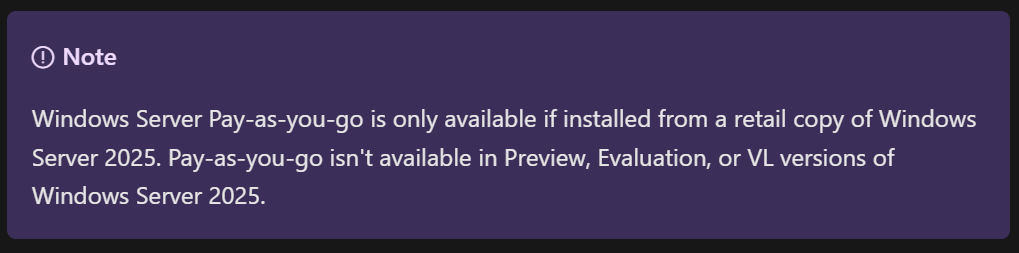
This, taken from the Microsoft Learn page, is very odd:
Apparently, you can only use Windows Server PAYG if you install a retail copy of Windows Server 2025?!
We have also seen that there will be a 10% price increase for Windows Server 2025 & System Center 2025 from December 1st 2024 and then also for SPLA from January 1st, 2025.
For the first time in a long time, Microsoft have updated the definition of an External User, with the new term coming in effect for agreements signed from October 1, 2024 onward.
Current term
“External Users” refers to users that are not employees, onsite contractors, or onsite agents of Customer or its Affiliate
New term
“External Users” will refer to users that are not:
(a) employees of Customer or its Affiliates
(b) contractors or agents that typically work for Customer or its Affiliates for more than 30 hours on average per week, or
(c) contractors or agents that typically work onsite for Customer or its Affiliates on each working day.
Adding in the amount of hours worked as a criteria means there will be a little more flexibility but also more work for organisations to define who is/isn’t an external user.
Teams has been “consciously decoupled*” from Microsoft 365 on a global basis, so they’re now only available separately to new users. Existing users can continue to renew but if you need to buy both, it equals more cash more Microsoft.
Teams Enterprise is now listed, which appears to be the standalone version of Teams. From a naming perspective, “that “Enterprise” sounds “bigger” than “Premium” (which is a paid add-on) so I’d expect a rebrand at some point soon🤔
Dynamics 365 Supply Chain Premium has been added…plus another error as “Dynamics 365 Supply Chain Management” is listed as having a minimum purchase quantity of both 10 and 20…clearly one should say “Premium” at the end (the one with 10 I believe).
They’ve still not corrected the D364 error from last month either 🤣












 Cloudy with a chance of Licensing