Microsoft have retired the “From SA” license offering starting from February 1, 2024 for Microsoft 365.
What are they?
Introduced in 2015, these licenses were Cloud USLs at a reduced price for customers who had on-premises licenses with active Software Assurance (SA) and aimed to make it less costly for them to move to Microsoft’s Online Services.
What’s changed?
Microsoft say that “Cloud services are now the predominant way customers use Microsoft products and services” and so these From SA SKUs are no longer needed.
Microsoft 365
Feb 1st 2024: You won’t be able to order additional or new From SA subscription licenses for Microsoft 365 and its standalone products. The impacted products are:
Core CAL Suite Bridge for Office 365 From SA
Enterprise CAL Bridge for Enterprise Mobility + Security From SA (User SL)
Enterprise CAL Suite Bridge for Office 365 From SA
Enterprise Mobility + Security E3/E5/G3/G5 From SA
Microsoft 365 Apps for enterprise From SA
Microsoft 365 E3/E5/G3/G5 From SA
Microsoft Teams Phone Standard From SA
Office 365 E1/E3/E5/G1/G3/G5 From SA
Project Plan 1/3/5 From SA
Visio Online Plan 1 and 2 From SA
Windows 11 Enterprise E3/E5/G5 From SA
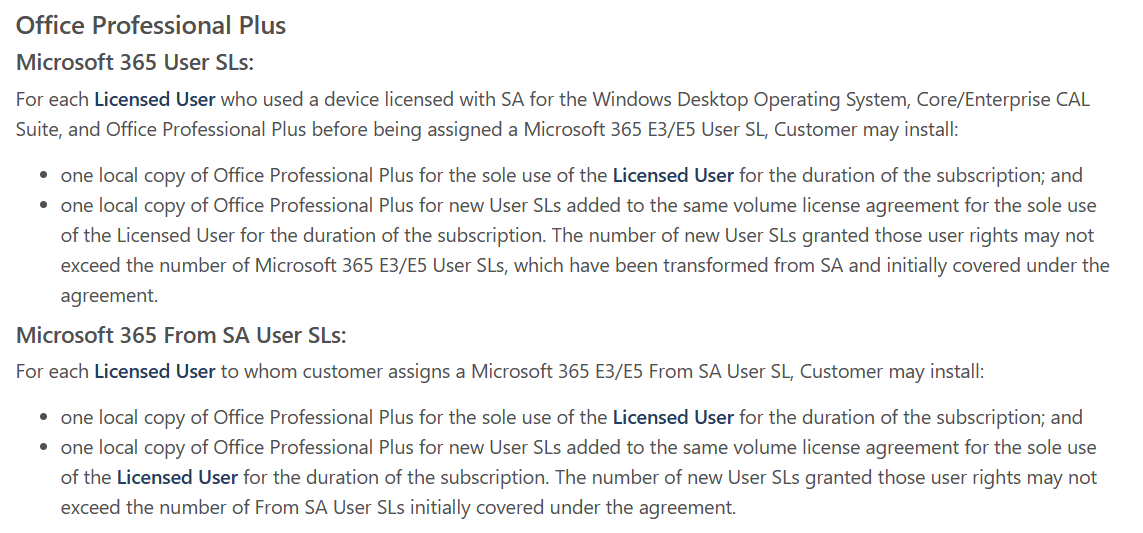
Office Professional Plus rights
There is now also wording that states any “licensed user” who used a device licensed with all 3 of:
Windows OS w/SA
Core/Enterprise CAL w/SA
Office Professional Plus w/SA
and has now been assigned a Microsoft 365 E3/E5 User SL can install a local copy of Office Professional Plus for the duration of the USL subscription.
This section from MS isn’t totally clear as to what it is saying/changing so questions/thoughts welcome. I think the phrase “transformed from SA” is new and is doing some of the work here…
Dynamics 365
April 1st 2024: You won’t be able to order additional or new From SA subscription licenses for Dynamics 365. The impacted products are:
Dynamics 365 Business Central Device From SA
Dynamics 365 Business Central Essentials From SA
Dynamics 365 Business Central Premium From SA
Dynamics 365 Business Central Team Members From SA
Dynamics 365 Commerce From SA
Dynamics 365 Customer Service Enterprise From SA
Dynamics 365 Customer Service Enterprise Device From SA
Dynamics 365 Customer Service Professional From SA
Dynamics 365 Human Resources From SA
Dynamics 365 Field Services From SA
Dynamics 365 Finance From SA
Dynamics 365 Operations – Activity From SA
Dynamics 365 Operations – Device From SA
Dynamics 365 Project Operations From SA
Dynamics 365 Sales Enterprise From SA
Dynamics 365 Sales Enterprise Device From SA
Dynamics 365 Sales Professional From SA
Dynamics 365 Supply Chain Management From SA
Dynamics 365 Team Members From SA
However, there will be a time limited “promotional migration offer” being made available to EA customers by April 1st to help customers migrate.
Any licenses purchased before the change date can continue to be renewed but quantities can’t be increased.
You can see the Microsoft announcement here. Interestingly, it’s dated December 15th but it hasn’t been publicised until today – or at least I didn’t see it!
Another announcement at Microsoft Inspire is that soon users will be able to view and interact with Dynamics 365 records and data directly inside Microsoft Teams – without requiring additional licensing.
In a blog post, Microsoft state that they are “eliminating the licensing tax” that has previously prevented organisations from integrating Dynamics 365 & Microsoft Teams. There isn’t a huge amount of additional information available yet so the specific questions as to what data can be shared and what can be done to it etc. will have to wait for another day. This blog from Jukka Niiranen attempts to uncover some potential insights from the Microsoft demo video that’s available.
However, it is clear that this is (another) shot at Salesforce in Microsoft’s efforts to make Dynamics 365 the #1 CRM system out there. It also serves to further Teams’ growing position as the central hub for users throughout their work day, where they’re able to do most things at this point (but no email).
Microsoft’s financial results for Q3 FY21 (Jan – Mar 21) are in and, as usual, they’re pretty impressive.
Revenue = $41.7 billion – up 19%
Operating income = $17 billion – up 31%
Looking at the different product divisions we can see:
Productivity & Business Processes
Revenue = $13.6 billion – up 15%
Office 365 Commercial was up 22%, LinkedIn increased 25%, and Dynamics 365 was up 45%.
Microsoft Teams is up to 145 million daily active users, almost doubling YoY and Office 365 Commercial has nearly 300 million paid seats. Office Commercial products (on-premises Office) was down 25% – continuing its downwards trend as organisations continue to move to the cloud.
Satya Nadella revealed that Power Platform now has almost 16 million monthly active users, an increase of 97%, and revenue has increased by 84%. Amy Hood (CFO) called out Power Apps and Dynamics 365 Finance & Operations as strong performers.
Intelligent Cloud
Revenue = $15.1 billion – up 23%
Azure growth was 50% yet again, with Amy Hood highlighting an increase in the number of large, long-term Azure contracts.
On-premises server products grew 3%, although that seems to largely be due to year on year currency fluctuations, and the EMS install base grew again, now sitting at 174 million seats.
SQL Server on Azure VMs grew 129% YoY alongside Cosmos DB growth too.
More Personal Computing
Revenue = $13 billion – up 19%
Again there was a big difference in Windows OEM as Pro revenue declined 2% but non-Pro grew 44%.
Microsoft have, once again, had a stellar quarter (Oct-Dec 20) with overall results of:
Revenue up 17% to $43.1 billion
Operating income up 29% to $17.9 billion
Looking deeper into specific product categories and areas we can see:
Productivity and Business Processes
Revenue was up 13% to $13.4 billion which included:
Office 365 Commercial up 21%
Dynamics 365 up 39%
LinkedIn up 23%
Intelligent Cloud
Revenue was up 23% to $14.6 billion and Azure was revenue growth of 50%
More Personal Computing
The “other” parts of Microsoft’s business all saw success to with revenue up 14% to $15.1 billion. This included:
Windows Commercial up 10%
Xbox up 40%
Surface up 3%
Microsoft’s results are very consistent and are outperforming pretty much every comparable competitor you can think of…Oracle, SAP, and IBM are very far away from numbers like these! Amazon are still seeing great success with AWS – currently rising around 28% – but that is a greatly limited portfolio when compared to that under Satya Nadella’s control.
There are several areas of Microsoft’s product line-up which are at the very start of their evolution and will grow and continue these results for the foreseeable future.
Microsoft Cloud Healthcare Add-on: This can be added onto M365 E3/E5, Power Apps/Automate/BI, or a range of D365 licenses
GitHub Enterprise Æ <– 👀 Not sure if this is the actual name or a typo! As a couple of people have pointed out, it’s got a bit of an Elon Musk vibe 😂
Couple of promotions added too…
Free Audio Conferencing licenses for EA, EAS, and EES customers: You need to have a paid sub with Teams. Requires min. 20% Teams adoption within 6 months Not available in China or India
Free audio conferencing for CSP & Web direct: Free (up to) 12 months licenses are available via the admin portal, not in China or India.
As I think most of us expected, Microsoft’s strong financial results continued in Q1 FY21.
Headline figures
In July – September 2020, Microsoft saw:
Revenue up 12% to $37.2 billion
Operating Income up 25% to $15.9 billion
Net Income up 30% to $13.9 billion
Operating Expenses grew by 10% (primarily driven by investments in Azure)
This is a fantastic performance as Microsoft – unlike many of their rivals – continue to grow and thrive during the COVID-19 pandemic. While IBM, Oracle, and SAP are all reporting lacklustre numbers – Microsoft are doing very well. This is mainly due to Microsoft’s wide and varied portfolio – if you don’t want one thing, there are plenty of others they can sell you – but also due to the relevance of their product line-up.
Not only are Microsoft 365 and Azure hugely relevant right now, so are products like the Power Platform and Dynamics 365 as they enable new ways of working and digital transformation. This is a strength many of their competitors don’t have – if you don’t want to buy a big database or an ERP system, that dramatically reduces the options for Oracle & SAP for example.
Product Highlights
Office 365 commercial revenue was up 21%
Dynamics 365 again grew by 38%
Azure saw another quarter of 48% growth
LinkedIn was up 16%
Surface revenue rose 37%
Enterprise Mobility & Security install base has grown to 152 million+ seats
On the flip side – Office Commercial was down 30% showing the move away from on-premises perpetual to cloud-based subscriptions continues apace.
Microsoft also called out “continued weakness” in transactional licensing as they saw a 1% drop in “server products” revenue. To be honest, I’m surprised it isn’t a bigger drop than that…
Another drop in Windows Pro OEM sales (22%) while Windows non-Pro OEM grew by 31%. This will partly be due to organisations de-prioritising laptop refreshes right now but also, I suspect, by users working from home buying themselves new “work” devices. That latter aspect opens up some licensing issues – as volume licensing Windows licenses generally can’t be applied to Windows Home licenses.
Microsoft are in a very strong position and it’s further proof that Satya Nadella has overseen one of the greatest corporate turnarounds for a long time!
Microsoft have announced that they’re retiring two Dynamics 365 apps, Talent Attract and Talent Onboard, with the LinkedIn Talent Hub being the preferred replacement.
The retirement date is February 1, 2022 and “eligible” customers can continue using the services until that date or the end of their most recent contract or renewal – whichever comes first. If you’re not currently using these apps but have a plan to do so – and still want to continue now Microsoft have announced they’re being phased out and no new capabilities will be added – there is an opt-in process to enable eligibility. You can raise a support ticket to become eligible to access the services until 2022 – that process must be completed by January 31, 2020.
Microsoft are rebranding their “core HR capabilities” from “Dynamics 365 Talent” to “Dynamics 365 Human Resources”, with current customers being transitioned to the new service automatically. This is all further change and flux within the Dynamics 365 family – it will be interesting to see if it calms down through 2020 at all.








 Cloudy with a chance of Licensing