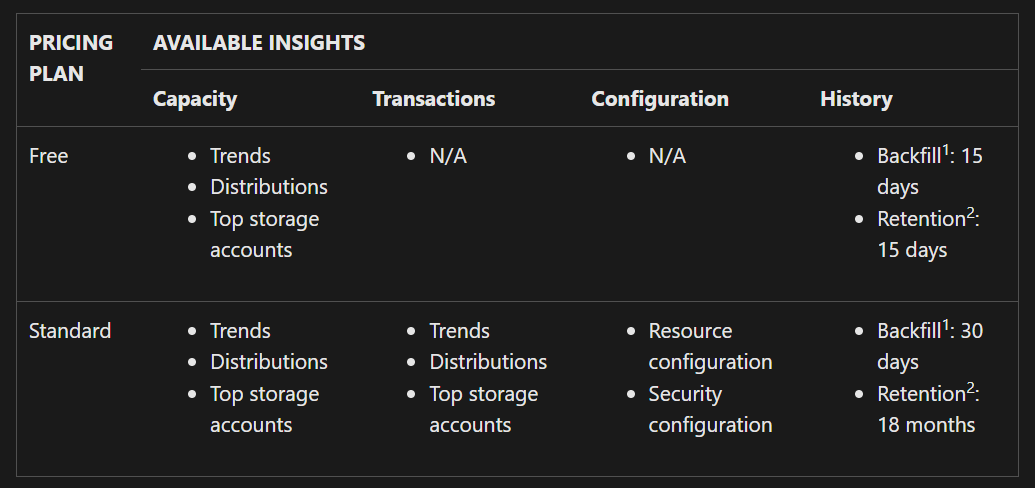
1 The backfill feature automatically adds historic data into a Storage Discovery workspace from before the workspace is created. 2 Every workspace retains insights for some time to allow for historical analysis.
The total cost will be comprised of:
Pricing plan
Workspace configuration
Number of storage resources & data objects analysed
Note that a storage resource can be included in multiple workspaces and will be charged in each one.
How much will all this cost? As the service is in Preview, and you’re able to use it for free, Microsoft haven’t released pricing details. These will become available on Azure.com before October 1, 2025, when billing kicks in.
To find out more about what it does and how it works, head here.
Microsoft Purview is a suite of products focused on data security, governance, and compliance across the Microsoft portfolio.
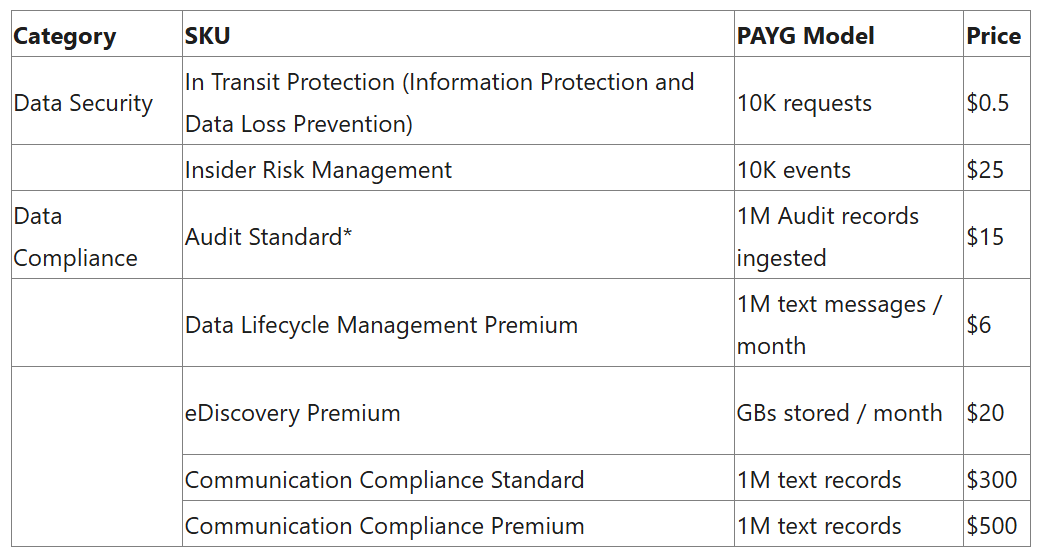
Microsoft first introduced Pay As You Go (PAYG) aka Consumption SKUs for Purview in January 2025 and now, from May 1, 2025 there are a new set. These new SKUs are aimed at protecting “your data as it moves across networks and through GenAI applications“.
The * is to note that Audit Standard is included within “Microsoft first party applications such as Microsoft 365 applications, Fabric, and Microsoft first party AI apps like Microsoft 365 Copilot, Security Copilot or AI applications custom-built using Copilot Studio“.
New metric/acronym alert! The 10,000 events for Insider Risk Management are known as a “Data Security Processing Unit (DPSU)”.
I notice that, for “Data Security Investigations”, Microsoft say:
“Data Security Investigations is billed through two meters: 1) the Data Security Investigations non-AI processing and storage meter and 2) Security Compute Units.
The Data Security Investigations non-AI processing and storage meter allows customers to store data related to an investigation. Security Compute Units are used to measure the computational capacity needed to run the AI analysis within DSI.”
Security Compute Units (SCUs) were introduced with Microsoft Security Copilot. It seems now that certain Purview PAYG usage may also consume your SCUs – needing further planning and budget insights.
Hotpatching – the ability to install patch updates without needing to restart the server – has been available in Microsoft Azure for a while. It is now coming to on-premises Windows Server 2025 machines…for a fee.
This new capability requires connection to Azure Arc and is currently free in preview but, from July 1 2025, it will cost $1.50 per core per month. That’s over $100,000 per year for 100 x 64 core servers…
If you’ve enrolled into the Preview, make sure you unenroll by June 30th to avoid being charged!
Interestingly, it doesn’t remove reboots completely but reduces the number from 12 per year to 4.
It’s that time of year again – Microsoft have announced their Q4 and full financial year results…so let’s take a look.
Full Year FY24 Results
Revenue = $245.1 billion, a 16% increase
Net Income = $88.1 billion, a 22% increase
Microsoft Cloud = $135 billion +, a 23% increase.
Q4 FY 24 Results
Q4 Revenue = $64.7 billion, a 15% increase
Q4 Net Income = $22 billion, a 10% increase
Microsoft Cloud
This isn’t a Business Unit but rather a group of related products across the organisation including:
Azure
O365 Commercial
Dynamics 365
Parts of LinkedIn
“Other cloud properties”
Revenue was $36.8 billion, an increase of 21% Year on Year (YoY).
Microsoft note that gross margin decreased YoY to 69%. This is driven by “sales mix shift to Azure” but was partially offset by Microsoft making Azure improvements including scaling their AI Infrastructure.
Now let’s look at some of the individual Business Units and how they performed in Q4 FY24.
Productivity and Business Processes
Revenue = $20.3 billion, an 11% increase
Office 365 Commercial = 13% increase. Seat growth was again driven by SMB and Frontline Worker growth while Average Revenue Per User (ARPU) growth was driven by E5 and Copilot for M365.
LinkedIn = 10% increase
Dynamics 365 = 19% increase <– This is now almost 90% of all Dynamics revenue.
This gives a good overview of growth over the last 5 quarters:
Intelligent Cloud
Revenue = $28.5 billion, a 19% increase
Azure (and other cloud services) growth was 29% for this quarter, a little drop from the percentage point increase of the last 2 quarters but, as it’s Q4, likely increasing from a higher base. Microsoft highlight that 8 points of this growth was from AI services.
Amy Hood (CFO) states that AI demand is higher than Microsoft’s currently available capacity but they expect availability to increase in H2 FY25 aka Jan 2025 onwards.
Server Products grew by 2% this quarter, again driven by hybrid BYOL use with Azure Hybrid Benefit.
Overall growth over the last 5 quarters looks like this:
Overall business and FY25
In terms of how Microsoft are spending money, Amy Hood, CFO, stated that:
“Cloud and AI related spend represents nearly all of total capital expenditures [CAPEX]. Within that, roughly half is for infrastructure needs where we continue to build and lease datacenters that will support monetization over the next 15 years and beyond. The remaining cloud and AI related spend is primarily for servers, both CPUs and GPUs, to serve customers based on demand signals.”
Amy Hood gave her expectations for Q1 FY25 (and beyond) and they are:
Productivity and Business Processes
Expected revenue growth of between 10% and 11% in constant currency (or $20.3 to $20.6 billion), with O365 driven by E5 and Copilot for M365.
Intelligent Cloud
Expected revenue growth of 18 – 20% (or $28.6 to $28.9 billion) with Azure expected to be 28% – 29% up.
Earnings Call highlights
42 mentions of Copilot.
Number of customers with 10,000+ licenses of Copilot for Microsoft 365 doubled quarter over quarter,
Industry specific Copilots are here. DAX Copilot for Healthcare (over on the Nuance side of the portfolio) has over 400 customers currently.
Over 1,000 paying customers of Copilot for Security. Satya Nadella also states they have “1.2 million security customers” <– that indicates a lot of potential growth for Copilot there!
60,000+ Open AI customers – with average spend per customer increasing.
GitHub Copilot accounts for over 40% of GitHub’s revenue and is bigger than GitHub was when Microsoft acquired it.
36,000 Azure Arc customers, a 90% YoY increase.
14,000+ paying Microsoft Fabric customers.
48 million Monthly Active Users of Power Platform, a 40% YoY increase.
Over 40,000 organisations using Dynamics 365 Business Central.
Over 3 million users of Teams Premium.
More large-scale SAP workloads being migrated to Azure.
There was further growth in the “number of 10-million-dollar-plus and 100-million-dollar-plus contracts for both Azure and Microsoft 365“
Microsoft & CISPE have come to an agreement which takes some of the legal pressure off Microsoft and should lead to a more diverse cloud market…to a point.
Background
CISPE (the Cloud Infrastructure Service Providers in Europe) is, as its name suggests, a group comprised of, and working for, European Cloud hosting organisations including AWS, OVH, and Aruba.
In November 2022, CISPE filed a formal complaint with the European Commission about Microsoft’s “anti-competitive licensing practices” in the cloud. CISPE said:
“the new contractual terms imposed unilaterally by Microsoft on 1st October 2022 add new unfair practices to the list. Microsoft’s ongoing position and behaviours are irreparably damaging the European cloud ecosystem and depriving European customers of choice in their cloud deployments.”
The crux of the issue is that Microsoft’s licensing rules make it cheaper to run Microsoft workloads in Azure than any other cloud environment, thus giving them an unfair advantage against their competitors.
What’s happened now?
The two parties have signed a Memorandum of Understanding (MoU) where Microsoft have committed to make changes to address the claims and so CISPE have agreed to withdraw its complaint and also that they “will not initiate or support complaints on these issues in Europe or elsewhere”. Microsoft have also agreed to pay $22 million to CISPE to reimburse them for the last 3 years’ of “cost of litigation and campaigns for fair software licensing”.
Central to the agreement is Microsoft agreeing to release “Azure Stack HCI for Hosters”. This new Azure Stack HCI offering will include:
Multi-session virtual desktop infrastructure based on Windows 11
Free Extended Security Updates (ESU)
Pay-as-you-go licensing for SQL Server
Enabling 3rd-party cloud providers to close the gap between their services and those available in Microsoft Azure – a key part of the complaint.
There is a clock ticking for Microsoft now, as changes must be made within 9 months. They must release this new offering and/or solve the issues another way within that timeframe otherwise the complaint will be refiled with the European Commission.
It must be noted that CISPE state:
“Amazon Web Services, a CISPE member, was excluded from these negotiations and it, along with Google Cloud Platform and AliCloud, will neither benefit from nor be bound by these terms”
This means Microsoft’s “Listed Provider” exclusion still applies to this change.
European Cloud Observatory (ECO)
This new body, established by CISPE and including Microsoft, will monitor the development of “Azure Stack HCI for Hosters” and the fairness of Microsoft’s cloud licensing.
Reception
Not everyone is happy with this outcome. It has been reported that Google made an offer to CISPE worth almost $500 million, comprised of licenses and cash, for them to continue their compliant against Microsoft.
Additionally, Google’s Head of Platform, Amit Zavery, has said:
“Microsoft’s playbook of paying off complainants rather than addressing the substance of their complaint hurts businesses and shouldn’t fool anyone“
“Microsoft selectively making these changes for some CISPE members shows that there are no technical barriers that prevent Microsoft from making its software more easily available to rival cloud providers”
What’s next?
The Azure Stack for Hosters product will enable cloud providers to offer new features and capabilities that are attractive to customers, which is good. The main issue that many people may have is that this agreement excludes Amazon AWS and Google Cloud Platform, so their customers are no better off than before.
While that is true, I think it is also representative of what I believe is CISPE’s main aim – to help boost the non-hyperscaler cloud market in Europe. They want to help companies like OVH, Irideos, and UpCloud more so than Amazon and Google.
This is certainly not the end of this story. The cloud is going to be a battleground for many years to come and so licensing and competitive advantages will be a key issue for some time…
Microsoft have been running an Azure Support Offer through FY24 where Azure customers get 6 months of free Azure support but this ends June 30th, 2024 and will not be renewed. If you took up this offer within the last 6 months, you lose access on that date too:
“The 6-month period begins on the date that the agreement is signed or renewed and ends on the date of 6 months after the agreement is signed or renewed, or June 30th, 2024, whichever comes first.”
Should you wish to continue with tech support above the free Basic plan from July 1st, 2024 you will need to buy a support plan:
Microsoft have revealed that the previously announced end of Azure Compute Reservation exchanges has been postponed “until further notice“. They say:
“You may continue exchanging your compute reservations for different instance series and regions until we notify you again, which will be at least 6 months in advance. In addition, any compute reservations purchased during this extended grace period will retain the right to one more exchange after the grace period ends.”
Let’s look at the numbers and main takeaways from Microsoft’s FY24 Q2 earnings. Not surprisingly, there’s a lot of talk about AI with Satya Nadella saying:
“We’ve moved from talking about AI to applying AI at scale.
By infusing AI across every layer of our tech stack, we’re winning new customers and helping drive new benefits and productivity gains.”
Headline numbers
Revenue = $62 billion (increase of 18%)
Net Income = $21.9 billion (increase of 33%)
Within that, what they call “Microsoft Cloud” accounted for $33.7 billion of the revenue – an increase of 24%.
Productivity & Business Processes
Revenue = $19.2 billion (increase of 15%)
Office 365 Commercial up 17%
LinkedIn up 9% (better than expected)
Dynamics 365 up 27%
Intelligent Cloud
Revenue = $25.9 billion
Azure growth was 30% this quarter. That’s 1% higher than last quarter although, in constant currency (where the impact of exchange rates is minimised) it was 28% i.e. 1% lower. Either way, it’s strong growth from Azure again, in no small part thanks to 6 percentage points added by AI.
Side note: The latest quarterly results for Amazon AWS (Q4 FY23) was $24.2 billion -so Azure is, for the first time I think (?), bigger than it’s long standing – and still market leading rival…at least on a quarterly basis.
Earnings Call Highlights
Over 53,000 Azure AI customers and over 1/3 of them are new Azure customers within the last 12 months.
Nadella mentions “an increase in the number of billion-dollar-plus Azure commitments“, citing Vodafone’s $1.5 billion commitment over the next 10 years.
Cosmos DB gets another shout out – and 42% YoY increase in data transactions…definitely a golden child product at the moment.
Over 400 million paid Office 365 seats which is a 9% YoY increase, primarily driven by SMB and Frontline SKUs.
On-premises server revenue increased 3% – driven by Windows Server 2012 end of life. That could be customers upgrading to newer versions but I’d wager a lot of it is Extended Security Update (ESU) revenue…
Nadella mentions the upcoming dedicated “Copilot” key on new Windows devices…
I’ve recently recorded a couple of videos with Nathan Miller, Microsoft Program Manager at Bytes.
In the first, we discuss Copilot for Microsoft 365 (we recorded this in October 2023 but it took me ages to edit it!):
We talk about the General Availability of Copilot for M365 as well as tips for preparing for deployment.
We then talk about the Microsoft Azure Consumption Commitment (MACC): agreement:
where we explain what the MACC agreement is, how it works, and the potential pros and cons for customer organisations. We also talk about the Azure cloud marketplace and the impact this will have on customer procurement processes and also the wider IT channel.
I hope you find the videos useful and informative – as there are more planned! Let me know if you have requests for topics and also if you’d like to jump on a video or podcast with me at some point. I usually focus on blog posts but am looking to get all multimedia on you in 2024 so this is just the start 😁