From 1 February 2027, Microsoft will raise prices for specific Azure Virtual Machine series and Azure Storage services in seven regions, by between 8% and 17%.
Regions and increases
Dublin takes the largest rise at 17%, and Singapore the smallest at 8%:
EU North (Dublin)
17%
France Central
11%
France South
11%
EU West (Amsterdam)
9%
Norway East
9%
Norway West
9%
Southeast Asia (Singapore)
8%
Microsoft has published an exclusion list as follows:
Excluded Virtual Machine series:
v1: Bv1, D, Ds, F, Fs, G, Gs, L, NP, HCS
v2: Av2, Amv2, Dv2, Dsv2, Fsv2, Lsv2
v7: Dsv7, Ddsv7, Dlsv7, Dldsv7, Esv7, Edsv7
Excluded Azure Storage services: Container Storage, Managed Lustre, NetApp Files Cross Region Replication SKU, Blob Features, Change Feed, General Block Blob, Import/Export, Queues, Queues v2, Standard Page Blob, Storage Actions, Storage Bandwidth, Storage Discovery, Tables and the Transaction Optimized SKU.
If you’re heavily in these datacentres, particularly Dublin, modelling your bills next year – and potential mitigations – should be on the list for FinOps and ITAM teams.
Remember, this is the same date (Feb 1, 2027) that the reservation changes kick in too.
Private GA of Azure Future Capacity Reservations added…”Azure Future Capacity Reservations allow Customers to request capacity for specified Microsoft Azure resources in a specified region, with a scheduled start date and reservation term”
A robed traveler confronts a luminous cloud gateway surrounded by digital data streams and futuristic servers.
Azure Future Capacity Reservations have been added to the Product Terms – these “allow Customers to request capacity for specified Microsoft Azure resources in a specified region, with a scheduled start date and reservation term“.
This seems a way of alleviating concerns over lack of capacity in certain regions and giving Microsoft more information with which to make resource and capacity increase decisions.
How do they work?
You request: A specific amount of Azure capacity, in a region, starting on a future date, for a set term.
Microsoft decides: They can accept, reject, or modify the request, normally within 7 days.
Availability: Microsoft tries to provide the capacity on the agreed start date. If they can’t provide all of it, they have 30 days to fulfil the remainder.
You can’t change it: Once accepted, you can’t modify it during the 12 weeks before the start date or the 30-day fulfilment period.
You pay for what they provide: Whether you actually use the capacity or not. Equally – you don’t pay for what they don’t provide.
If Microsoft can’t provide it: You can cancel the unfulfilled portion after the 30-day fulfilment period.
No compensation: Generally, Microsoft doesn’t owe you service credits for failing to provide the capacity.
No discount: This is capacity assurance, not a price discount, and doesn’t give you dedicated hardware.
You still have to do the admin: Subscription, quota, deployment and configuration requirements remain your responsibility.
End of term: The reservation expires and subsequent usage is charged at the then-current consumption rates.
Microsoft’s financial year ended on June 30, 2026 and, as usual, there aren’t many surprises. Microsoft continues to make an enormous amount of money, Azure continues to grow at a strong rate, and AI is still absolutely everywhere.
But there are a few things in these results that are particularly interesting from a licensing and FinOps perspective.
So, let’s dive in.
The headline numbers
For the full financial year:
Revenue = $331.8 billion, an increase of 16%
Net Income = $133.7 billion, an increase of 31%
Azure revenue surpassed $100 billion
Microsoft 365 Copilot has more than 30 million paid seats
So, yes, Microsoft is still generating an insane amount of money and the Q4 numbers were also pretty impressive:
Revenue = $90 billion, up 18%
Net Income = $35.8 billion, up 31%
Microsoft Cloud revenue = $59.3 billion, up 27%
Alongside this, Microsoft’s investment in AI infrastructure continues at quite a pace:
Capital expenditure increased by 70% to $41 billion in Q4, with Microsoft saying this was to support demand for cloud and AI offerings. Around two-thirds of that spending- almost $27 billion – was on CPUs and GPUs.
That level of spending contributed to a 23% decrease in free cash flow for the quarter, although Microsoft still generated $19.6 billion. When software vendors need money, they look to their customers so this big CAPEX outlay is likely to have an impact on pricing and discounts.
AI is still the focus
Satya Nadella’s opening comments were very much in line with what we’ve been hearing from Microsoft for the last couple of years.
He said:
“We are advancing the frontier on the cost-to-outcome curve, ensuring every customer can turn tokens into business results”
I think that wording is interesting.
There is obviously still an enormous focus on AI consumption, but Microsoft (and everyone else involved with AI) increasingly needs to talk about the value customers are getting from that consumption.
It’s one thing to tell organisations that they can use millions of tokens. It’s another thing to explain what those tokens actually achieved.
Satya also talked about two goals for Microsoft:
Making sure AI empowers people and increases their ability to achieve what they want to achieve.
Helping organisations build their own continuous learning loops without outsourcing their core intellectual property.
To support this, Microsoft has added 31 new datacentres across five continents, bringing the total to 88.
So the investment in infrastructure isn’t slowing down. Where is the money coming from?
Microsoft 365 and Copilot
Microsoft says that hundreds of enterprise customers have already purchased millions of Microsoft 365 E7 seats.
Alongside E5 and Copilot, this is helping drive ARPU — Average Revenue Per User growth.
And that is an important metric for Microsoft. As I’ve mentioned in previous posts, Microsoft doesn’t just want more customers. It wants to make more money from each customer and E5, Copilot, and now E7 are all part of that strategy.
Microsoft 365 Commercial revenue increased by 14% for the full year, while seats increased by 6%, driven by SMB and F-SKUs.
M365 Copilot has now passed 30 million paid seats. Of course, it’s still only a proportion of the overall Microsoft 365 user base, so there is potentially a lot more growth available if Microsoft can convince customers to roll Copilot out more widely.
Consumption is becoming increasingly important
This is probably the bit of the results that we all need to pay the most attention to.
Microsoft is continuing to move away from a world where software is simply purchased as a fixed number of licences. Consumption is becoming a much bigger part of the Microsoft business.
For example, Microsoft says that usage-based credit consumption for Dynamics 365 Customer Service increased fourfold quarter over quarter.
And GitHub Copilot switched to a consumption model on June 1 where Microsoft says it has already seen “significant consumption revenue” since the new model came into effect.
This is something I’ve been banging on about for a while now.
The traditional software licensing model was relatively easy to understand:
How many users do you have? Multiply that by the price per user.
Consumption changes that.
Now you need to understand what people are doing with the software, how much they are using it and what that usage is costing. AI is accelerating this shift dramatically.
Microsoft clearly believes this is working — and I expect we’ll see much more of it.
Productivity & Business Processes
The Productivity & Business Processes segment generated $37.8 billion, up 14%.
Within that:
Microsoft 365 Commercial revenue increased 14%
Microsoft 365 Commercial seats increased 6%
Dynamics 365 revenue increased 13%
Again, the important thing here is that Microsoft is getting growth from both more users and increased revenue from those users.
The move towards E5, E7 and Copilot gives Microsoft plenty of opportunities to increase ARPU without necessarily needing a corresponding increase in seat numbers.
Intelligent Cloud
Intelligent Cloud revenue was $39.3 billion, an increase of 32%.
Azure revenue increased by 43%.
And for the full financial year, Azure passed the rather significant milestone of $100 billion in annual revenue.
Databases are growing
Microsoft says cloud databases are surging, driven by AI systems’ need for access to data.
PostgreSQL revenue increased by 55%.
Microsoft is also launching Horizon DB, a new fully managed PostgreSQL service in Azure.
This makes sense. AI might be the headline story, but AI needs data. Lots of it. That means databases, storage and all of the other services supporting AI workloads stand to benefit from the growth in AI consumption.
Microsoft Fabric
Microsoft Fabric now has more than 40,000 paid customers.
That’s up from 35,000 just a few months ago. Fabric is another good example of Microsoft’s broader strategy: bring multiple capabilities together, make them easier to consume and then monetise the consumption.
Agent 365
There are now almost 40 million agents registered in Agent 365.
We’ve gone from talking about individual users having Copilots to organisations having thousands of software agents doing work on their behalf.
And that creates a whole new set of questions.
Who owns the agent?
How do you control what it can access?
How do you measure what it is doing?
And, perhaps most importantly, how much is it costing?
If software moves from being something a person uses to something that can operate autonomously, the traditional per-user licensing model becomes increasingly difficult to apply.
So what does this mean for customers?
There are three things that stand out to me from these results.
1. AI isn’t slowing down
Microsoft is spending enormous amounts of money building the infrastructure required to support AI.
The $41 billion quarterly capital expenditure figure tells you that.
Microsoft clearly believes the demand is there. We’ll find out if they’re right in a couple of years.
2. Consumption billing is coming for more of your Microsoft estate
If you’re still thinking about Microsoft licensing purely in terms of users × licences × price, you’re going to increasingly find that model doesn’t describe what you’re actually buying.
Now we’re seeing the same approach spread into Dynamics, GitHub Copilot, Microsoft 365 and AI services.
That means FinOps and ITAM are going to have to work increasingly closely together.
3. The value question is becoming more important
Microsoft isn’t just talking about AI adoption anymore.
They’re talking about the cost-to-outcome curve. Customers are going to need to understand not just how much AI they’re consuming, but what they’re getting from it.
If you’re spending millions on AI tokens, you need to know what those tokens are actually achieving. Otherwise, you’re just measuring consumption and that’s only part of the story.
One final thought
Microsoft has just finished another enormous year.
$331.8 billion of revenue
$133.7 billion of net income
$100 billion+ of Azure revenue
30 million+ paid Copilot seats
Tens of billions being invested in the infrastructure needed to support the next phase of AI.
Microsoft is becoming a business that combines licensing and consumption.
For all of us working in ITAM, FinOps, and/or Microsoft licensing, understanding how those two worlds come together is going to be increasingly important.
Minor update to Responsible Use of Microsoft AI Services Web IQ added to Privacy & Security terms M365 G3 & G5 added as eligible pre-requisites for M365 Copilot Minor renaming of Microsoft Defender Expert services Updates to terms around Professional Services
Slightly bigger is the clarification/addition to terms that customers with SA who enable Azure Arc are eligible for ESU (Extended Security Updates).
There are some other changes that weren’t in the Product Terms:
A robot wearing a GitHub Copilot Workshop vest stands in a busy office with people collaborating in the background.
Microsoft have announced General Availability of a new feature within Copilot Studio – the GitHub Copilot harness. This sits alongside the already available Standard harness and Copilot Chat harness.
This new capability means your in-house created agents can now use the same coding and reasoning capabilities as Copilot Cowork and GitHub Copilot – putting new capabilities on the table for your AI agents.
While that is all well and good I would, not surprisingly, like to focus in on a licensing/pricing change. The Microsoft post casually states:
“Agents running on the GitHub Copilot harness use usage-based billing for all work, regardless of Microsoft 365 Copilot licensing.”
That, potentially, has quite the impact. Agents built using the 2 existing harnesses have their Copilot Credits covered by a user’s M365 Copilot license – this is not the case when agents are built with the GitHub Copilot harness. This means those agents will use Copilot Credits and burn pre-purchased amounts or incur PAYG costs.
To be clear, Microsoft aren’t removing anything or forcing this more expensive model on customers; the GitHub Copilot harness is a new, additional option that organisations can choose to use, or not. However it does add another potential way for people to inadvertently spend money with Microsoft and thus further highlights the need for storng internal governance and awareness/training programs.
A customer discusses a return with a store employee near a return policy sign.
From February 1st, 2027 – Azure Reservations will no longer be eligible* to be exchanged if the service also has a Savings Plan available. This applies to:
Azure Virtual Machines
Azure App Service
Azure SQL Database
and “similar services”.
*Reservations purchased before February 1, 2027, keep the right to one final exchange.
Equally, from that date any additional compute or database services that also become available for a Savings Plan will be subject to this change. Instance Size Flexibility isn’t impacted by this change.
The following are excluded from the change:
Reservations for products or services that are deprecated and approaching end of life.
Reservations for products and services that aren’t covered by savings plans, such as Azure VMware Solution. If you have a reservation for Azure VMware Solution, this policy change doesn’t affect it.
Cloud environments that don’t currently support savings plans.
Microsoft initially announced this change in October 2022 with a date of Jan 1, 2024. That was then pushed back to July 1, 2024 and then postponed indefinitely – with a promise of 6 months notice before it would be implemented again…and that’s what Microsoft have given. Could we see another postponement? Perhaps, but it seems unlikley tbh.
It’s clear that Microsoft want Savings Plans to be the primary option for organisations so here’s a quick overview if you’re not familiar:
Feature
Azure Reserved Instances
Azure Savings Plans
Commitment
Commit to a specific Azure resource (e.g. VM family, SQL Database, App Service)
Commit to an hourly spend amount on eligible compute & database services
Term
1 or 3 years
1 or 3 years
Discount
Typically offers the highest discount when usage is stable
Lower maximum discount, but greater flexibility
Flexibility
Low – tied to the purchased resource
High – discounts automatically apply across eligible compute resources
Changing VM Size
Allowed within instance size flexibility rules for some services
No action required
Changing VM Family
Previously possible through Reservation exchanges (being phased out)
No action required
Changing Region
May require a Reservation exchange (being phased out)
No action required
Workload Changes
Best suited to stable, predictable workloads
Designed for dynamic, changing cloud environments
Administration
Requires ongoing monitoring and optimisation to ensure Reservations still match usage
Much lower administrative overhead once purchased
Best For
Long-running production workloads with predictable resource requirements
Organisations with frequently changing compute usage, autoscaling or modern cloud architectures
Risk
Higher risk of underutilisation if workloads change
Lower risk, as discounts follow eligible usage automatically
FinOps impact
The ability to exchange Reserved Instances has been part of mature Azure commitment strategies for quite some time but this is bringing much of that to an end. Strategies will need to be reviewed and a decision made on whether Savings Plans are now a better option, even with the potential loss of discount.
Make sure you communicate this change internally and work to update your governance and strategy asap.
Microsoft has officially announced that Copilot Cowork is generally available. If you caught my LinkedIn post on this just after launch, you’ll know I flagged the headline numbers – and promised a deeper look. Here it is.
This isn’t just another Copilot feature release, Cowork represents a different, additional way of working…and brings with it an additional billing mechanism.
What Is Copilot Cowork?
Copilot Cowork is Microsoft’s agentic AI layer sitting on top of Microsoft 365 Copilot. Where standard Copilot handles in-the-moment assistance (drafting emails, summarising meetings, generating content), Cowork is designed for longer-running, multi-step tasks that span multiple apps and require sustained reasoning in the background.
How the Billing Works
This is where things get interesting and where CFOs – and everyone else – will want to pay close attention.
Copilot Cowork uses a seat + consumption model:
Seat requirement: Users must already hold a Microsoft 365 Copilot licence Consumption billing: Cowork usage is billed on top of that, via Copilot Credits
In other words, you’re not paying a flat per-user fee for Cowork. You’re paying based on what people actually do with it. That might sound fair – but as we’ll see, it creates significant cost unpredictability at scale.
The Three Prompt Types
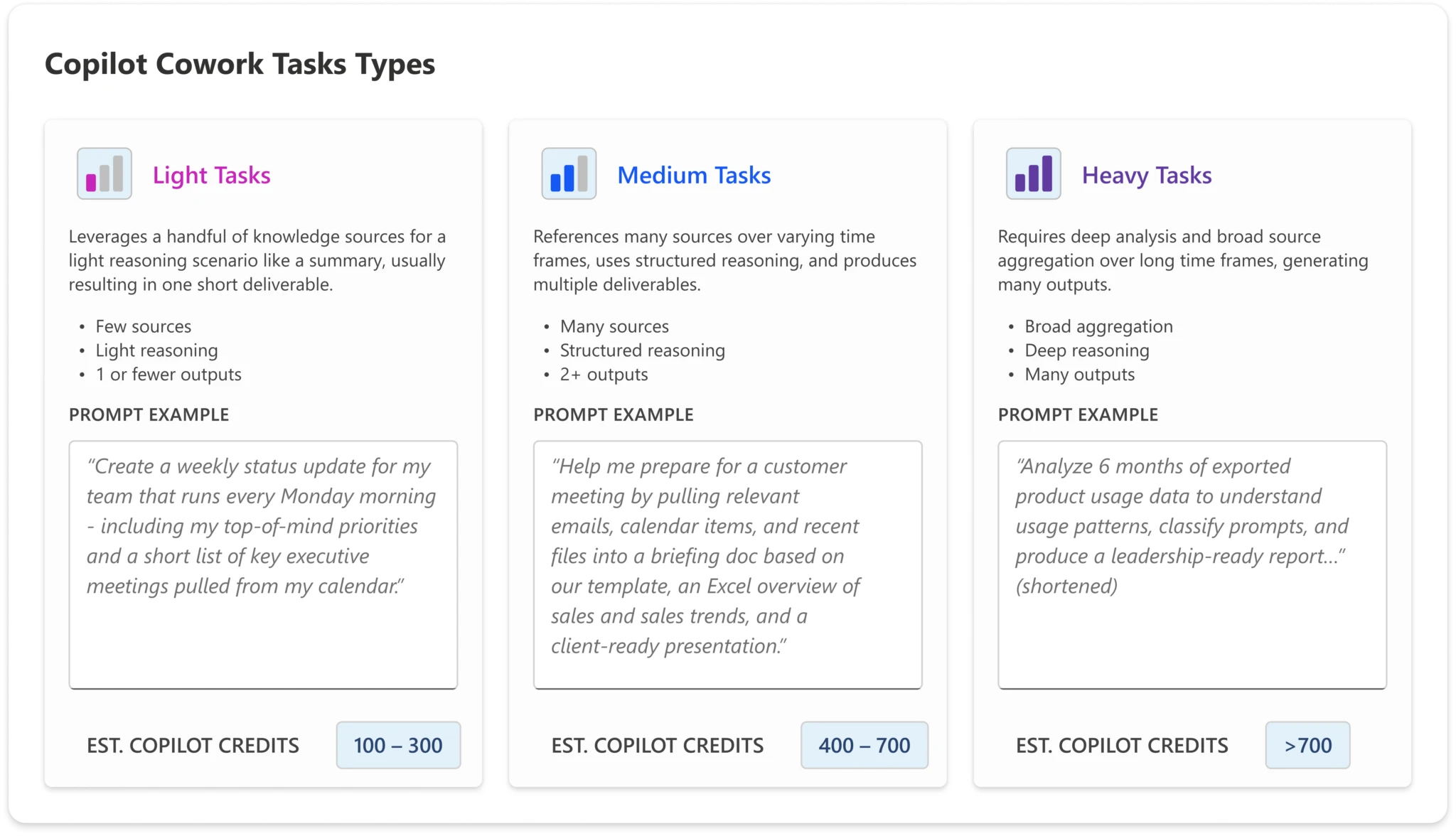
To help organisations estimate their likely spend, Microsoft has defined three categories of prompt complexity:
Light Simple, quick tasks – lookups, short summaries, straightforward Q&A
Medium Multi-step tasks with moderate reasoning or tool use
Heavy Complex, long-running agentic tasks – deep research, multi-app orchestration, extended workflows
The credit cost per interaction scales accordingly. A user who primarily sends light prompts will consume far fewer credits than one regularly triggering heavy agentic workflows.
The Four Microsoft-Defined Personas
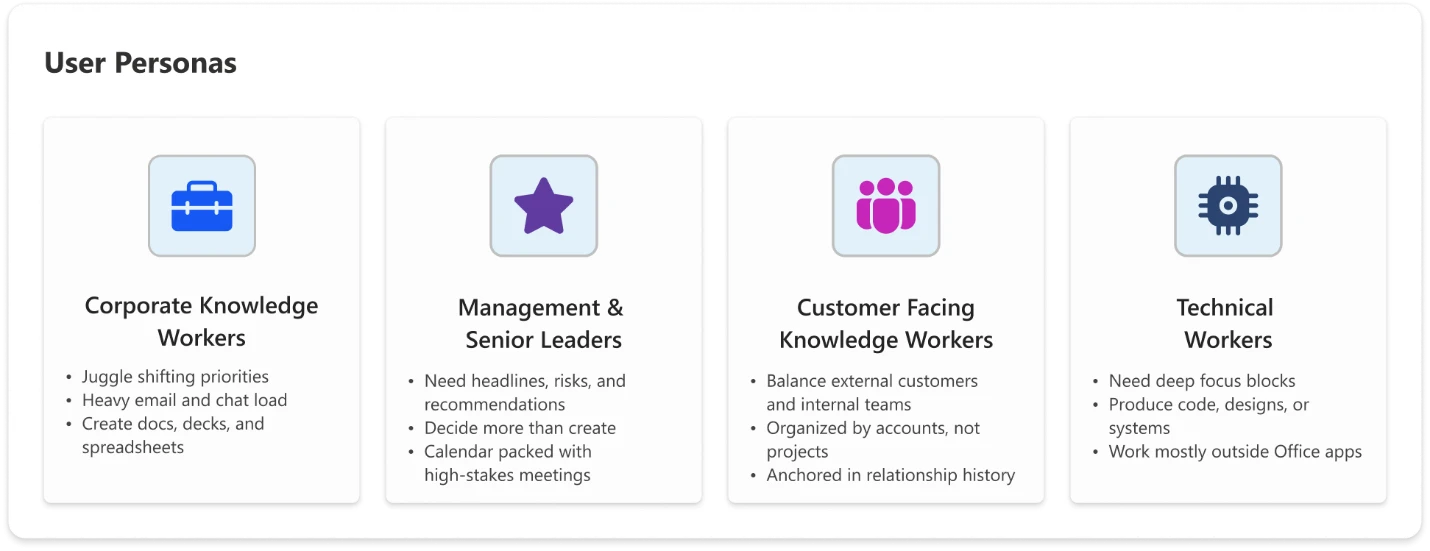
Microsoft has also defined four user personas to help organisations model expected usage – and therefore expected cost:
Knowledge Worker
Your standard office employee: using Copilot for day-to-day tasks like drafting documents, summarising emails, and pulling information. Predominantly light-to-medium prompt usage.
Customer-Facing Knowledge Worker
Staff in sales, customer success, support, or account management. Higher interaction volume and a greater likelihood of medium-to-heavy prompts – researching customer history, generating proposals, triaging complex queries.
Technical Worker
Developers, analysts, engineers, and data professionals. Usage tends towards heavier, more complex prompts – code generation, data analysis, technical documentation, multi-step problem solving.
Manager / Senior Leader
Executives and team leads. Usage is often more strategic – executive briefings, synthesising reports across sources, preparing for key meetings. Likely lower volume but higher complexity per interaction.
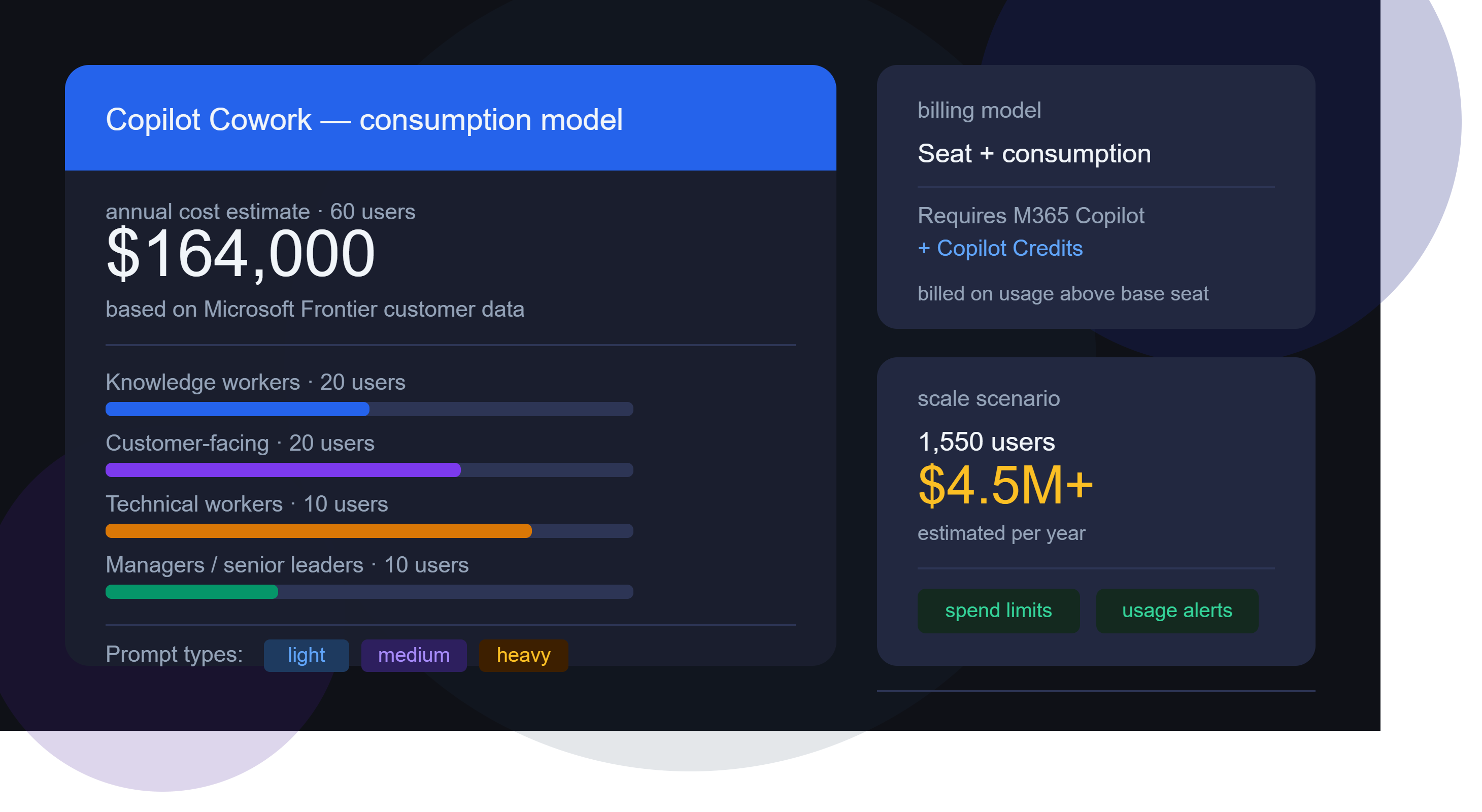
Microsoft has shared estimated annual Cowork costs based on data from early Frontier customers. Modelling the costs is where things start to get really surprising…the below uses list pricing and doesn’t factor in any type of discount.
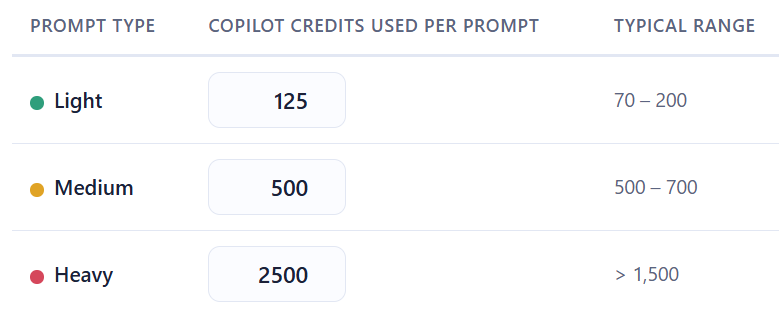
As was pointed out in a comment, there is a small but important difference between the two. The Github hosted calculator estimates “Heavy” prompts at 2,500 credits while the spreadsheet version uses a value of 1,200. This means the latter version produces lower prices for those heavy prompt users.
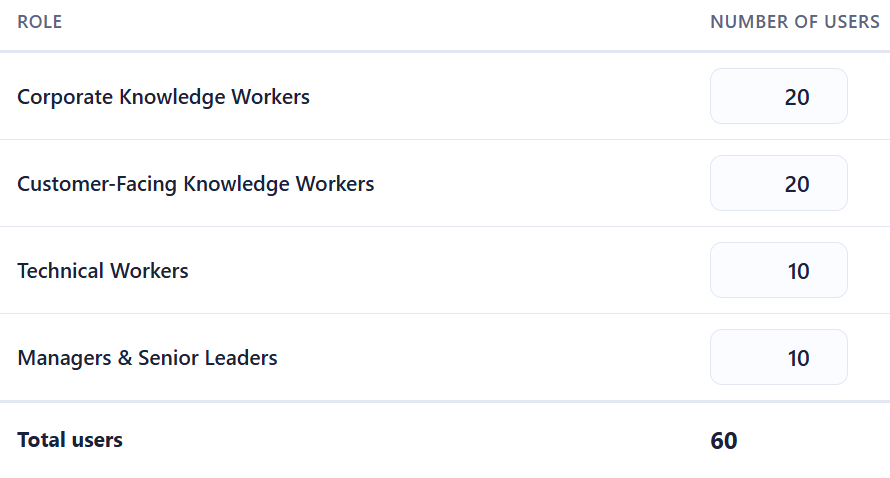
Let’s look first at a small org of 60 users:
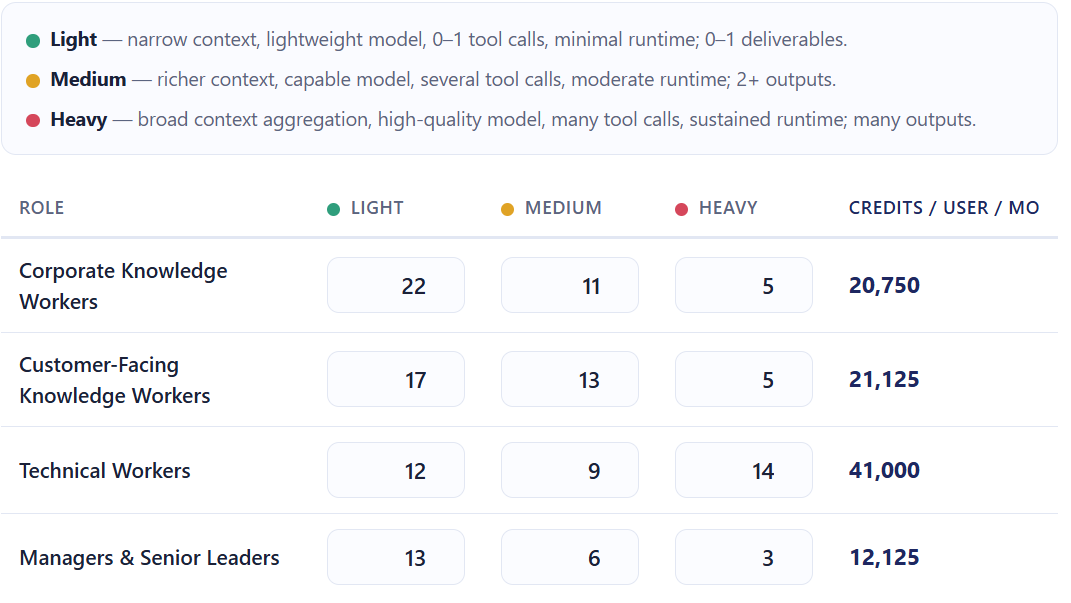
The Microsoft calculator uses the following estimates for the number and type of prompts each persona will use:
and these for the number of credits used per prompt:
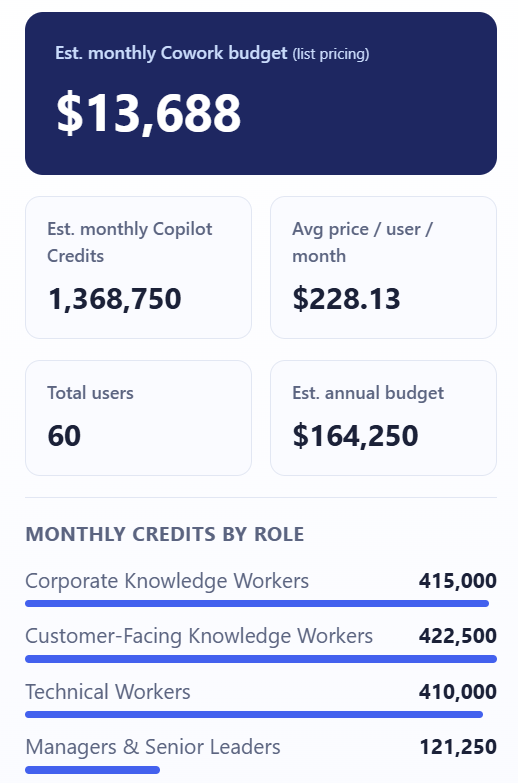
That gives a final estimate of:
That’s right – over $164,000 per year for 60 people to use Copilot Cowork.
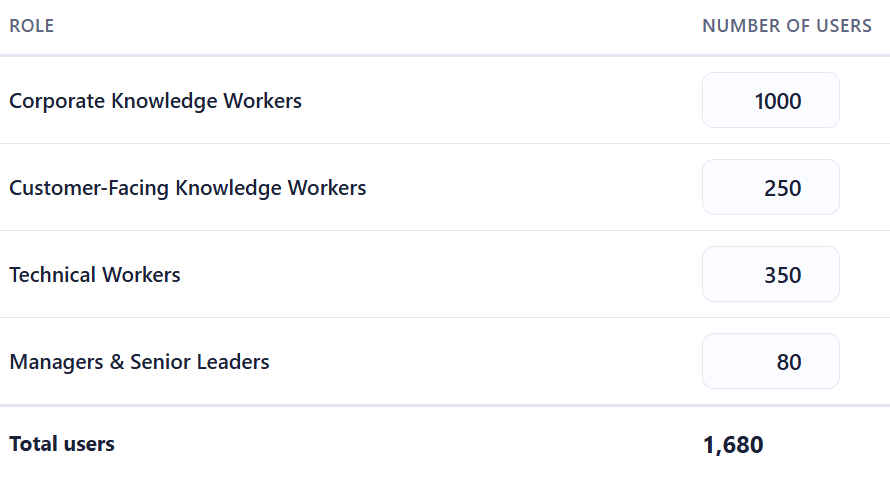
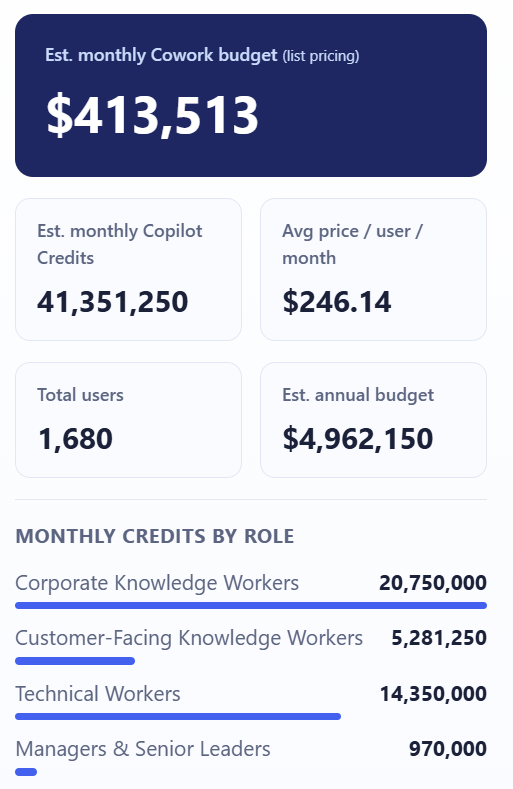
For a company of 1,680 staff:
You end up with an estimated annual bill of almost $5,000,000!
It seems impossible that companies are going to pay these amounts – surely? If these costs are real, it shows that customers are going to have to be much more realistic as to who gets access to Copilot Cowork.
The Guardrails Microsoft Provides
To be fair to them, Microsoft have built in some controls:
Spending limits – administrators can cap Cowork credit consumption at tenant, group, and user levels Usage alerts – notifications when consumption approaches defined thresholds
Usage reporting – Admins see usage broken down by user, group, and feature
User-level pricing – Users see what each task costs as they run it (coming soon)
These are sensible features, and their inclusion suggests Microsoft is aware of the sticker shock potential and are trying to get out in front of it.
This is what I really want to focus on, because the billing model isn’t just a procurement question — it’s an organisational design question.
Not all usage is equal value
A heavy prompt from a technical worker building an internal tool could save dozens of engineering hours. A heavy prompt from someone using Cowork to draft a quick internal update is a poor use of credits. The credit model treats both the same. Your organisation needs a way to distinguish between them.
You need a usage policy, not just a spending cap
A spending cap is a ceiling. What you actually need is a framework that answers questions like:
Which personas should have access to Cowork at all?
What types of tasks are appropriate for Cowork vs. standard Copilot?
Who approves high-complexity agentic workflows?
How do we measure whether Cowork usage is delivering value?
Without answers to these, you’re handing out a consumption-based service with no purchasing guidelines.
The ROI question is now urgent
With flat-fee AI tools, ROI questions are important but not time-sensitive – you’re paying regardless of use. With consumption billing, poor adoption and excessive adoption are both problems. You need a framework for measuring the value of AI usage – not just the cost.
Consumption models reward the vocal, not the strategic
In many organisations, power users will naturally gravitate toward the most capable features. That’s not always aligned with where the highest-value use cases are. Without intentional governance, Cowork credit consumption may cluster around enthusiastic individuals rather than high-value workflows.
What Organisations Should Do Now
If you’re already running Microsoft 365 Copilot – or planning to – here’s where to focus:
Map your personas
Use Microsoft’s four categories as a starting point, but refine them for your organisation. Who are your heaviest potential users? Where are the highest-value use cases?
Model your costs before you deploy
Use the per-persona estimates to build a realistic cost projection. Stress-test it against both optimistic and conservative adoption scenarios.
Define your governance framework
Decide who gets access to Cowork, for what purposes, and with what approval process for high-complexity tasks. Document this as policy, not just an IT configuration.
Set up monitoring from day one
Don’t wait for the first bill to understand usage patterns. Use Microsoft’s alerting tools, and complement them with your own reporting.
Establish a value measurement approach
Credits spent should be traceable to outcomes. What did that agentic workflow actually deliver? This doesn’t need to be complex – even a lightweight system for use case categories can help you build the picture.
As I say every few months, it’s another bumper quarter for Microsoft with all the numbers getting bigger.
Revenue = $82.9 billion (up 18%)
Net Income = $31.8 billion (up 23%)
Microsoft Cloud = $54.5 billion (up 29%)
Microsoft had Operating Expenses of $17.7 billion this quarter and say they were “primarily driven by continued investments in R&D compute capacity, AI talent, and data“.
Productivity & Business Processes
Revenue = $35 billion, up 17%
Microsoft 365 Commercial cloud revenue increased 19%
Dynamics 365 revenue increased 22%
M365 Copilot is now over 20 million paid seats. That’s a 33% increase over Q2 (where it was 15 million) but still a fraction of the overall customer base.
Paid M365 Commercial seats grew 6% YoY and ARPU increased driven by E5 & M365 Copilot.
Intelligent Cloud
Revenue = $34.7 billion, up 30%
Azure increased 40%
Earnings Call
Satya Nadella started by saying “We are at the beginning of one of the most consequential platform shifts that will change the entire tech stack as agents proliferate and become the dominant workload.”
He says there are “Tens of thousands of companies are already managing tens of millions of agents in Agent 365” – frankly, that surprises me.
Cosmos DB had 50% YoY revenue growth
Microsoft Fabric up to 35,000 paid customers, a 60% YoY increase
Copilot Credit spend almost doubled quarter over quarter
Nearly 60% of “service customers” are buying consumption credits
I’ve been banging on about consumption billion (aka Pay as You Go) billing for a few years now and it’s definitely where Microsoft (and a lot of the software industry) is going. Amy Hood, MS CFO, said;
“I start to think about it as a license business plus a consumption business, and really applying far more broadly than I think people have thought about that. And so, it starts to mean that over time, bookings will actually also look a little different. It’ll still have that per-seat license logic, but it’ll also have a meter, just like you see in Azure.”
and Satya said:
“seat-based pricing is just entitlement to some consumption”
While I think he means that seat based licenses are effectively a bundle of some consumption packaged up, that certainly sounds like it being a gateway to more consumption charges…which of course it is in many cases.